

How to Store Mounjaro: The Complete UK Guide
Everything you need to know about keeping your Mounjaro pen safe, effective and ready to use – from fridge temperatures and travel tips to the mistakes that could make your medication unsafe.

Clinically reviewed by
Shadeia Younis, Superintendent Pharmacist (GPhC 2052119)
You’re standing in the kitchen holding your Mounjaro pen, and a thought crosses your mind: was the fridge cold enough last night? Or maybe the pen has been sitting on the counter since yesterday and you’re no longer certain it’s still fine to use. For a medication that costs between £129 and £267 a month, these are not small worries.
This is the question that comes up again and again – not in consultations, but in the quiet moments between doses. People spend hours researching which medication to start, which provider to trust, what to eat on treatment. Almost nobody tells you the basics: how to look after the pen itself.
Storing Mounjaro incorrectly does not just waste money. It can mean injecting a medication that has degraded, reducing its effectiveness at precisely the moment you are trying to make progress. Getting this right takes minutes to learn and costs nothing to do properly.
This guide covers everything – the correct temperatures, what room temperature actually means in practice, how to travel with your pens, what to do during a power cut, and the common mistakes that patients make without realising they are making them. By the end, there will be nothing left to wonder about.
The Storage Mistake That Could Be Costing You £200 a Month
At between £129 and £267 per monthly prescription, Mounjaro is a meaningful financial commitment for most patients. What is rarely discussed is that improper storage can quietly reduce the effectiveness of the medication – not by making it dangerous, but by degrading the active molecule to a point where the dose you inject is no longer delivering its full effect.
This is not a remote risk. Storing pens in the fridge door, leaving them out in a warm car, or losing track of how long a pen has been outside the fridge are common, everyday situations. The medication still looks fine. The pen still functions. But the tirzepatide inside may have partially degraded – and you would not know until you notice your results plateauing or your appetite suppression feeling weaker than expected.
The fix is not complicated. The storage rules take a few minutes to understand and cost nothing to follow. That is what this guide is for.
Key Storage Points at a Glance
- Store unopened Mounjaro pens in a refrigerator at 2°C to 8°C
- Never freeze – a frozen pen must be discarded, not used
- After first use, the pen may be stored unrefrigerated below 30°C for up to 30 days
- Always keep pens in the original carton to protect from light
- Take your pen out of the fridge around 30 minutes before injecting
- Never inject cold medication – it is uncomfortable and unnecessary
- When travelling, keep pens in an insulated cool bag, not in checked luggage
- Check the expiry date before every injection
What’s Covered in This Guide
- What is Mounjaro and why does storage matter?
- The complete Mounjaro storage guide
- UK-specific storage guidance
- Your step-by-step storage routine
- How Mounjaro is delivered and what to check on arrival
- Common storage mistakes and how to avoid them
- Common real-life storage scenarios
- Expiry dates and when to check your pen
- How storage affects your weight loss results
- Not sure if your pen is still safe?
- When to discard a pen and seek advice
- How to get Mounjaro from Slinic
- Frequently asked questions

What is Mounjaro and Why Does Proper Storage Matter?
Mounjaro is the brand name for tirzepatide, a weekly injectable medication licensed in the UK for both type 2 diabetes management and weight loss. It is manufactured by Eli Lilly and works through a dual mechanism – activating both the GIP (glucose-dependent insulinotropic polypeptide) and GLP-1 (glucagon-like peptide-1) receptors in the body. This dual action sets it apart from single-pathway GLP-1 medications and is why the clinical trial data shows greater average weight loss compared to earlier treatments in its class.
Mounjaro is supplied in a pre-filled multi-dose pen called the KwikPen, which contains 4 doses – one for each week of the month. You use one dose per week from the same pen, injecting subcutaneously – under the skin – into the abdomen, thigh, or upper arm. Once all 4 doses have been administered, the pen is disposed of safely. This multi-dose format is important for understanding storage: the pen does not get replaced each week, which means the remaining doses inside must be kept in the correct conditions between each injection.
Tirzepatide is a biological molecule – a protein-based medicine. Like all biological medicines, it is sensitive to temperature, light, and physical stress. When a biological medicine is exposed to temperatures outside its intended range, the protein structure can degrade. The molecules unfold or clump in ways that are invisible to the naked eye. The liquid in the pen will still look clear. The pen will still function. But the medication may no longer work as intended.
This is why the storage rules for Mounjaro are not guidelines born of excessive caution. They reflect the underlying chemistry of the medication. Following them is not about being meticulous for its own sake. It is about making sure the dose you inject on a given Wednesday morning is the same effective dose that was dispensed by the pharmacy.
Why This Matters More Than You Might Think
Mounjaro works by precise biochemical signalling. A degraded dose does not necessarily fail completely – but it may deliver a reduced effect. If you are mid-titration and wondering why your results feel inconsistent, storage is one of the first things worth reviewing.
This is part of why Slinic’s pharmacist-led model includes ongoing clinical support throughout your treatment – so questions like these have someone qualified to answer them, not just a help page.

The Complete Mounjaro Storage Guide
Before First Use: Refrigerator Storage
When your Mounjaro pens arrive, they should go straight into the refrigerator. The required temperature range is 2°C to 8°C. This is the standard “safe zone” for biological medicines in the UK, the same range used for insulin and vaccines.
A few specific things to note about where in the fridge you keep them:
- Avoid the freezer compartment. The area at the back of a fridge, particularly near the top where the freezer shelf sits, can drop below 0°C. If a pen freezes even partially, it is no longer safe to use.
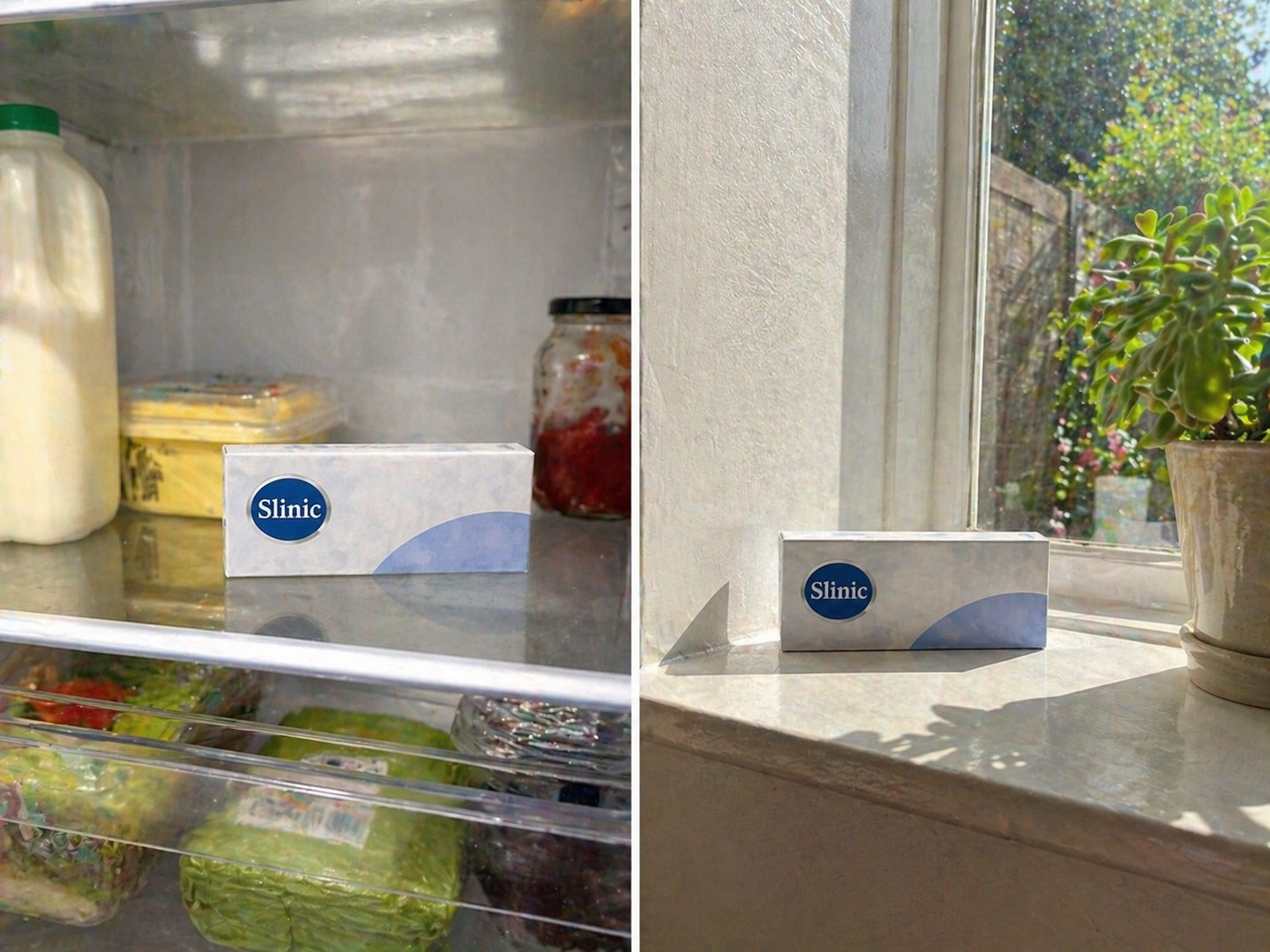
- Avoid the fridge door. The door experiences the most temperature fluctuation each time you open and close it. A consistent mid-shelf position in the main fridge compartment is better.
- Keep them in the original outer carton. The carton is not just packaging – it protects the pen from light exposure, which can also degrade the medication over time.
After First Use: Room Temperature Rules
You do not have to keep Mounjaro in the fridge at all times. After the first dose has been taken, the pen may be stored unrefrigerated at room temperature below 30°C for up to 30 days. After 30 days outside the fridge following first use, the pen should be discarded even if doses remain and the expiry date has not passed.
Storage Guidance Can Change
Manufacturer storage guidance is occasionally updated. The 30-day post-first-use room temperature limit and all other storage figures in this article were accurate at the time of publication, based on the Mounjaro UK Summary of Product Characteristics (SPC). Always check the most current version of the SPC at emc.medicines.org.uk before relying on any storage figure, and confirm the current guidance with your dispensing pharmacist if you have any doubt.
This 30-day window is useful to know for practical reasons. If you are travelling, staying away from home, or find it more convenient to keep your pen on the counter between weekly doses, you have real flexibility. You are not required to refrigerate the pen after each injection – provided the temperature stays below 30°C and you track how many days have passed since first use.
The 30-Day Clock Starts at First Use
Keep a note of the date you first use the pen. The 30-day limit counts from that first dose – not from when the pen was opened from its packaging or removed from the fridge. If you take your first dose, return the pen to the fridge, then take it out again later, the days outside the fridge after first use accumulate toward the 30-day limit.
The simplest approach: write the date of your first injection on the outer carton with a marker. That gives you a clear reference point for every dose that follows.
Temperature: What 30°C Actually Means in the UK
For most of the year in the UK, keeping medication “below 30°C” at room temperature is not difficult. The challenge comes in summer, during warm weather, and in environments like cars, direct sunlight, or hot utility rooms. A bedroom in a well-heated UK home in winter typically sits between 18°C and 22°C – well within the safe range. A car parked in summer sun can reach 50°C or more inside, which is not.
The 30°C limit is not a rough guideline. Temperatures above this accelerate the degradation of the medication’s active molecules. Treat it as an absolute ceiling, not a point to approach closely.
Light Exposure
Keep Mounjaro pens in the outer carton at all times until you are ready to inject. Tirzepatide is sensitive to prolonged light exposure. Leaving a pen on a windowsill, a bathroom shelf near a window, or in direct sunlight – even for a short time – can accelerate degradation. The carton takes two seconds to open and costs nothing to use correctly. It is worth forming the habit.
Freezing: A Clear Line
Mounjaro must never be frozen. If a pen has been frozen – whether accidentally placed too near the freezer compartment, left in a car overnight in winter, or subjected to any freezing temperature – it should be discarded. Frozen medication should not be thawed and used. There is no way to visually confirm whether freezing has damaged the molecular structure of the drug.
Discard a Pen Immediately If It Has Been Frozen
Do not use a Mounjaro pen if it has been frozen, even if it appears clear and normal after thawing. The physical appearance of the liquid does not confirm the medication’s effectiveness after freeze damage. Contact your prescriber or pharmacist for a replacement dose.

Thinking About Starting Mounjaro?
The Slinic consultation takes around three minutes, and a pharmacist reviews your information within 24 hours. Pricing is transparent from your very first dose.
Start Your Confidential ConsultationUK-Specific Storage Guidance
Travelling Within the UK
Short trips within the UK do not need complicated preparation, but they do need thought. If you are driving to visit family for a weekend, keep your pen in an insulated travel cool bag with an ice pack – available from pharmacies and online for a few pounds. Do not put the pen directly against the ice pack; this can cause localised freezing. Wrap it in a cloth or use a dedicated medication travel pouch with an internal separator.
On trains and public transport, a small insulated bag in your carry-on luggage is fine for journeys of several hours. The priority is keeping the pen away from direct heat (e.g., next to a radiator on a train, or in a bag left in direct sunlight).
Travelling Abroad From the UK
If you are flying abroad from the UK, Mounjaro should always travel in your hand luggage, never checked baggage. Aircraft cargo holds are not temperature-controlled in a way that protects biological medicines. Temperatures can drop well below zero or fluctuate unpredictably. Hand luggage in the cabin is kept at a controlled, comfortable temperature throughout the flight.
At UK airport security, injectable medications are permitted through security. Carry your original pharmacy packaging, prescription documentation, and a covering letter from your prescriber if you have one. This smooths the process at UK and international checkpoints. It is worth contacting the airline in advance for longer international journeys to confirm their policy on insulin-type medications.
If you are travelling to a hot country, plan your storage carefully at the destination. A fridge in a hotel room or holiday apartment will suffice for overnight storage. For days out, a quality insulin travel wallet with a reusable cooling element will maintain the correct temperature for several hours. Most hotels will refrigerate medication on request if your room has no fridge – contact the hotel before you travel to arrange this rather than hoping on arrival.
Hot Weather Holidays: Spain, Greece, Portugal and Beyond
Popular UK holiday destinations in summer regularly see air temperatures above 30°C, and the environments tourists typically encounter are far hotter than that. A car parked in the sun in Spain can reach interior temperatures of 60°C or more. A beach bag sitting on hot sand in direct sunlight is not a safe place for Mounjaro – at any point in the day. A hotel room without air conditioning on a hot afternoon can sit well above 30°C. The 30°C ceiling must be actively managed in these environments, not passively assumed to be fine.
A quality insulated travel wallet with a reusable cooling gel element will typically maintain a safe temperature for 8 to 12 hours depending on ambient conditions and sun exposure. Higher-specification options can maintain temperature for longer. Check the product’s stated temperature range and duration before relying on it for a full day out, and recharge the cooling element overnight in the hotel fridge.
Day Trips vs Multi-Day Travel
If you are going on a day trip and your injection day is not until you return, there is no reason to bring the pen with you at all. Leave it in the hotel fridge and keep it there. Only carry the pen on the day you are injecting, return it to the fridge as soon as possible afterwards, and do not leave it in your beach bag or daypack between doses.
For longer trips spanning multiple injection days, plan refrigeration at each destination in advance. Overnight ferry crossings, self-catering apartments, and campsites each present different challenges. The common thread is: know where the fridge is before you need it, not on the morning of your injection.
Four Things Never to Do With Mounjaro in Hot Weather
- Never leave the pen in a parked car, even for a short time in warm weather
- Never put the pen in a beach bag or backpack left in direct sunlight
- Never assume a hotel room without air conditioning stays below 30°C in summer
- Never refrigerate the pen in a hotel minibar set to near-freezing temperatures – check the dial first
What to Pack When Travelling With Mounjaro
Before any trip where you will be injecting away from home, make sure you have: an insulated travel wallet with a reusable cooling element sized for the pen; the original pharmacy carton and pen; a copy of your prescription or prescription documentation; a covering letter from your prescriber if travelling internationally; a travel sharps container or small sharps bin for the final disposal of the pen once all doses are used; and a marker pen to note the first-use date on the carton if the trip starts during an active pen. The pharmacist team at Slinic can provide a prescription letter to assist with international travel if needed.
UK Power Cuts
During a power cut, a closed fridge maintains its temperature for approximately 4 hours. If the outage extends beyond this, check the fridge temperature before assuming your pens are still safe. If the temperature inside has risen above 8°C for an extended period, any pen that has already had its first dose taken will begin accumulating time toward its 30-day post-first-use limit from that point. Pens that are still unused are not affected by the 30-day rule – that clock only starts at first use – but they should still return to refrigeration as soon as possible. If the temperature has stayed below 30°C throughout, the medication remains within acceptable conditions.
If you have any doubt about whether a power cut has compromised your medication, contact your prescriber or the Slinic pharmacist team. Do not guess.
Fridge-Sharing in Shared Housing
If you share a fridge with other people, keep your Mounjaro pens clearly labelled and positioned away from the freezer compartment. A small sealed container or box on a mid-shelf keeps them identifiable and protected. Housemates handling items near the pens will not damage them unless they are physically moved into the wrong area or accidentally frozen.

Your Step-by-Step Mounjaro Storage Routine
Storage is not complicated once it is routine. The following steps cover the complete cycle from when your medication is delivered through to safe disposal.
When Your Delivery Arrives
Open the delivery promptly and place your Mounjaro pen in the fridge as soon as possible on arrival. Slinic delivers in temperature-controlled packaging, but do not leave the pen in the delivery box for extended periods after arrival. Place it in the main body of the fridge (not the door, not near the freezer compartment), in the original carton.
The Day Before Your Injection
There is nothing you need to do the day before. Leave the pen in the fridge. Some patients like to check the expiry date on the pen and carton the day before – this is a sensible habit to build in, so you are not discovering an issue on the morning of your injection.
On Injection Day: 30 Minutes Before You Inject
Remove the pen from the fridge approximately 30 minutes before your scheduled injection time. This allows the liquid to reach room temperature. Injecting cold medication is uncomfortable – it can cause more localised stinging and irritation at the injection site than a pen at room temperature. There is no clinical reason to inject cold, and every reason not to.
Checking the Pen Before Injecting
Before you inject, check the liquid through the viewing window. It should be clear, colourless to slightly yellow, and free from visible particles or cloudiness. Do not use a pen if the liquid looks cloudy, discoloured, or contains visible particles. Do not use a pen if it has been dropped and the casing is cracked or damaged.
After Each Injection: Capping and Storing the Pen
The Mounjaro KwikPen contains 4 doses – one per week. After each injection, replace the outer cap on the pen and return it to safe storage (fridge or room temperature below 30°C). Do not place the pen in a sharps bin until all 4 doses have been administered. Once the final dose has been taken, place the whole pen in a sharps disposal bin. NHS-provided sharps bins are available through your local council or GP surgery. Do not put a used pen in household recycling or general waste.
Managing Your Supply Between Deliveries
You will typically receive one pen per monthly supply, containing 4 weekly doses. Keep the pen refrigerated in its original carton when not actively in use. Once you have taken your first dose, the pen can remain at room temperature below 30°C for up to 30 days – so there is no obligation to return it to the fridge between each weekly injection if that suits your routine better. Any additional pens you have in reserve stay refrigerated until you start using them.
Questions About Your Routine? Your Pharmacist Can Help
Many patients come to Slinic with practical questions about their injection schedule, dose timing, and storage between doses. These are exactly the kinds of questions the Slinic team is there to answer – not just at the point of consultation, but throughout the course of your treatment. If your routine changes or a question comes up, reach out through your patient account.
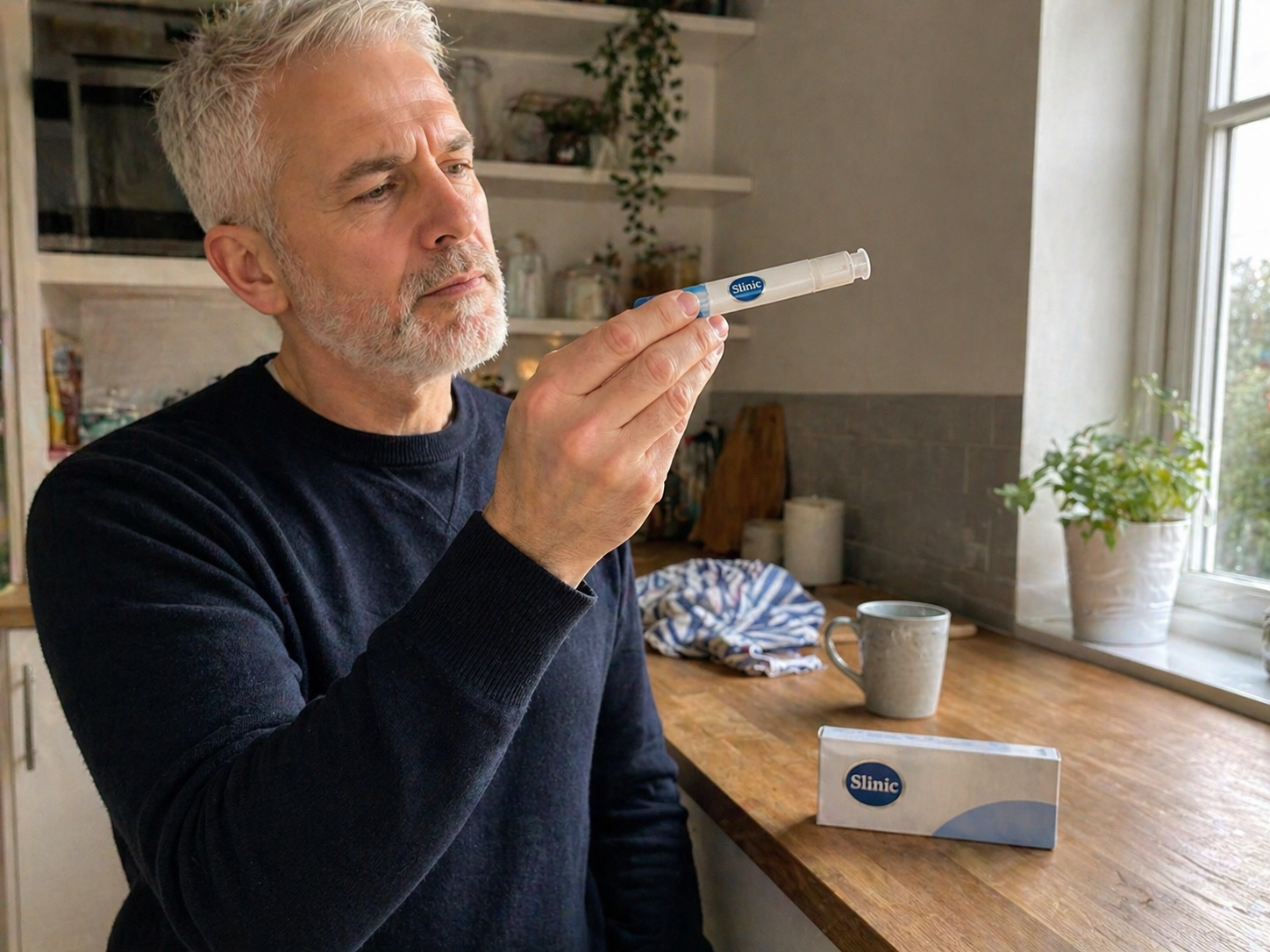
How Mounjaro Is Delivered and What to Check on Arrival
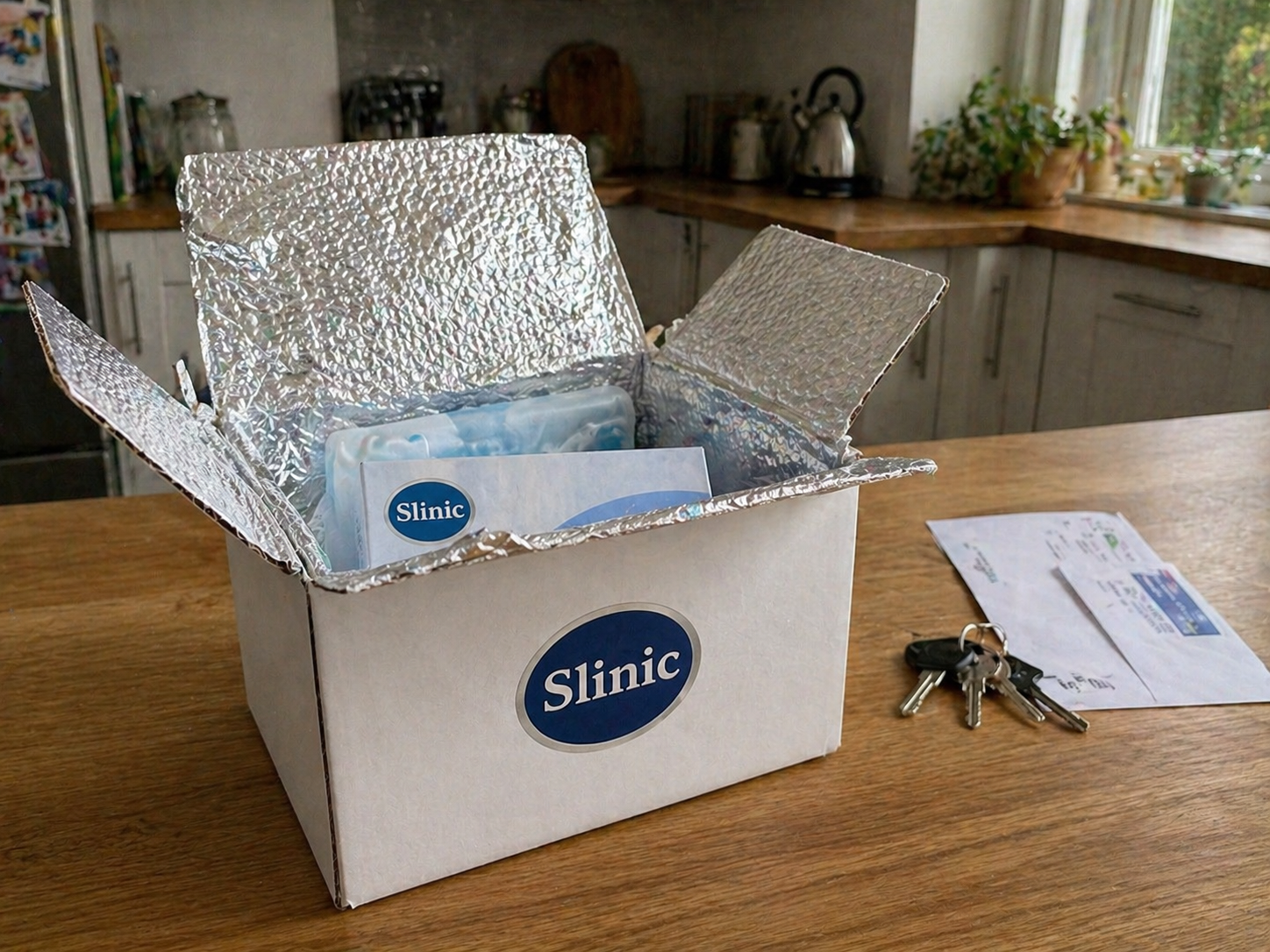
Mounjaro is a temperature-sensitive biological medicine. Slinic ships it in packaging specifically designed to maintain the cold chain throughout transit – the pen is packed with cooling elements and insulating material so it arrives at the correct storage temperature, regardless of typical UK delivery times and seasonal variation.
The cold chain is the unbroken sequence of refrigerated handling that runs from the manufacturer through the pharmacy to your door. Slinic’s role is to manage that chain right up to the moment of delivery. What you do when the box arrives is the final link – and it matters.
What to Check the Moment Your Delivery Arrives
- The outer box should be undamaged. Significant impact to the packaging may have damaged the pen inside.
- The packaging should feel cool when opened. The cooling elements inside should still be cold – partially melted gel packs are acceptable for standard UK delivery windows. Completely warm gel packs are not.
- No visible moisture damage inside the box. Condensation on the inner packaging is normal. Soaking wet packaging suggests the cooling elements have been fully depleted for some time.
- The pen carton should be intact. Check that the carton shows no signs of impact damage or exposure to water.
- The pen itself, seen through the carton window if applicable, should look normal. Clear, undamaged, and not frozen.
What to Do If Something Does Not Look Right
If the delivery box arrives noticeably warm, has been significantly delayed, or you have any doubt about the temperature the pen has been exposed to during transit, do not refrigerate the pen and proceed as normal. Cooling a pen that has been exposed to warmth does not reverse any degradation that may have occurred. The right action is to contact the Slinic pharmacist team before using the medication. In many cases – particularly for standard UK deliveries in normal weather – the pen will be absolutely fine. But that confirmation should come from a pharmacist assessing the actual situation, not from guessing.
If your delivery was held up for significantly longer than expected – a day or more beyond the typical delivery window – contact Slinic directly. In these situations, a replacement may be arranged so you are not left uncertain about the medication you have received.
If Your Delivery Does Not Feel Cold
If the packaging arrives warmer than expected, the answer is not to put the pen in the fridge and hope for the best. Consider the context: a standard UK next-day delivery in autumn or winter, where the gel pack is no longer cold but the room temperature has been moderate, is a very different situation from a delayed summer delivery in a heatwave. In most normal UK delivery scenarios, a cool-but-not-cold pack simply means the insulation did its job as expected. However, if the interior of the box feels genuinely warm – not just room temperature – contact Slinic before using the pen. This is exactly what pharmacist-led support is for: getting a confident answer rather than an anxious guess.
Many online prescribing services dispatch medication without detailed guidance on cold chain handling, delivery checks, or what to do if something does not look right. At Slinic, these questions are part of the service – not an afterthought. Every prescription is dispensed by a GPhC-registered pharmacist, and ongoing clinical support is available throughout your treatment. If a delivery concern comes up, there is a qualified pharmacist to contact, not just a customer service inbox.
Common Mounjaro Storage Mistakes (and How to Avoid Them)
These are the storage errors that patients report most often – sometimes discovering the mistake weeks after it happened. None of them are careless. They are understandable lapses that happen when storage instructions are not explained clearly from the start.
Mistake 1: Storing the Pen in the Fridge Door
The fridge door is the warmest, most temperature-variable part of any refrigerator. Every time you open the door, warm air enters and the door shelf experiences a temperature spike. Storing Mounjaro here means repeated temperature stress across every injection cycle. Move your pens to a mid-shelf inside the main compartment.
One of the most common things we see in practice is patients who have been storing their pens in the fridge door for months without realising it causes a problem. It feels like a natural place to keep medication – visible, easy to grab. But fridge doors on a busy household fridge can swing between 4°C and 12°C throughout the day. Over a course of treatment, that repeated temperature stress adds up. A simple move to the middle shelf costs nothing and removes the risk entirely.
Mistake 2: Leaving the Pen in a Hot Car
A car parked in sunshine – even on a mild UK day – can heat its interior to temperatures well above 30°C within minutes. Many patients keep their pen in a bag or glove compartment out of habit, forgetting that the 30°C threshold applies at all times. If you are driving to a clinic, GP visit, or have simply had your pen in the car for any period in warm weather, treat it as potentially compromised. When in doubt, contact your pharmacist.
Mistake 3: Storing Too Close to the Freezer Compartment
In many domestic fridges, the freezer compartment sits at the top or the back. The area immediately adjacent to it – particularly the top shelf of the main fridge – can hover at or below 2°C in a well-chilled refrigerator. Temperature monitoring shows that pens stored too close to freezer elements can experience partial freezing of the liquid. Store your pens on a middle shelf, away from the back wall of the fridge.
Mistake 4: Discarding the Outer Carton
Some patients remove pens from the outer carton to save space or because they prefer to see the pens directly. The carton is not just packaging. It protects the pen from light exposure, which degrades the medication over time. Keep each pen in its individual inner tray and carton until you are ready to use it.
Mistake 5: Injecting Cold
This is not technically a storage error, but it is a related mistake. Injecting a pen straight from the fridge is uncomfortable. The cold liquid can cause more stinging, localised irritation, and discomfort at the injection site. Taking the pen out 30 minutes before makes the injection more comfortable without any risk to the medication. Some patients report that this small change significantly improved their injection experience.
Mistake 6: Packing Mounjaro in Checked Luggage When Flying
Aircraft cargo holds are not reliably temperature-controlled. Temperatures can drop below freezing in certain sections of the hold during long-haul flights. Mounjaro should always travel in your carry-on bag, kept in the cabin throughout the flight. This is true regardless of flight duration.
Mistake 7: Not Tracking the Date of First Use
The 30-day post-first-use limit is only useful if you are tracking it. Without a note of when you first injected from the pen, you have no reliable way to know how many days of the allowable window remain. Write the date of your first injection on the outer carton the moment you use it. This takes three seconds and removes all uncertainty for every dose that follows.
When in Doubt, Ask
If you are ever uncertain whether a pen has been stored correctly – you’ve found one that has been left out, you’ve returned from a holiday unsure whether the hotel fridge was cold enough, or your fridge broke down – do not guess. Slinic’s pharmacist team can advise whether your specific situation is likely to have compromised your medication. That conversation is always worth having before you inject.
Common Real-Life Storage Scenarios: What to Do
Storage questions rarely arrive in neat, theoretical terms. They arrive at 7am on injection day when you realise the pen has been on the kitchen counter since Tuesday. The table below covers the situations that come up most often, with a clear answer for each one.
| Scenario | Is it safe to use? | What to do |
|---|---|---|
| Left out overnight at home Pen on kitchen counter, normal UK home temperature |
Likely yes | If the home temperature remained below 30°C and the pen has been used at least once, this falls within the 30-day post-first-use window. Note the first-use date on the carton if you have not already. No action needed for a single overnight period in normal UK conditions. |
| Left in a hot car Parked in sunshine, warm or hot day |
Treat as potentially compromised | Car interiors can exceed 30°C within minutes on a warm UK day and reach 50°C or more in full sun. Do not use the pen without checking. Contact your pharmacist before injecting. The length of time and estimated temperature will help them advise you accurately. |
| Fridge broke overnight Closed fridge, power off for several hours |
Depends on temperature reached | A closed fridge holds temperature for approximately 4 hours. If the fridge remained closed and the outage was short, the pen is very likely fine. Check the internal temperature when power returns. If below 30°C throughout, it is within acceptable conditions. If genuinely warm inside, contact Slinic before using. |
| Hotel mini fridge – temperature uncertain Mini fridge on unknown setting, abroad |
Check before assuming | Hotel mini fridges vary widely. Some run very cold and can freeze medication placed near the back or top. Others barely chill. Check the temperature dial and place the pen in the middle of the fridge, away from any cold elements. If it has felt frozen, discard it and contact Slinic. If it feels normally cold, it should be fine. |
| Taken on a plane in hand luggage Carried through airport, stowed in overhead locker |
Yes | Cabin conditions on commercial flights are temperature-controlled and suitable for Mounjaro. Hand luggage is always the right choice. The pen will experience minor temperature variation during boarding and at the gate, but this is well within acceptable limits for the duration of typical flights. |
| Carried in a handbag all day Standard UK day, bag not in direct sun |
Likely yes | In typical UK ambient temperatures, a handbag does not reach 30°C. If the bag has been in a cool or air-conditioned environment all day, there is no storage concern. If it has spent time in direct sunlight – on a seat by a window, left in a warm car, or outside in summer heat – treat with more caution and contact your pharmacist if the bag felt genuinely hot. |
The Rule Behind Every Scenario
Every scenario above comes down to one question: has the pen been above 30°C for any meaningful period, or frozen at any point? If the honest answer to both is no, the pen is within acceptable storage conditions. If the answer to either is yes, or if you genuinely do not know, that is the moment to contact your pharmacist rather than proceed on hope. The Slinic team handles these queries regularly – a quick message takes less time than the uncertainty.
Can I Still Use My Mounjaro Pen?
Use the logic below to get a fast, clear answer. When in doubt, the last row always applies.
The pen has been frozen
Discard it immediately. Do not thaw and use. Freezing permanently damages tirzepatide and the pen cannot be recovered.
The pen may have been above 30°C
Do not use without checking first. Contact your Slinic pharmacist. The duration and estimated temperature will determine whether the pen is still safe.
Room temperature, consistently below 30°C, used within 30 days of first use
Likely safe to use. Confirm the first-use date on the carton and check the liquid looks clear before injecting.
Not sure what happened or how long it’s been
Contact Slinic before injecting. A quick message to the pharmacist team takes less time than the uncertainty – and is always the right call.
Real Patient Experience
“My experience with Slinic has been excellent from start to finish. The whole process was fast, efficient, and incredibly professional. My treatment was clinically checked and verified before being dispensed, which gave me complete peace of mind. The video consultation was thorough and reassuring – the pharmacist took time to explain everything clearly and made sure all my questions were answered. Delivery was quick, discreet, and reliable, arriving exactly when expected. I couldn’t have asked for a smoother or more professional service. I feel confident knowing my care is verified, clinically safe, and managed by a trusted team.”
– Pauline Lane, 21kg lost
Expiry Dates and When to Check Your Pen
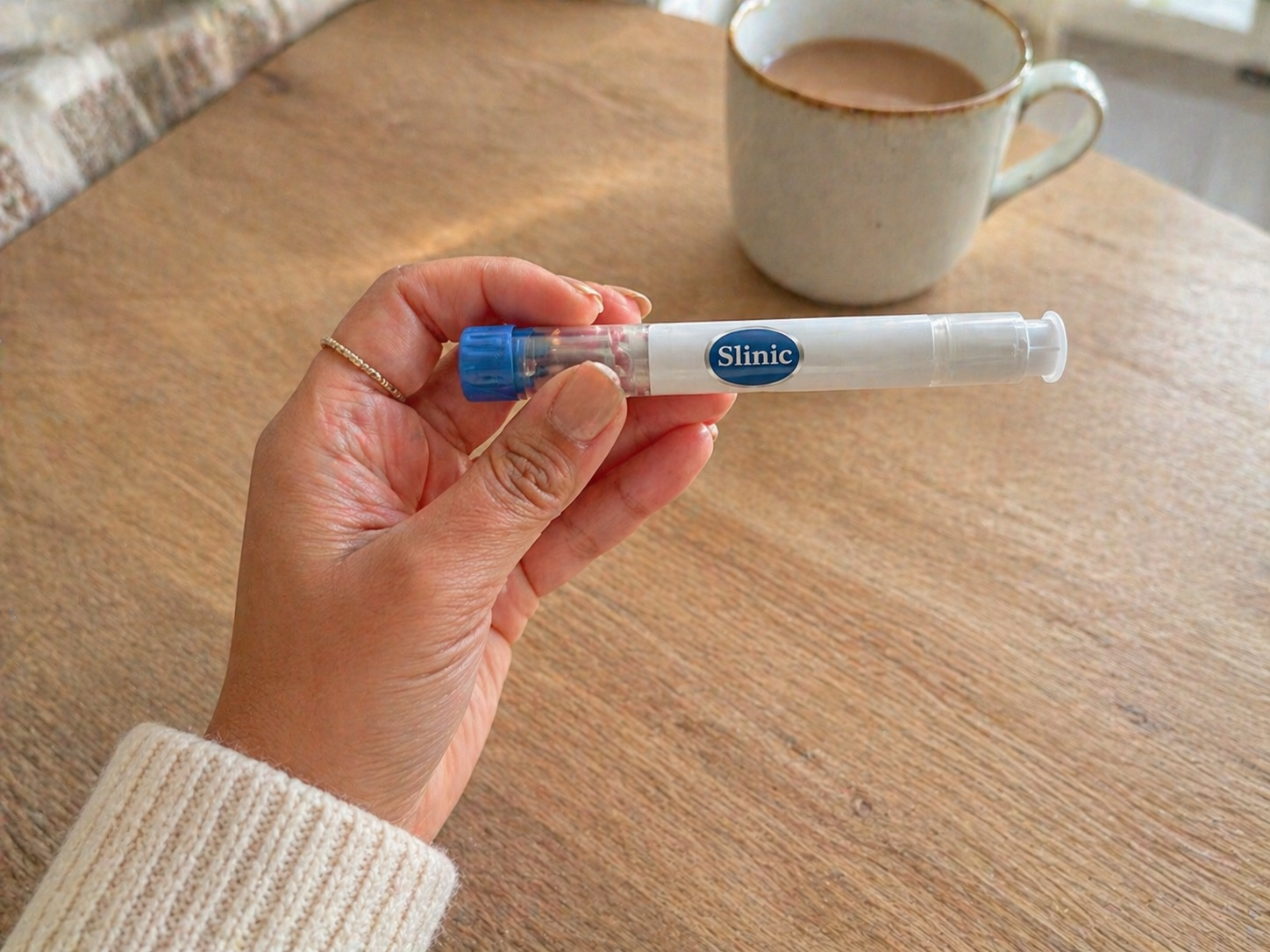
Every Mounjaro pen has an expiry date printed on the label and the outer carton. This date reflects how long the manufacturer can guarantee the medication’s full potency under correct storage conditions. Using a pen past its expiry date is not recommended, even if it has been stored perfectly. The guarantee expires at that date.
Check the expiry date:
- When your delivery first arrives
- Before each injection
- If the pen has been stored outside the fridge for any period
- Whenever you have been away from home and your storage situation was not ideal
Mounjaro pens typically carry an expiry date 18 to 24 months from manufacture. If your supply is coming monthly through Slinic, you are unlikely to be anywhere near the expiry date under normal circumstances. But it is worth building the habit of checking, particularly if you have stockpiled pens or your treatment has been paused for any reason. If you have paused treatment and want to restart, the Slinic team can review your prescription and confirm your supply is current before you resume.
What to Look for When Inspecting the Pen
Before every injection, check that the liquid is clear and colourless to slightly yellow. Do not use the pen if:
- The liquid looks cloudy or discoloured
- You can see visible particles or floaters in the liquid
- The pen casing is cracked or damaged
- The pen has been frozen
- The expiry date has passed
- The pen has been outside the fridge for more than 30 days since first use
How Storage Affects Your Weight Loss Outcomes
The clinical trial data for Mounjaro – the SURMOUNT programme, published in the New England Journal of Medicine – is compelling. At the 15mg dose over 72 weeks, participants lost an average of 22.5% of their body weight. More than 90% achieved at least 5% weight loss. These results were achieved in controlled settings where every aspect of the treatment was carefully managed – including how the medication was stored and handled. When stored correctly, every dose delivers the full clinical effect seen in those trials. The difference between a well-stored pen and a poorly-stored one is not a theoretical concern – it is the difference between getting what you paid for and not.
Nobody talks about what happens when storage conditions drift. The short answer is that degraded medication delivers a weakened version of the therapeutic effect you are expecting. You may be injecting on time, eating correctly, and doing everything right – but if the pen has been improperly stored, the dose may not be delivering its full effect.
This becomes particularly relevant during dose escalation. Mounjaro is titrated upward from 2.5mg every four weeks, with therapeutic effects kicking in meaningfully at 5mg and above. During this escalation period, patients are adjusting to the dose and looking for results. Any variability introduced by storage errors creates noise in an already variable process.
Consistency in treatment means consistency in everything – dose timing, injection technique, and yes, storage. The medication is doing a great deal of work at a molecular level. Give it the conditions it needs to do that work properly.
Slinic’s Role in the Cold Chain
When Mounjaro leaves Slinic’s pharmacy, it has been stored at the correct temperature throughout its time in our care. Every treatment is clinically verified before dispensing, and deliveries are packed in temperature-controlled packaging to maintain the cold chain to your door. What happens at your end – from the moment the box arrives – is in your hands. This guide gives you everything you need to keep that chain unbroken.
Mounjaro Storage Reference Table
| Situation | Action Required | Notes |
|---|---|---|
| Delivery arrives | Place in the fridge as soon as possible on arrival | Store in original carton, mid-shelf, away from freezer compartment |
| Pen in fridge | Keep at 2°C to 8°C | Do not store in door or near back/freezer area |
| After first use | Store below 30°C for up to 30 days | Write date of first injection on carton. Check emc.medicines.org.uk for the most current duration figure. |
| Pen accidentally frozen | Discard immediately | Do not thaw and use – contact prescriber for replacement |
| Pen left in hot car | Treat as potentially compromised | Contact pharmacist before using if above 30°C for any period |
| Power cut (fridge off) | Check temperature when power returns | Closed fridge holds temperature for ~4 hours; for in-use pens, time above 8°C after first use counts toward 30-day unrefrigerated limit |
| Flying | Always carry in hand luggage | Never in checked baggage; bring prescription documentation |
| Pen past expiry date | Discard and contact prescriber | Do not use regardless of visual appearance |
| Liquid looks cloudy or contains particles | Discard immediately | Clear liquid only; any cloudiness means the pen should not be used |
| Pen dropped and cracked | Discard | Physical damage compromises the dose delivery mechanism |
Not Sure If Your Pen Is Still Safe? Here’s What to Do
Sometimes things happen – a holiday packing slip, a power cut overnight, a moment of doubt about how long the pen has been out of the fridge. The uncertainty can feel stressful, particularly when you are mid-treatment and your next dose is due.
The answer is not to guess. Injecting a pen that has been frozen or severely overheated will not cause immediate harm in most cases, but it will mean injecting medication that may no longer work as intended. A missed result is the most likely consequence – but given that each dose matters, that is reason enough to pause and check.
Use the decision logic below to work through your situation clearly.
If You Are Certain the Pen Has Been Frozen
Discard it. Do not attempt to thaw and use it. Freezing permanently damages the biological structure of tirzepatide and the medication cannot be recovered by warming it back up. Even if the liquid looks completely normal, the effectiveness has been compromised. Contact your Slinic pharmacist to discuss replacing the pen.
If You Are Certain the Pen Has Been Above 30°C
Do not use it. How long it was overheated and by how much matters – a pen briefly placed in a warm car for a few minutes in mild weather is a different situation to one left in a hot glove box for several hours. If there is any genuine doubt that the pen exceeded 30°C for more than a brief period, contact your Slinic pharmacist before injecting.
If You Are Simply Unsure
Do not guess. The right action is to contact your Slinic pharmacist and describe exactly what happened. Bring the pen, note the date of first use, and be honest about what occurred. Your pharmacist can help you assess whether the pen is still within its storage window and advise on next steps – including whether a replacement is needed.
A missed dose is a far better outcome than an ineffective injection that sets your treatment back. When in doubt, check first.
Visual Checks: When the Pen May Look Different
Mounjaro solution should be clear and colourless or slightly yellow when you look through the pen window. The following may indicate a problem:
- Visible cloudiness or haziness in the liquid
- Floating particles or clumps
- A noticeably different colour compared to previous pens
- Any change in consistency
If you notice any of these, do not inject. Contact your pharmacist immediately. Note that a visually normal-looking pen is not a guarantee that storage conditions have been maintained – compromised medication can look completely unchanged.
Your Slinic Pharmacist Is There for Exactly This
Shadeia Younis and the Slinic team are available to answer storage questions, assess whether a pen is still safe, and advise on replacements where needed. This is the clinical support that comes with every Slinic prescription – not an add-on, not a paid extra. If you are unsure about your pen, reach out before injecting. That is what pharmacist-led care looks like in practice.
When to Discard a Pen and Seek Advice
There are situations where the right answer is to stop, discard the pen, and make contact with your prescriber or pharmacist before proceeding. None of these situations require you to miss a dose permanently – they require a short conversation and, in most cases, a replacement pen.
Discard the Pen and Contact Your Pharmacist if:
- The pen has been frozen at any point, even partially
- The liquid appears cloudy, discoloured, or contains visible particles
- The pen casing is cracked, damaged, or the mechanism does not function correctly
- The expiry date has passed
- The pen has been outside the fridge for more than 30 days since first use
- The pen has been in conditions above 30°C for more than a brief period
- You are unsure whether correct storage was maintained and cannot confirm it
Missing one weekly dose whilst arranging a replacement is not ideal, but it is far preferable to injecting a degraded medication. If you are on a dose titration schedule, a short gap of one week is unlikely to significantly disrupt your progress. Your Slinic pharmacist can advise on the correct way to resume your schedule after a missed dose.
What Happens if You Miss a Dose?
If a dose is missed and the next scheduled injection day is more than 4 days away, administer the missed dose as soon as you can. If fewer than 4 days remain before your next scheduled injection, skip the missed dose and resume your normal weekly schedule. Do not inject two doses in close succession. This guidance is consistent with standard UK prescribing information for tirzepatide.
When to Change Treatment
Storage problems are not a reason to change treatment – they are a reason to change storage habits. If you find yourself repeatedly in situations that compromise your medication (frequent travel, unreliable refrigeration, or inadequate delivery timing), talk to your Slinic pharmacist about how to adapt your supply schedule and storage arrangements. There are practical solutions for most circumstances.

How to Get Mounjaro From Slinic
You have been through the research. You have read the guides, checked the forums, and weighed up your options. At some point, the information gathering has to turn into something. Most patients tell us the same thing a few weeks after starting: they wish they had done it sooner.
Slinic is a GPhC-registered online pharmacy (registration 1033729) specialising in weight loss treatments. The consultation is done online and takes around two to three minutes to complete. A prescriber reviews your information, a video consultation is arranged if required, and your medication is clinically verified and dispensed by Slinic’s superintendent pharmacist, Shadeia Younis.
Shadeia Younis
Superintendent Pharmacist, Slinic (GPhC 2052119)
Every Mounjaro prescription dispensed by Slinic is clinically verified and overseen by Shadeia Younis, our superintendent pharmacist. That means before your medication leaves our pharmacy – including the temperature-controlled packaging it travels in – it has been checked by a qualified, registered professional who is accountable for its safety.
This level of oversight is not standard across all online providers. Pharmacist-led dispensing means a real clinical expert reviews your treatment at every stage, not an automated system.
Mounjaro through Slinic is available from £129 per month at the 2.5mg starting dose, with doses progressing through the titration schedule as your treatment advances. There are no hidden consultation fees. Pricing is transparent from the outset.
| Dose | Monthly Price |
|---|---|
| 2.5mg (starting dose) | £129 |
| 5mg | £155 |
| 7.5mg | £206 |
| 10mg | £230 |
| 12.5mg | £247 |
| 15mg | £267 |
Private eligibility through Slinic requires a BMI of 30 or above, or a BMI of 27 or above with a weight-related health condition. No GP referral is needed. No waiting list.
Your medication arrives in temperature-controlled packaging, and the storage guidance in this article applies from the moment it reaches you. Your Slinic pharmacist team is available throughout your treatment to answer questions – including any that come up about storage, missed doses, or travel planning.
Mounjaro With Clinical Oversight at Every Step
From prescription to delivery to ongoing support, Slinic’s pharmacist-led model means there is always a qualified professional behind your treatment – not just at sign-up, but throughout. Transparent pricing, no hidden fees, and a three-minute online consultation to get started with confidence.
Complete Our Online Consultation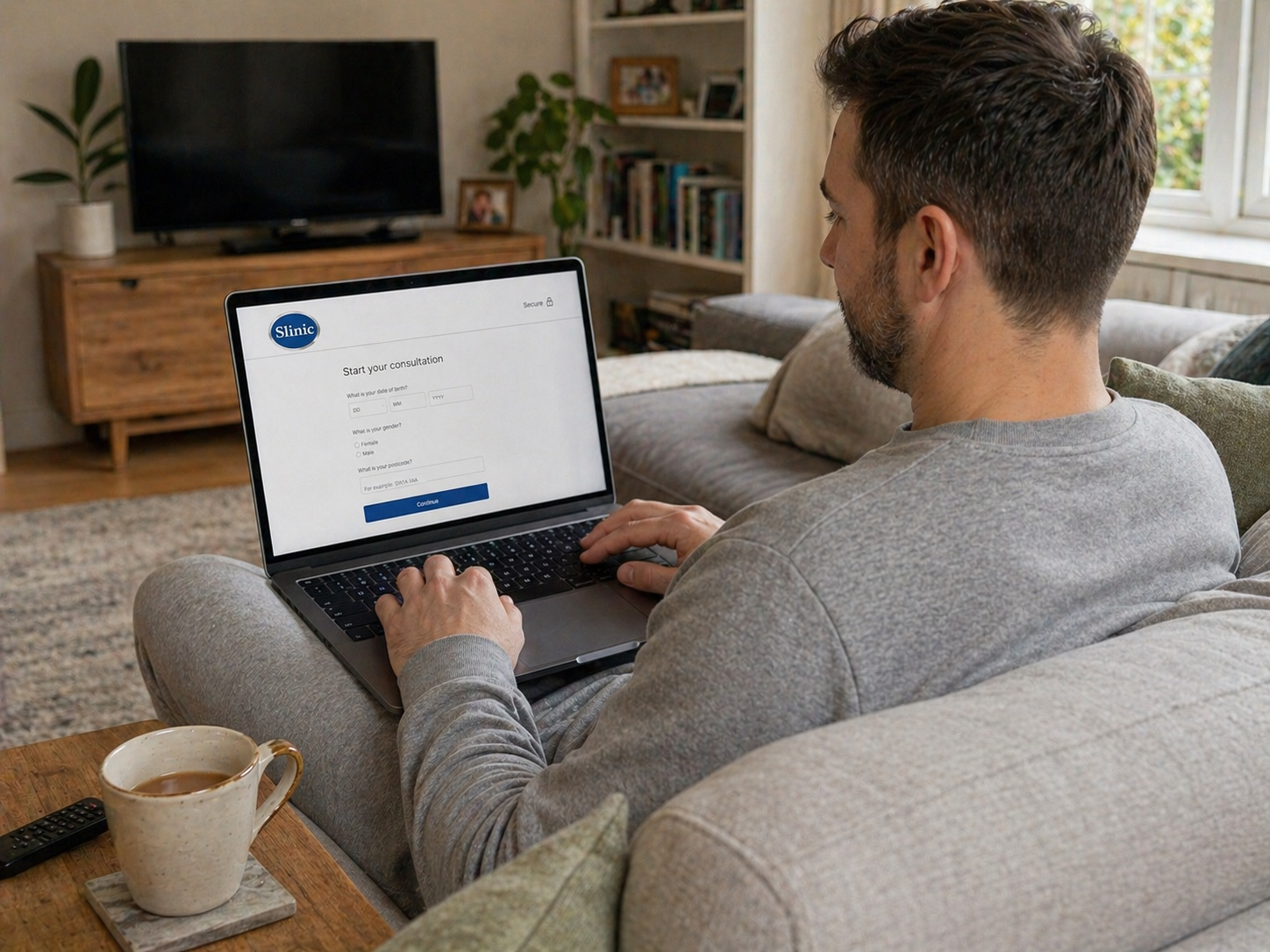
Frequently Asked Questions About Storing Mounjaro
Yes, but only within specific limits. After first use, a Mounjaro pen may be stored unrefrigerated at room temperature below 30°C for up to 30 days, based on the current UK Summary of Product Characteristics. After that window, the pen should be discarded even if doses remain and the expiry date has not passed. Storage guidance can be updated by the manufacturer – always check the most current SPC at emc.medicines.org.uk or confirm with your pharmacist.
For most patients, the fridge remains the most reliable option between doses. The room-temperature allowance is particularly useful for travel, or if you find it more practical to keep the pen accessible during the week. If you do store it at room temperature, write the date of your first injection on the carton so you can track the 30-day window accurately.
A frozen Mounjaro pen must be discarded. Freezing can damage the molecular structure of tirzepatide in ways that are not visible to the naked eye – the liquid will still look clear after thawing, but the medication may have lost potency or the integrity of the formulation may have been compromised. There is no safe way to test whether a thawed pen is still effective.
If you think your pen has been frozen, contact the Slinic pharmacist team. In most cases, a replacement can be arranged so you do not miss a dose.
Yes. Mounjaro is permitted on flights, but it must travel in your hand luggage – never in checked baggage. Aircraft cargo holds are not reliably temperature-controlled and can reach freezing temperatures during long-haul flights, which would destroy the medication.
At airport security, carry your original pharmacy packaging and prescription documentation. A short covering letter from your prescriber can help at international checkpoints. The medication itself – being a liquid in a pre-filled pen – should be declared at security in the standard way for liquid medicines. Airline policies vary, so it is worth checking in advance for international travel, particularly for longer journeys requiring more than one pen.
It does matter. The two areas to avoid are the fridge door and the area directly adjacent to the freezer compartment. The door experiences the most temperature variation each time you open the fridge. The area near the freezer – typically the back or top shelf of the main compartment – can dip below 2°C or even reach freezing temperatures in a well-chilled fridge.
The safest position is a middle shelf in the main body of the fridge, away from the back wall and the freezer element. Keep the pens in their original cartons and, if sharing a fridge, in a small container or box to keep them identifiable and protected.
A closed fridge maintains its internal temperature for approximately 4 hours after power is lost. If the outage was shorter than that and the fridge remained closed, your pens are very likely still within the safe temperature range. If the outage was longer, the key question is whether the internal temperature stayed below 30°C – and how long it exceeded 8°C.
For any pen that has already had its first dose taken, time above 8°C counts toward the 30-day post-first-use unrefrigerated limit. If the temperature remained below 30°C throughout the outage, those pens are still within acceptable conditions – note the date and use within the remaining days of the 30-day window. Pens that have not yet been opened are not subject to the 30-day rule, but should return to refrigeration promptly. If the temperature approached or exceeded 30°C at any point, or if you are uncertain, contact the Slinic pharmacist team before using the affected pens.
If the temperature where it was left remained below 30°C – which is typical of a UK home at most times of year – then yes, it is still within the acceptable storage window. Two days is well within the 30-day post-first-use limit. Keep it away from direct sunlight and heat sources, and use it within the remaining days of the 30-day window. Write the date of your first injection on the carton if you have not done so already.
During unusually warm weather, or if the pen was near a heat source, radiator, or in direct sun for any of those two days, exercise more caution and contact your pharmacist if you are uncertain.
There is no strict clinical requirement to inject at exactly room temperature – the medication will function if injected cold. But injecting a cold liquid subcutaneously is noticeably more uncomfortable. The cold temperature can cause more stinging, localised irritation, and discomfort at the injection site compared to a pen that has had 30 minutes to reach room temperature.
Many patients who experience injection-site discomfort find that this single change – taking the pen out of the fridge 30 minutes before injecting – makes a meaningful difference to their weekly experience. There is no reason to make the process more uncomfortable than it needs to be.
The Mounjaro KwikPen contains 4 doses – one per week. After each weekly injection, replace the outer cap and return the pen to its storage location. Do not dispose of the pen after each dose. Only once all 4 doses have been used should the pen be placed in a sharps bin. Sharps bins are available through your GP surgery or local pharmacy, and many councils provide a sharps collection service for patients on injectable medications.
If you are a Slinic patient and unsure of the nearest sharps disposal option in your area, the Slinic team can advise. Never put a finished pen in household recycling or general waste – it always goes into a sharps bin.
You can maintain a small supply buffer, but be mindful of expiry dates and storage space. Mounjaro pens have an expiry date printed on the label – typically 18 to 24 months from manufacture. Provided you store them correctly at 2°C to 8°C and they do not exceed the printed expiry date, they remain usable.
For most patients, receiving monthly supplies and storing them correctly is the most practical approach. If you have specific concerns about supply continuity, discuss them with the Slinic team when completing your consultation.
Indirectly, yes. Mounjaro can be injected into the abdomen, thigh, or upper arm. The temperature of the medication at the point of injection does affect how comfortable the experience is – cold medication causes more localised stinging regardless of site. Allowing the pen to reach room temperature before injecting is a good habit to build regardless of which site you use.
Rotating injection sites is important for a different reason: repeated injections into the same area of skin can cause localised tissue changes over time. Vary between sites week to week. Your Slinic pharmacist can provide specific guidance on injection technique and site rotation during your consultation.
Mounjaro (tirzepatide) was approved by NICE for weight management in December 2024 under Technology Appraisal TA1026. However, NHS England has agreed a phased rollout over a period of up to 12 years due to the scale of budget impact. In practice, access through NHS primary care remains limited in 2026 – most GP practices are not yet able to prescribe tirzepatide for weight management, and availability varies considerably by postcode.
Through Slinic, Mounjaro is available privately without a waiting list and without a GP referral. Private eligibility requires a BMI of 30 or above, or 27 or above with a weight-related health condition. If you are on an NHS waiting list, or your postcode does not yet have access, private access through Slinic is an option worth considering.
Yes, absolutely. Slinic’s pharmacist-led model means that clinical support continues throughout your treatment – not just at the point of dispensing. If you have a storage question, a concern about a pen that may have been improperly stored, a question about travelling with your medication, or any other practical query, the Slinic team is available to advise.
This is one of the key differences between a pharmacist-led service and a purely transactional one. You are not left to navigate these questions on your own after your consultation. Complete our online consultation to get started, and know that the support continues from there.
Related Guides and Pages
Mounjaro Treatment Guides
These articles answer the questions most Mounjaro patients have alongside storage – from what the injection process looks like to how to manage side effects and understand the costs.
- Mounjaro dosing schedule UK: 2.5mg to 15mg explained – How the titration works, when doses increase, and what to do if side effects slow your progress.
- Starting Mounjaro: what to expect in your first month – A realistic look at weeks one to four, covering appetite changes, energy levels, and early results.
- Mounjaro side effects: what UK patients should expect – Why side effects happen, when they peak, and the practical strategies that help most.
- The complete Mounjaro cost breakdown for the UK – Monthly pricing, what is and is not included, and how to compare providers honestly.
- Free Mounjaro meal plan – What to eat on Mounjaro to support the medication’s appetite-regulating effect.
- Why am I not losing weight on 2.5mg Mounjaro? – Why the starting dose can feel slow, what is normal, and when to step up.
Key Slinic Pages
The pages most Slinic visitors read before and after starting treatment.
- Mounjaro treatment page – Full overview of Mounjaro at Slinic: how it works, eligibility, pricing, and how to get started.
- Weight loss treatments – Slinic’s weight loss treatment options, including Mounjaro and Wegovy, and how to choose between them.
- About Slinic – Who we are, our GPhC registration, and the pharmacist-led model that sets Slinic apart.
- Treatment guide hub – All Slinic treatment guides in one place – dosing, side effects, costs, and clinical support.
- Complete our online consultation – Start your Mounjaro or Wegovy treatment. Takes around three minutes. No GP referral needed.
Medical References and Guidance
Storage guidance in this article is based on the Mounjaro (tirzepatide) Summary of Product Characteristics (SPC) as approved by the MHRA for use in the UK. Clinical trial data referenced is from the SURMOUNT programme, published in the New England Journal of Medicine. NICE Technology Appraisal TA1026 covers tirzepatide for weight management in adults (published December 2024). All medical facts in Slinic content are verified against MHRA, NICE, NHS, and BNF sources.
You’ve Done the Research. This Is the Easy Part.
Most patients tell us that getting started was less complicated than they expected. Complete our online consultation and a prescriber will review your information within 24 hours.
Complete Our Online ConsultationRelated Blog Posts From Slinic
Mounjaro Storage Guide: Clinical Best Practices for Maintaining Efficacy – a deeper clinical look at keeping Mounjaro at full potency, from fridge storage to the first-use window.
Next Day Mounjaro Delivery: A Specialist Guide to Safe Clinical Access – how next-day cold-chain delivery works and what safe clinical access looks like in practice.
Restarting Mounjaro After a Break – how to reorder and restart Mounjaro safely after a pause in treatment.