

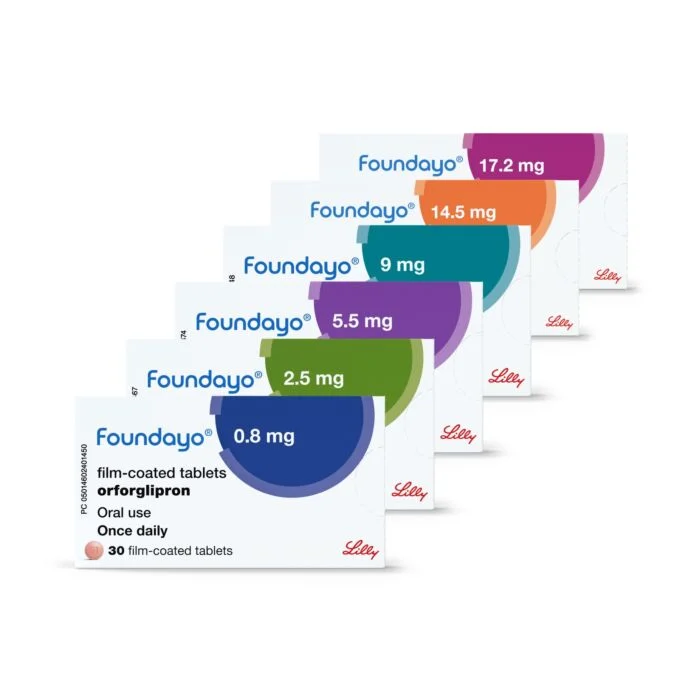
Foundayo (Orforglipron) Side Effects UK: Common Effects, Risks & When to Get Help
Gastrointestinal side effects are the most frequently reported with Foundayo (orforglipron). They are most common during dose escalation and generally decrease over time. This page sets out what the UK Summary of Product Characteristics actually reports — with the real frequency figures rather than a vague list — and, more importantly, which symptoms mean you should stop reading and get medical help.
Quick verdict
Gastrointestinal effects are the most frequently reported. At the highest dose reported in the pooled placebo-controlled weight-management safety data, gastrointestinal adverse reactions occurred in 68.7% of participants receiving orforglipron compared with 36.3% receiving placebo. Most were mild (61.8%) or moderate (34.3%), with 3.9% severe, and 6.8% stopped treatment because of them.
They were most frequent during dose escalation and decreased over time. Discontinuation because of them ranged from 3.7% to 6.8% across doses, against 0.6% on placebo.
Beyond the gut, important effects to know about include a small average rise in heart rate, low blood pressure, gallstones, transient hair loss and, uncommonly, acute pancreatitis.
Foundayo carries a black triangle (▼). If you experience a side effect, please report it through the MHRA Yellow Card scheme as well as telling your prescriber.
✍️ Written by Shadeia Younis, Superintendent Pharmacist (GPhC No. 2052119) and the Slinic Clinical Team
Last medically reviewed: 15th August 2026 · Clinical content verified against the UK Summary of Product Characteristics published on the electronic Medicines Compendium, 14 August 2026
About the author
Shadeia Younis is the founder and Superintendent Pharmacist of Slinic (GPhC No. 2052119), with 25 years of clinical pharmacy experience. She has owned and operated community pharmacies in Lancashire since 2008, oversees the clinical governance of Slinic’s prescribing service, and holds SCOPE certification in obesity management.
Pharmacy Premises GPhC No. 1033729 · NHS-Contracted Community Pharmacy · Led by a SCOPE-Certified Pharmacist · LegitScript Certified · UK Doctor & Pharmacist Led · 25+ Years Pharmacy Experience · Monthly Clinical Reviews
The most common Foundayo side effects are nausea, constipation, diarrhoea, vomiting, indigestion and abdominal pain. These are classed as very common, meaning they affect at least 1 in 10 people. Headache, dizziness, reflux, bloating, fatigue, hair loss, low blood pressure and increased heart rate are classed as common, affecting up to 1 in 10 people.
Side effects are most likely while your dose is being increased and often decrease over time. In the weight-management studies, between 3.7% and 6.8% of participants stopped treatment because of gastrointestinal side effects.
Seek urgent medical advice if you have
- Severe, persistent abdominal pain, with or without pain spreading to your back — this can indicate pancreatitis
- Swelling of the face, lips, tongue or throat, or difficulty breathing
- Severe abdominal swelling or pain with persistent vomiting, particularly if you cannot pass stool or wind
- Confusion, fainting, or inability to keep any fluid down
- Sudden change in vision
- Severe hypoglycaemia if you take insulin or a sulfonylurea
Important
This guide is general information and does not replace advice from a qualified healthcare professional. It is not a complete list of side effects — the patient information leaflet supplied with your medicine is.
Do not routinely change your dose without speaking to your prescriber. If a side effect is troubling you, contact them and let them make that decision with you. If you develop symptoms requiring urgent medical attention, seek medical help immediately and follow the advice you are given.
How common are Foundayo side effects?
Across the placebo-controlled phase 3 studies, 4,158 people took orforglipron. Gastrointestinal effects were the most frequently reported, and they rose with dose.
| Foundayo tablet equivalent of trial dose | Any GI side effect | Stopped because of GI effects |
|---|---|---|
| 5.5 mg | 60.1% | 3.7% |
| 9 mg | 67.4% | 6.3% |
| 17.2 mg | 68.7% | 6.8% |
| Placebo | 36.3% | 0.6% |
Two things worth reading out of that. First, more than a third of people on placebo also reported gastrointestinal symptoms — so not everything you feel while taking a medicine is caused by it. Second, the great majority of people who experienced side effects carried on: even at the highest dose, over 93% did not stop because of them.
In the type 2 diabetes studies, gastrointestinal adverse reactions occurred in 59.1% at the highest dose compared with 25.9% on placebo; 6.2% at that dose discontinued because of gastrointestinal adverse reactions, compared with 0.4% on placebo.
A note on the dose figures
The trials used a hard capsule formulation at 6, 12 and 36 mg. Those correspond to the 5.5, 9 and 17.2 mg marketed tablets, which is how they are labelled above. The two forms are not substitutable milligram-for-milligram — see our guide to Foundayo doses.
Very common: more than 1 in 10 people
The SmPC lists these as affecting at least one in ten people. All of them are gastrointestinal, apart from one relating to diabetes treatment.
- Nausea
- Constipation
- Diarrhoea
- Vomiting
- Dyspepsia (indigestion)
- Abdominal pain
- Hypoglycaemia — when used with basal insulin, with or without metformin and/or an SGLT2 inhibitor
Foundayo nausea, diarrhoea and constipation: how common are they?
People often want a figure for a single symptom rather than the gastrointestinal group as a whole. The UK SmPC reports these individually by frequency category rather than by percentage, so the honest answer is the category rather than a number.
| Symptom | SmPC frequency | What that means |
|---|---|---|
| Nausea | Very common | At least 1 in 10 people |
| Constipation | Very common | At least 1 in 10 people |
| Diarrhoea | Very common | At least 1 in 10 people |
| Vomiting | Very common | At least 1 in 10 people |
| Reflux, bloating, belching, flatulence | Common | Up to 1 in 10 people |
What the SmPC does give as figures is the picture across all gastrointestinal effects combined — 68.7% at the highest dose against 36.3% on placebo, mostly mild or moderate. It also states that nausea, vomiting and diarrhoea specifically were more frequent during dose escalation and decreased over time.
Individual trials and overseas product information may report precise percentages for nausea and other single symptoms. For this UK guide we use the frequency categories and pooled safety figures reported in the current UK SmPC.
Common: up to 1 in 10 people
| Body system | Reported effects |
|---|---|
| Digestive | Abdominal distension (bloating), eructation (belching), gastro-oesophageal reflux, flatulence |
| Nervous system | Dizziness, headache |
| Heart | Tachycardia (a fast heart rate) |
| Blood vessels | Hypotension (low blood pressure) |
| Gallbladder | Cholelithiasis (gallstones) |
| Skin and hair | Hair loss |
| General | Fatigue |
| Blood tests | Increased amylase, increased lipase |
| Metabolism | Hypoglycaemia when used with a sulfonylurea |
On the raised amylase and lipase: in the weight-management studies, mean serum pancreatic amylase increased by 18.9% from baseline with orforglipron against 2.9% with placebo, while mean lipase increased by 28.8% against 3.8%. Those are average changes in enzyme level, not the proportion of people affected. The SmPC states that, in the absence of other signs and symptoms of pancreatitis, the clinical significance of raised pancreatic enzymes alone is unknown. If your prescriber orders these tests, a raised result on its own is not the same as a diagnosis.
Uncommon side effects and other important safety reports
- Acute pancreatitis
- Dysgeusia (altered taste) and dysaesthesia (altered sensation)
- Hypoglycaemia when used without insulin or a sulfonylurea
Post-marketing reports and safety signals from related GLP-1 medicines
The SmPC also lists events reported either during post-approval use of orforglipron or with relevant medicines having similar structure, activity or target engagement. Because these reports arise from populations of uncertain size, their frequency cannot always be estimated and a causal relationship cannot always be established.
- Eyes: non-arteritic anterior ischaemic optic neuropathy (NAION), a rare condition that can cause decreased vision including permanent loss of vision
- Digestive: acute, haemorrhagic and necrotising pancreatitis, sometimes fatal; ileus; intestinal obstruction; severe constipation including faecal impaction
- Allergy: anaphylaxis, angioedema
- Lungs: pulmonary aspiration during procedures requiring general anaesthesia or deep sedation
- Kidneys: acute renal failure or worsening of chronic renal failure, sometimes requiring haemodialysis
Foundayo and the contraceptive pill
This is the safety point most easily missed, because it is not a side effect in the usual sense — but it matters as much as anything else on this page.
If you use oral hormonal contraception
Foundayo may reduce the effectiveness of oral hormonal contraceptives. The UK SmPC advises switching to a non-oral contraceptive method, or adding a barrier method such as condoms, for 30 days after starting Foundayo and for 30 days after each dose increase.
Because you may titrate through several dose steps, that is potentially several separate 30-day windows rather than a one-off precaution at the start.
Speak to your prescriber or pharmacist about contraception before you start treatment, and plan each window before a dose increase rather than afterwards. Women of childbearing potential should use effective contraception throughout treatment.
Worth knowing alongside this: weight loss can restore fertility, which matters particularly if you have PCOS and were not previously ovulating. Pregnancy can happen sooner than expected.
Pregnancy and breastfeeding
Foundayo should not be used during pregnancy or while breastfeeding.
If you are planning a pregnancy, the UK SmPC advises stopping orforglipron at least three weeks before trying to conceive, because of how long it stays in the body. If you become pregnant while taking it, contact your prescriber and stop treatment as advised.
Orforglipron was found in animal milk and a risk to a breastfed infant cannot be excluded, which is why it is not recommended during breastfeeding.
When side effects tend to happen
The SmPC states that the incidence of nausea, vomiting and diarrhoea was higher during the dose escalation period and decreased over time. That single sentence explains most of the pattern people describe.
| Point in treatment | What tends to happen |
|---|---|
| First dose | The effect on gastric emptying is greatest after the first dose and diminishes over time. Gastrointestinal symptoms can occur during early treatment. |
| First few weeks | The adjustment period. Constipation may appear as intake falls. |
| After each dose increase | Symptoms often return briefly before settling again. Heart rate rises tended to peak during escalation. |
| On a stable dose | GI symptoms often lessen once the dose is stable, but persistent symptoms should be reviewed rather than tolerated. |
Managing the common ones
These are comfort measures, not treatment. None of them replace speaking to your prescriber, and none of them involve changing your dose — that is a prescribing decision.
| Symptom | What often helps | Contact your prescriber if |
|---|---|---|
| Nausea | Smaller portions, eating slowly, avoiding rich, fatty or heavily spiced meals, stopping when full rather than finishing the plate | It stops you eating or drinking, or hasn’t settled after several weeks |
| Constipation | Keeping fluids up, increasing fibre gradually, staying active. Ask your pharmacist before using any laxative | Several days without a bowel movement, or with pain or bloating |
| Diarrhoea | Maintaining fluid intake, avoiding known triggers | Severe, prolonged, or with signs of dehydration |
| Vomiting | Small frequent sips of fluid, not forcing food | Persistent, you can’t keep fluids down, or it comes with abdominal pain |
| Reflux and indigestion | Avoiding large meals late in the evening, staying upright after eating | Persistent or troublesome |
| Bloating and belching | Eating slowly, smaller portions, noting any pattern with particular foods | Marked or accompanied by pain |
| Fatigue | Checking you’re eating and drinking enough — low intake is a frequent contributor | Marked, persistent, or with dizziness or breathlessness |
| Dizziness | Standing up slowly, keeping hydrated | Frequent, or on standing — this may mean a blood pressure review is due |
Dehydration is the risk that links several of these together
The SmPC specifically warns that nausea, vomiting and diarrhoea can lead to dehydration and volume depletion, which could cause a deterioration in renal function including acute kidney injury. If you are having significant gut symptoms, keeping fluids up is not just about comfort. Confusion, fainting or an inability to keep any fluid down all warrant urgent medical advice.
Side effects shouldn’t be something you just put up with
Slinic’s weight management service includes monthly clinical reviews as standard, with direct access to our pharmacy team in between — not a ticket queue.
Explore Weight Management Support →
Free · 2 minutes · Reviewed by an experienced UK-registered doctor or pharmacist prescriber
GPhC Registered Pharmacy No. 1033729 · Completing an assessment does not guarantee approval
Heart rate and blood pressure
This gets less attention than the gut effects but is worth understanding, because both are listed as common.
Heart rate. Treatment produced a mean increase in pulse rate, generally peaking during dose escalation — 6.7 to 8.6 beats per minute in the weight-management studies — then gradually decreasing to a mean change of 3.9 to 5.2 bpm by week 72. Tachycardia was reported in 2.7% of orforglipron participants against 0.8% on placebo. A greater proportion of participants on orforglipron than placebo had treatment-emergent arrhythmia and cardiac conduction events.
Blood pressure. Orforglipron may lead to a decrease in blood pressure, and hypotension was reported more frequently in people also receiving antihypertensive treatment. If you take blood-pressure medicines, symptoms such as dizziness or light-headedness — particularly on standing — should prompt a blood-pressure and medication review rather than being accepted.
Hair loss
Hair loss was reported in 3.7% of orforglipron participants against 1.8% on placebo in the weight-management studies. The SmPC describes it as transient and associated with weight reduction.
That framing matters. The SmPC describes the reported hair loss as transient and associated with weight reduction; it does not establish that orforglipron directly damages the hair follicle. Substantial weight loss from any cause can trigger a temporary shedding phase some months later, and hair loss was reported far less often in the diabetes studies, where average weight loss was smaller.
If hair shedding is marked, persistent or concerning, discuss it during your clinical review so other possible causes can also be considered.
The serious warnings in full
These are uncommon or rare, but they are the reasons Foundayo is a prescription-only medicine assessed individually rather than something you can simply buy.
Acute pancreatitis. Reported in patients treated with orforglipron. Necrotising pancreatitis and pancreatitis with a fatal outcome have been reported with GLP-1 receptor agonists as a class. The warning sign is persistent, severe abdominal pain — seek immediate medical attention. If pancreatitis is confirmed, orforglipron should not be restarted.
Acute gallbladder disease. Reported with GLP-1 receptor agonists including orforglipron, and associated with weight reduction. Gallstones were reported in 1.3% of orforglipron participants against 0.6% on placebo. Pain in the upper right abdomen, yellowing of the skin or eyes, or pale stools warrant prompt assessment.
Severe gastrointestinal reactions. Orforglipron has not been studied in people with severe gastrointestinal disease, including severe gastroparesis, and should be used with caution in that situation.
Acute kidney injury. Through dehydration from gut symptoms, as above.
Diabetic retinopathy. Orforglipron has not been studied in people currently receiving or planning treatment for diabetic retinopathy or macular oedema, and should be used with caution. Rapid improvement in glucose control has been associated with temporary worsening of diabetic retinopathy, so anyone with a history should be monitored for progression.
Heart failure. There is no experience in patients with congestive heart failure NYHA class IV, and orforglipron is not recommended in that group.
What about the thyroid warning?
In the United States, orforglipron carries a boxed warning about thyroid C-cell tumours seen in rodent studies. The current UK SmPC does not contain that boxed warning, and medullary thyroid carcinoma (MTC) and MEN 2 are not listed as contraindications in the current UK SmPC. US and UK labelling differ. Raise any personal or family history of thyroid cancer at assessment as you would with any medicine.
If you have type 2 diabetes
The side-effect picture changes if you take glucose-lowering medicines, and hypoglycaemia becomes the thing to watch.
In the phase 3 study of people with type 2 diabetes and obesity or overweight, clinically significant hypoglycaemia was reported in 2% of orforglipron participants against 0.2% on placebo. In the subset of 388 participants also taking a sulfonylurea, 6.7% reported hypoglycaemia compared with 0.5% of those not taking one.
The SmPC advises that when orforglipron is added to existing sulfonylurea or insulin therapy, a reduction in those doses may be considered to reduce hypoglycaemia risk, with blood glucose self-monitoring needed to guide it. A stepwise approach to insulin reduction is recommended. Metformin and SGLT2 inhibitors can usually continue at their current dose.
That is a decision for whoever manages your diabetes, made alongside your Foundayo prescriber — not something to adjust yourself.
Surgery, procedures and anaesthesia
GLP-1 receptor agonists including orforglipron delay gastric emptying, and pulmonary aspiration has been reported in patients on long-acting GLP-1 receptor agonists undergoing general anaesthesia or deep sedation. The SmPC says this should be considered before such procedures.
In practical terms: tell your surgical and anaesthetic team well in advance of any planned operation, endoscopy or dental procedure under sedation. Have that conversation at the pre-assessment appointment rather than on the day. They will advise on whether and when to stop.
Questions people ask about specific symptoms
Does Foundayo cause headaches?
Headache is listed in the UK SmPC as a common adverse reaction, meaning it may affect up to one in ten people. Dizziness is listed alongside it in the same category. Both sit under nervous system disorders rather than being gastrointestinal effects.
Dehydration from gut symptoms and simply eating and drinking less than usual can both contribute, so keeping fluids up is worth checking before assuming the medicine is directly responsible. Persistent or severe headache should be raised with your prescriber.
Does Foundayo make you tired?
Fatigue is listed as a common adverse reaction, affecting up to one in ten people.
In practice there are usually several things happening at once: reduced food intake, reduced fluid intake, and for some people falling blood pressure as weight comes down. If you are markedly tired, it is worth checking you are eating and drinking enough before concluding it is unavoidable. Fatigue with dizziness or breathlessness should be reviewed.
Why do side effects come back after a dose increase?
Because that is when they are most frequent. The SmPC states that nausea, vomiting and diarrhoea were more frequent during the dose escalation period and decreased over time — and each step up is a fresh escalation.
Symptoms returning briefly after an increase is a recognised pattern rather than a sign something has gone wrong. If they do not settle, that is a reason to speak to your prescriber, who may suggest staying at your current dose for longer. Remember the contraception precaution also restarts at every increase.
How this compares to the injections
Foundayo, Mounjaro and Wegovy share the GLP-1 class side-effect profile, which is predominantly gastrointestinal. There is no direct weight-management trial comparing Foundayo’s tolerability head-to-head with the Mounjaro or Wegovy injections, so the available trials cannot tell us reliably which is “gentler”.
Two differences are definite rather than inferred. Foundayo produces no injection-site reactions, because there is no injection. And it has some important medicine interactions: certain strong CYP3A4 or OATP1B inhibitors limit the maximum Foundayo dose to 9 mg, strong CYP3A4 inducers should be avoided, the simvastatin dose should be halved alongside it, and it can reduce the effectiveness of oral hormonal contraception. Your regular medicines should be checked before prescribing. Our doses guide covers this in full.
Reporting a side effect
Foundayo carries a black triangle (▼), meaning it is subject to additional monitoring so that new safety information can be identified quickly. That status exists precisely because a newly licensed medicine has been studied in thousands of people rather than millions.
If you experience a side effect, report it through the MHRA Yellow Card scheme — you don’t need to be certain the medicine caused it, and patients can report directly. Tell your prescriber as well; the two serve different purposes.
Frequently asked questions
1. What are the most common Foundayo side effects?
Nausea, constipation, diarrhoea, vomiting, indigestion and abdominal pain are all listed as very common, affecting more than one in ten people.
2. How long do the side effects last?
The SmPC states that nausea, vomiting and diarrhoea were more frequent during dose escalation and decreased over time. How long symptoms last varies between individuals.
3. Do side effects get worse at higher doses?
Rates rose across the studied doses — gastrointestinal effects in 60.1%, 67.4% and 68.7% of people at the 5.5, 9 and 17.2 mg equivalents, against 36.3% on placebo.
4. How many people stop because of side effects?
Between 3.7% and 6.8% across the doses studied, against 0.6% on placebo. So over 93% of people at the highest dose did not stop for that reason.
5. Should I stop taking it if I get side effects?
Contact your prescriber rather than deciding alone. Depending on what’s happening, they may suggest staying at your current dose longer, adjusting it, or stopping. For the urgent symptoms listed at the top of this page, seek medical help immediately.
6. Can I take anti-sickness or laxative medicines alongside it?
Ask your pharmacist or prescriber before taking additional medicines for side effects. Foundayo has several clinically important medicine interactions, and because it delays gastric emptying it can also affect the rate at which some oral medicines are absorbed.
7. Does Foundayo cause hair loss?
Hair loss was reported in 3.7% of orforglipron participants compared with 1.8% on placebo. The UK SmPC describes reported hair-loss reactions as transient and associated with weight reduction.
8. Will it affect my heart rate?
A small mean increase is expected, generally peaking during dose escalation at 6.7 to 8.6 bpm and settling to 3.9 to 5.2 bpm by week 72. Tachycardia was reported in 2.7% against 0.8% on placebo. A persistently racing heart is worth reporting.
9. What are the signs of pancreatitis?
Persistent, severe abdominal pain, often radiating to the back. Seek immediate medical attention. If pancreatitis is confirmed, orforglipron should not be restarted.
10. Does Foundayo carry a thyroid cancer warning in the UK?
The current UK SmPC does not carry the US boxed thyroid C-cell tumour warning, and medullary thyroid carcinoma and MEN 2 are not listed among the UK contraindications. The US label does carry that warning, based on rodent studies. Labelling can change, so check the current patient information leaflet supplied with your medicine.
11. Are Foundayo’s side effects gentler than the injections?
There is no direct weight-management trial comparing Foundayo’s tolerability head-to-head with the injections, so the available evidence cannot tell us reliably which is “gentler”. What is certain is that there are no injection-site reactions, and that the interaction profile is wider.
12. My blood test showed raised amylase — is that pancreatitis?
Not on its own. The SmPC states that in the absence of other signs and symptoms of pancreatitis, the clinical significance of elevated pancreatic enzymes alone is unknown. Your prescriber will interpret it alongside your symptoms.
13. I’m having an operation — do I need to tell anyone?
Yes. Tell your surgical and anaesthetic team well in advance. Delayed gastric emptying increases aspiration risk under general anaesthesia or deep sedation.
14. Does Foundayo affect the contraceptive pill?
It may reduce the effectiveness of oral hormonal contraceptives. The UK SmPC advises switching to a non-oral method, or adding a barrier method, for 30 days after starting Foundayo and for 30 days after each dose increase.
15. Can I take Foundayo if I’m pregnant or trying to conceive?
No. Foundayo should not be used during pregnancy or breastfeeding. If you are planning a pregnancy, the SmPC advises stopping it at least three weeks beforehand. If you become pregnant while taking it, contact your prescriber and stop as advised.
16. How do I report a side effect?
Through the MHRA Yellow Card scheme. Foundayo carries a black triangle, so reporting is particularly encouraged. Tell your prescriber too.
Summary
Gastrointestinal effects are the most frequent, most common early or after a dose increase, and mostly mild to moderate. Between 3.7% and 6.8% of people stopped because of them, which means the large majority did not.
Beyond the gut: a modest rise in heart rate, low blood pressure, gallstones, transient hair loss, and raised pancreatic enzymes whose significance on their own is unknown. Acute pancreatitis is uncommon but is the one where the warning sign — severe, persistent abdominal pain — is worth memorising.
The thing to take away: side effects that are still bothering you on a stable dose are not something to quietly endure. They are a reason to talk to your prescriber, who has options you don’t have on your own.
Clinical support included, not charged extra
Learn about Slinic’s weight management service and the treatment options a prescriber may consider after an individual assessment. GPhC-registered, NHS-contracted, clinician-led.
Explore Weight Management Support →
Free · 2 minutes · Reviewed by an experienced UK-registered doctor or pharmacist prescriber
GPhC Registered Pharmacy No. 1033729 · No Subscription · Monthly Clinical Reviews Included
Related guides
- Foundayo (Orforglipron) UK — the complete guide to the oral GLP-1 tablet.
- Foundayo Doses — the titration schedule and why your maximum may be 9 mg.
- Switching from Mounjaro to Foundayo — what the evidence actually shows.
- Foundayo for Weight Maintenance — keeping weight off after injections.
- Mounjaro Side Effects Guide — symptom-by-symptom management.
- Slinic Weight Loss Clinic — start an assessment.
References
- Foundayo 17.2 mg film-coated tablets — Summary of Product Characteristics. Eli Lilly and Company Limited. electronic Medicines Compendium, last updated 14 August 2026. medicines.org.uk
- MHRA — UK first in Europe to authorise orforglipron for weight management and type 2 diabetes. GOV.UK, 10 August 2026.
- Wharton S, Aronne LJ, Stefanski A, et al. Orforglipron, an Oral Small-Molecule GLP-1 Receptor Agonist for Obesity Treatment. N Engl J Med. 2025;393(18):1796–1806. doi:10.1056/NEJMoa2511774
- MHRA Yellow Card scheme — report suspected side effects. yellowcard.mhra.gov.uk