
Foundayo (Orforglipron) Doses: 0.8 mg to 17.2 mg Explained
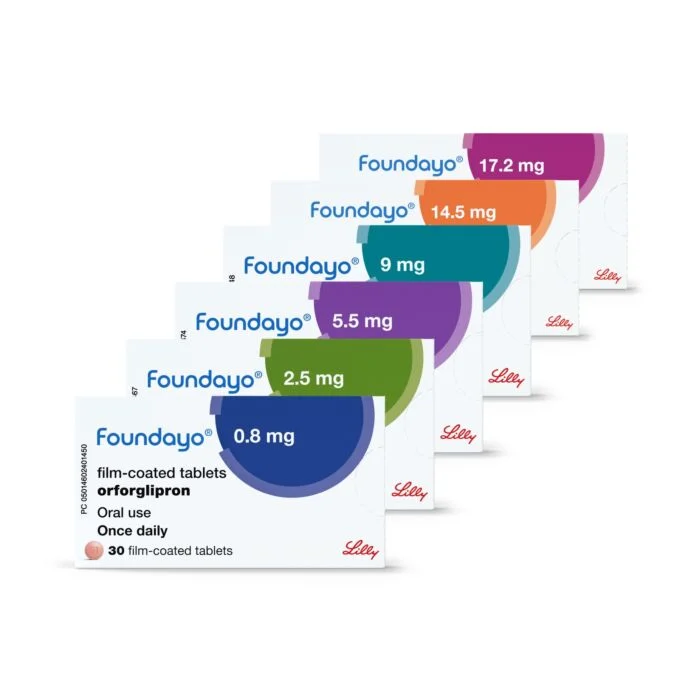
Foundayo (orforglipron) comes in six tablet strengths, and where you end up on that ladder is not simply “as high as possible”. Some people may not need to progress to the maximum dose. Some have a licensed maximum of 9 mg because of another medicine they take. And a lot of what you’ll read online quotes trial doses that don’t exist as UK tablets at all.
Quick verdict
Six strengths: 0.8, 2.5, 5.5, 9, 14.5 and 17.2 mg. You start at 0.8 mg for at least 30 days, move to 2.5 mg for at least 30 days, then 5.5 mg. Increases to 9, 14.5 and 17.2 mg may follow after at least 30 days at each dose, according to response and tolerability.
More is not automatically better. In the trials, average weight reduction rose from 7.8% to 12.4% across the dose range — but so did the rate of gastrointestinal side effects, and so did the number of people stopping because of them.
Your maximum may be 9 mg, not 17.2 mg. Certain common medicines cap the licensed dose, and that’s decided at assessment rather than later.
Never take more than one tablet a day. Two lower-strength tablets are not a substitute for the next strength up.
✍️ Written by Shadeia Younis, Superintendent Pharmacist (GPhC No. 2052119) and the Slinic Clinical Team
Last medically reviewed: 15th August 2026 · Clinical content verified against the UK Summary of Product Characteristics published on the electronic Medicines Compendium, 14 August 2026
About the author
Shadeia Younis is the founder and Superintendent Pharmacist of Slinic (GPhC No. 2052119), with 25 years of clinical pharmacy experience. She has owned and operated community pharmacies in Lancashire since 2008, oversees the clinical governance of Slinic’s prescribing service, and holds SCOPE certification in obesity management. She has been recognised as a finalist or winner across 19 national and European awards spanning healthcare and business.
Pharmacy Premises GPhC No. 1033729 · NHS-Contracted Community Pharmacy · Led by a SCOPE-Certified Pharmacist · LegitScript Certified · UK Doctor & Pharmacist Led · 25+ Years Pharmacy Experience · Fixed 2026 Prices · No Subscription · Monthly Clinical Reviews
Sources used
UK Summary of Product Characteristics for Foundayo (eMC, 14 August 2026) · MHRA authorisation, 10 August 2026 · ATTAIN-1 (Wharton et al, NEJM 2025) · ATTAIN-2 · ATTAIN-MAINTAIN (Aronne et al, Nature Medicine 2026). Full list in the references at the end.
Important
Foundayo (orforglipron) is a prescription-only medicine and carries a black triangle (▼), meaning it is under additional MHRA monitoring — report any suspected side effect through the Yellow Card scheme. This guide is general information and does not replace advice from a qualified healthcare professional.
Your dose is set by your prescriber. Never change your dose, skip steps or take extra tablets based on anything you have read online, including this page. The patient information leaflet supplied with your medicine and your prescriber’s directions take precedence.
The six Foundayo strengths
Foundayo strengths use identifiers G1 to G6. For example, the 17.2 mg tablet is debossed “G6” on one side and “Lilly” on the other. That imprint is how you and your pharmacist confirm which strength you actually have in your hand — useful when the boxes look similar and you are stepping up through the ladder.
| Tablet imprint | Strength | Where it sits |
|---|---|---|
| G1 | 0.8 mg | Licensed starting dose for standard initiation |
| G2 | 2.5 mg | Second step, still titration |
| G3 | 5.5 mg | Lowest strength with published efficacy data |
| G4 | 9 mg | Also the ceiling for certain drug interactions |
| G5 | 14.5 mg | Upper range |
| G6 | 17.2 mg | Maximum licensed daily dose |
The 17.2 mg tablet is described in the SmPC as a greyish purple, modified oval tablet of roughly 12 mm by 6 mm. If what arrives doesn’t match the description or the imprint for the strength on your label, don’t take it — contact the pharmacy that dispensed it.
The licensed titration schedule
The UK SmPC sets out the sequence precisely. The starting dose is 0.8 mg once daily. After at least 30 days, the dose should be increased to 2.5 mg once daily. After at least 30 days on that dose, it can be increased to 5.5 mg. From there, the dose may be increased to the next level — 9 mg, 14.5 mg or 17.2 mg — after at least 30 days at the current dose, based on treatment response and tolerability.
| Step | Dose | Minimum before increasing | Earliest you could reach it |
|---|---|---|---|
| 1 | 0.8 mg | 30 days | Day 1 |
| 2 | 2.5 mg | 30 days | Around month 2 |
| 3 | 5.5 mg | 30 days | Around month 3 |
| 4 | 9 mg | 30 days | Around month 4 |
| 5 | 14.5 mg | 30 days | Around month 5 |
| 6 | 17.2 mg | — | Around month 6 at the earliest |
Thirty days is the minimum interval — later increases depend on response and tolerability
The SmPC states that after at least 30 days the dose should be increased from 0.8 mg to 2.5 mg. From 2.5 mg onward, further increases are not automatic and depend on treatment response and tolerability. So the “earliest you could reach it” column is a floor rather than a schedule, and many people take longer or stop partway up.
What each dose actually delivers
ATTAIN-1 followed 3,127 adults for 72 weeks. Only three dose levels were studied, so there is no published figure for 0.8 mg, 2.5 mg or 14.5 mg — those are titration or intermediate steps rather than separately trialled doses.
| Marketed tablet equivalent | Average weight reduction at 72 weeks | Average kg lost | Reached ≥10% loss |
|---|---|---|---|
| 5.5 mg | 7.8% | 8.0 kg | 35.9% |
| 9 mg | 9.3% | 9.4 kg | 45.1% |
| 17.2 mg | 12.4% | 12.4 kg | 59.6% |
| Placebo | 0.9% | 1.0 kg | 8.6% |
At the maximum dose, 77.1% of participants lost at least 5% of their body weight, 39.6% lost at least 15% and 20.1% lost at least 20%. These are trial averages across a supported population, not a prediction for any individual — the spread in both directions is wide.
The trade-off nobody puts in a table
Weight reduction rises with dose. So does the rate of gastrointestinal side effects, and so does the proportion of people who stop treatment because of them. Both sides of that come from the same SmPC, and you should see them together.
| Marketed tablet equivalent | Average weight reduction | Any GI side effect | Stopped because of GI effects |
|---|---|---|---|
| 5.5 mg | 7.8% | 60.1% | 3.7% |
| 9 mg | 9.3% | 67.4% | 6.3% |
| 17.2 mg | 12.4% | 68.7% | 6.8% |
| Placebo | 0.9% | 36.3% | 0.6% |
Reading it honestly: across the studied doses, greater average weight reduction was accompanied by higher rates of gastrointestinal adverse effects and discontinuation. Where the balance sits is individual, and it is exactly the conversation to have at review rather than deciding by default.
Across the studies, gastrointestinal effects were mostly mild (61.8%) or moderate (34.3%), with 3.9% reporting severe events. They were most frequent during dose escalation and decreased over time.
Unsure whether to step up?
Monthly clinical reviews are included as standard, with direct access to our pharmacy team in between. Staying at your current dose is always a legitimate option.
Start Your Free Assessment →
Free · 2 minutes · Reviewed by an experienced UK-registered doctor or pharmacist prescriber
GPhC Registered Pharmacy No. 1033729 · Completing an assessment does not guarantee approval
Why your maximum might be 9 mg
This is the part of Foundayo dosing that catches people out, and it has nothing to do with how well the medicine is working.
Orforglipron is a substrate of CYP3A4 and CYP2J2, and of P-gp, OATP1B1 and OATP1B3. Certain medicines can substantially increase orforglipron exposure — so the SmPC caps the licensed dose rather than allowing the full ladder.
Your maximum is 9 mg once daily if you take
A strong CYP3A4 inhibitor — ketoconazole, clarithromycin or itraconazole are the named examples. Clarithromycin increased orforglipron exposure 3.5-fold in study.
An OATP1B inhibitor — ciclosporin is the studied example, which increased exposure 2.6-fold.
Some combinations are avoided rather than capped. Ritonavir and telaprevir inhibit both CYP3A4 and OATP1B, and should be avoided alongside orforglipron. Strong CYP3A4 inducers — rifampicin, phenytoin, St John’s wort — work the other way, cutting levels substantially, and should also be avoided. Carbamazepine reduced exposure by 82%, which would largely negate treatment.
Moderate inducers such as bosentan and efavirenz may reduce effectiveness without requiring avoidance — response is monitored and the dose adjusted as needed.
A short course counts too
Clarithromycin is a strong CYP3A4 inhibitor, and the SmPC limits orforglipron to a maximum of 9 mg once daily when the two are co-administered. It is also a common antibiotic, so if a GP or dentist prescribes one part-way through treatment, tell them you take Foundayo and tell your prescriber — this is not only a question about long-term medicines. Do not change your own dose; that is a prescribing decision.
One dose-related interaction runs the other way: the simvastatin dose should be halved when taken with orforglipron, because exposure to its active metabolite rose up to 2.5-fold.
Why you’ll see doses that don’t exist as tablets
Search Foundayo and you will find “36 mg”, “12 mg” and “3 mg” quoted as doses. None of those are UK tablet strengths.
All the phase 3 trials used a hard capsule formulation. The commercial product is a film-coated tablet. The SmPC states plainly that the two forms are not substitutable on a milligram-per-milligram basis, and publishes the equivalence directly.
| Imprint | Marketed tablet | Equivalent trial capsule |
|---|---|---|
| G1 | 0.8 mg | 1 mg |
| G2 | 2.5 mg | 3 mg |
| G3 | 5.5 mg | 6 mg |
| G4 | 9 mg | 12 mg |
| G5 | 14.5 mg | 24 mg |
| G6 | 17.2 mg | 36 mg |
So “36 mg produced 12.4% weight loss” and “the 17.2 mg equivalent produced 12.4% weight loss” describe the same result. If you see 6 mg, 12 mg or 36 mg quoted online, check the publication date: these are the phase 3 capsule doses rather than the marketed UK tablet strengths.
One further difference worth knowing: in the trials, everyone started at the 1 mg capsule and increased every four weeks. The licensed UK schedule uses a minimum of 30 days per step. Similar, but not identical — and it’s the licensed schedule that governs your prescription.
How to take each dose
The instructions are the same at every strength.
- Once daily, at any time of day. It can be taken with or without food and there is no water restriction — unlike the Wegovy pill, there is no fasting window to protect.
- Swallow whole. Tablets should not be broken, crushed or chewed.
- One tablet a day, maximum. The SmPC is explicit that more than one tablet a day should not be taken to achieve the effect of a higher dose.
- Keep it in the original bottle and carton and follow the storage conditions on the packaging.
Two 5.5 mg tablets do not equal one 9 mg tablet
This is worth stating plainly because it is an intuitive assumption and an incorrect one. If you need a higher strength, that is what should be dispensed. Doubling up on a lower strength is outside the licensed dosing and is not how the titration was studied.
If you miss a dose
The UK SmPC is brief on this: if a dose is missed, dosing should be resumed as soon as possible, and more than one tablet should not be taken per day.
Do not double up to compensate for a missed dose. The SmPC does not set an elapsed-time cut-off beyond that.
If you have missed several doses or had a prolonged break, contact your prescriber before restarting. The SmPC does not provide a specific restart schedule following a prolonged interruption, so your treatment should be reviewed individually.
Who needs a different dose — and who doesn’t
A common assumption is that older or heavier people, or those with kidney problems, need adjusted doses. For Foundayo, mostly they don’t.
| Situation | Dose adjustment needed? |
|---|---|
| Age, sex, ethnicity, body weight | No. Only very limited data in people aged 85 and over. |
| Kidney impairment, including end-stage renal disease | No dose adjustment required. |
| Mild or moderate liver impairment | No dose adjustment required. |
| Severe liver impairment | Not recommended. |
| Strong CYP3A4 or OATP1B inhibitor | Yes — maximum 9 mg once daily. |
| Insulin or a sulfonylurea | Not to Foundayo — but a reduction in those doses may be considered, with blood glucose self-monitoring. |
| Under 18 | Safety and efficacy not established; no data available. |
The dose-increase rule that is easy to overlook
If you take the oral contraceptive pill
Orforglipron may reduce the effectiveness of oral hormonal contraceptives. The UK SmPC advises switching to a non-oral method, or adding a barrier method, for 30 days after starting Foundayo and for 30 days after every dose increase.
Because there are five possible increases on the way to 17.2 mg, that is potentially six separate 30-day windows. It is not a one-off precaution at the start, and it is an important part of Foundayo dosing that is easy to overlook.
Planning a pregnancy?
Foundayo should not be used during pregnancy. The UK SmPC advises stopping orforglipron at least three weeks before a planned pregnancy, because of how long it stays in the body. It should not be used while breastfeeding either. If you become pregnant while taking it, stop and contact your prescriber straight away.
Practically: plan the window before the increase rather than afterwards, and if you are stepping up at a reorder, make the connection then rather than a fortnight later. Women of childbearing potential should use effective contraception throughout treatment.
When staying put is the better decision
The licensed schedule allows increases every 30 days. It does not require them. Reasons to hold at your current dose:
- You’re still having side effects. If side effects are still troublesome, increasing the dose may worsen tolerability. Your prescriber may recommend remaining at the current dose until symptoms have settled.
- You’re losing weight at a rate you’re happy with. The appropriate dose balances treatment response with tolerability; reaching 17.2 mg is not an objective in itself.
- You’ve reached your goal. If maintenance is now the objective, that changes what the right dose is — see our guide to weight maintenance.
- Something has changed. A new medicine, a planned pregnancy, an upcoming operation, or a period of illness are all reasons to pause the ladder and review.
- Cost. Price generally scales with dose across this market, so the lowest effective dose has a financial dimension as well as a clinical one.
If you’re coming off an injection
Your Mounjaro or Wegovy dose does not convert into a Foundayo dose. There is no published equivalence between them, and the SmPC does not set out a separate starting point for people transferring from an injectable.
Worth knowing, though: the ATTAIN-MAINTAIN trial did not use the standard 0.8 mg initiation dose for people transitioning off injections. Participants started on a 12 mg investigational capsule, corresponding to the 9 mg marketed tablet, within 14 days of their last injectable dose. That is trial evidence rather than established UK prescribing practice, and your starting dose remains a decision for your prescriber.
Our full guides: switching from Mounjaro to Foundayo and Foundayo for weight maintenance after injections.
Not sure which dose is right for you?
Your starting dose, your ceiling and how quickly you step up all depend on your history and your other medicines. A UK-registered prescriber reviews that individually.
Check Your Eligibility →
Free · 2 minutes · Reviewed by an experienced UK-registered doctor or pharmacist prescriber
GPhC Registered Pharmacy No. 1033729 · No Subscription · Monthly Clinical Reviews Included
Common dosing mistakes
- Doubling up on a lower strength. Two tablets a day is outside the licensed dosing regardless of the arithmetic.
- Judging the medicine at 0.8 mg. That is an introductory dose. The lowest strength with published efficacy data is 5.5 mg.
- Increasing every 30 days as a default. The interval is a minimum, and increases from 5.5 mg are meant to reflect response and tolerability.
- Assuming higher is better. Reaching 17.2 mg is not an objective in itself — side-effect rates and discontinuations rose alongside efficacy across the studied doses.
- Forgetting the contraception window at each increase. It applies every time, not only at the start.
- Not mentioning a short antibiotic course. Clarithromycin is a strong CYP3A4 inhibitor, and the SmPC limits orforglipron to 9 mg once daily when the two are taken together.
- Doubling up after a missed dose. Resume as normal instead.
- Restarting at your old dose after a long break. Tolerance can partly reverse — get it reviewed.
- Comparing your dose to someone else’s. Different ceilings, different tolerances, different goals.
Frequently asked questions
1. What dose does everyone start on?
0.8 mg once daily, for at least 30 days, before increasing to 2.5 mg.
2. What is the maximum Foundayo dose?
17.2 mg once daily. But if you take a strong CYP3A4 inhibitor or an OATP1B inhibitor, your licensed maximum is 9 mg.
3. How long until I reach the maximum dose?
Around six months at the earliest, given five increases at a minimum of 30 days each. Many people take longer, and many never reach it.
4. Do I have to reach 17.2 mg?
No. Increases beyond 2.5 mg are based on treatment response and tolerability, so not everyone needs to progress to the maximum dose.
5. Can I take two smaller tablets instead of one bigger one?
No. The SmPC states that more than one tablet a day should not be taken to achieve the effect of a higher dose.
6. Can I skip a step if I’m tolerating it well?
The licensed sequence moves through each strength in turn. Skipping steps is not how the titration was studied and is not what the SmPC describes.
7. Why do I see 36 mg mentioned?
All the phase 3 trials used capsules. The 36 mg capsule is equivalent to the 17.2 mg tablet. The SmPC states the two forms are not substitutable milligram-for-milligram.
8. What if I miss a dose?
Resume dosing as soon as possible, and never take more than one tablet in a day. Don’t double up to compensate.
9. Does my dose change if I have kidney problems?
No. The SmPC states no dose adjustment is required based on renal function, including end-stage renal disease. Severe liver impairment is different — Foundayo is not recommended there.
10. Does my weight or age change the dose?
No dose adjustment is required based on age, sex, ethnicity or body weight. Only very limited data are available for people aged 85 and over.
11. Do I need extra contraception at every dose increase?
If you use oral hormonal contraception, yes — the SmPC advises a non-oral or barrier method for 30 days after starting and for 30 days after every dose increase.
12. Will side effects come back each time I go up?
Often, briefly. Nausea, vomiting and diarrhoea were more frequent during dose escalation and decreased over time. If they don’t settle, that’s a reason to talk to your prescriber rather than push on.
13. Can I go back down a dose?
That’s a prescriber decision, and a legitimate one. If side effects at a higher dose outweigh the extra benefit, a lower dose may suit you better.
14. What dose would I start on coming off Mounjaro?
There’s no conversion between the two. Your prescriber decides, using the UK product information and your recent treatment history — see our switching guide.
Summary
Six strengths, starting at 0.8 mg, with a minimum of 30 days at each step and a maximum of 17.2 mg once daily. One tablet a day, swallowed whole, at any time, with no food or water restriction.
The two things most worth taking from this page: your licensed maximum may be 9 mg rather than 17.2 mg depending on what else you take, and the contraception precaution applies at every single dose increase rather than only at the start.
And the honest framing on where to aim: greater average weight reduction across the studied doses came alongside higher rates of gastrointestinal effects and discontinuation. The appropriate dose balances treatment response with tolerability; reaching 17.2 mg is not an objective in itself.
Dose reviews included as standard
Slinic is a GPhC-registered, NHS-contracted pharmacy providing clinician-led weight management, with monthly clinical reviews and direct access to our pharmacy team in between.
Start Your Free Assessment →
Free · 2 minutes · Reviewed by an experienced UK-registered doctor or pharmacist prescriber
GPhC Registered Pharmacy No. 1033729 · Completing an assessment does not guarantee approval
Related guides
- Foundayo (Orforglipron) UK — the complete guide to the oral GLP-1 tablet.
- Switching from Mounjaro to Foundayo — what the evidence actually shows.
- Foundayo for Weight Maintenance — keeping weight off after injections.
- Mounjaro UK — costs, eligibility, doses and side effects.
- Wegovy Pill UK — how oral semaglutide compares.
- Weight Loss Injections UK — the full overview of treatment options.
- Slinic Weight Loss Clinic — start an assessment.
References
- Foundayo 17.2 mg film-coated tablets — Summary of Product Characteristics. Eli Lilly and Company Limited. electronic Medicines Compendium, last updated 14 August 2026. medicines.org.uk
- MHRA — UK first in Europe to authorise orforglipron for weight management and type 2 diabetes. GOV.UK, 10 August 2026.
- Wharton S, Aronne LJ, Stefanski A, et al. Orforglipron, an Oral Small-Molecule GLP-1 Receptor Agonist for Obesity Treatment. N Engl J Med. 2025;393(18):1796–1806. doi:10.1056/NEJMoa2511774
- Aronne LJ, Horn DB, le Roux CW, et al. Orforglipron for maintenance of body weight reduction: the double-blind, randomized phase 3b ATTAIN-MAINTAIN trial. Nature Medicine. 2026;32(7):2679–2687. doi:10.1038/s41591-026-04386-7
- MHRA Yellow Card scheme — report suspected side effects. yellowcard.mhra.gov.uk