

Why Am I Not Losing Weight on 2.5mg of Mounjaro?
You’re three weeks in. The injections are on schedule. The scale hasn’t moved. And that quiet thought has started: what if this doesn’t work for me? Before that thought goes any further, read what Shadeia Younis, Superintendent Pharmacist at Slinic, tells every patient before their first dose.

Clinically reviewed by
Shadeia Younis, Superintendent Pharmacist (GPhC 2052119)
The 2.5mg dose of Mounjaro is a starting dose for body adjustment, not a therapeutic weight loss dose. It is taken for four weeks only. The SURMOUNT-1 trial that proved Mounjaro’s results studied patients at 5mg, 10mg, and 15mg – not 2.5mg. For most patients, meaningful weight loss begins when the dose increases to 5mg at week five. Not losing weight on 2.5mg is normal and clinically expected.
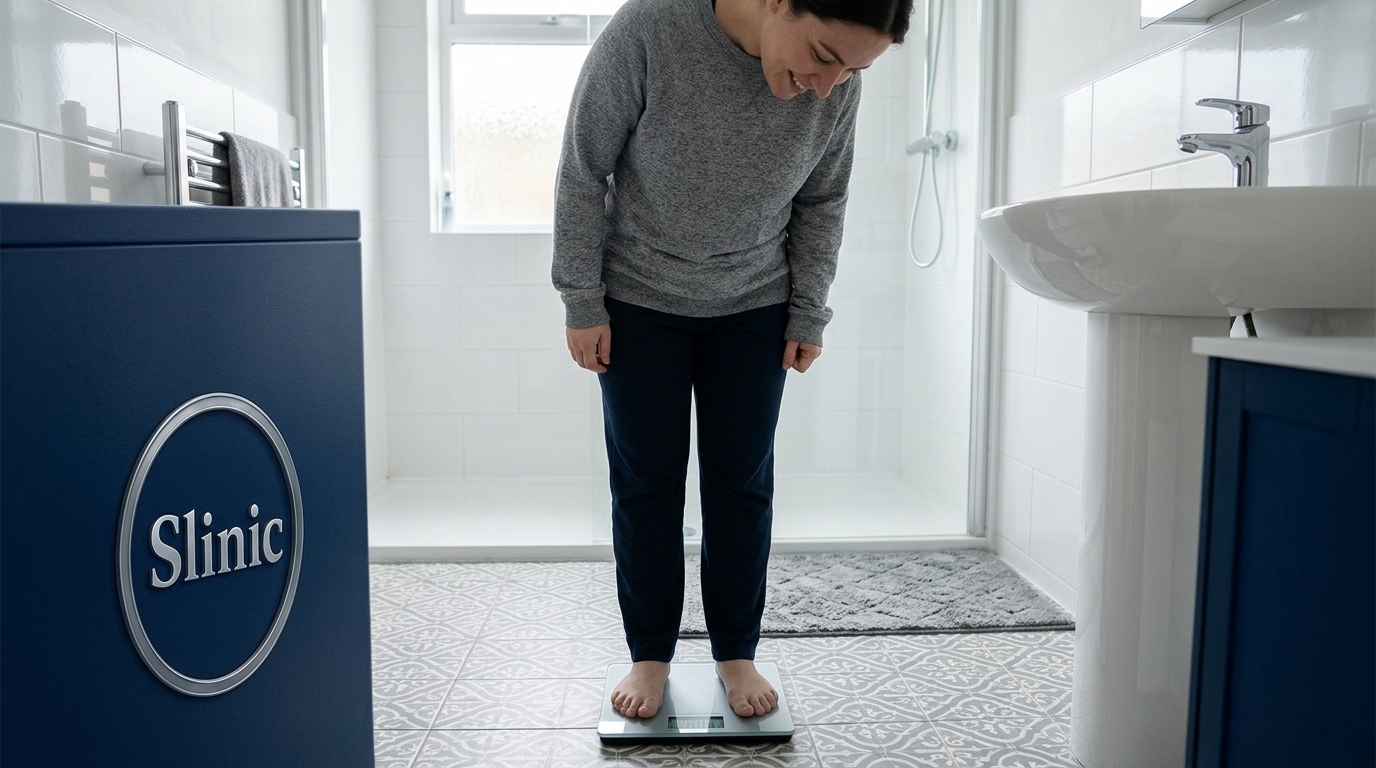
You started Mounjaro with a clear head and a plan. You’ve done the weekly injections on schedule. You’ve read enough about the medication to understand the basics. And for three or four weeks now, the scale has not moved in any meaningful way. Maybe it’s dropped a kilogram. Maybe it hasn’t shifted at all.
The thought arrives: is this working? Am I doing something wrong? You’ve seen other people post about losing half a stone in their first month. You’ve read forum threads about dramatic early results. None of it matches what you’re experiencing, and your provider hasn’t said much to make you feel better about it.
Here is what should have been explained before your first injection: the 2.5mg dose of Mounjaro is not designed to produce significant weight loss. It is a titration dose — a deliberate, low starting point that gives your body four weeks to adjust before the treatment moves to a level where the clinical effects become meaningful. If the scale hasn’t moved on 2.5mg, that is not Mounjaro failing. It is a gap in how the medication was explained to you.
Shadeia Younis, Superintendent Pharmacist at Slinic (GPhC 2052119), leads Slinic’s clinical prescribing for tirzepatide and semaglutide weight loss treatments. She has overseen hundreds of patients through the Mounjaro titration process and is direct about this point: you are not in the treatment phase yet. You are in the preparation phase. And that distinction changes how the first month should be understood.
Key Points at a Glance
- 2.5mg is the adjustment dose, taken for weeks 1-4 only. It is not a weight loss dose and was never intended to be
- The SURMOUNT-1 clinical trial studied weight loss at 5mg, 10mg, and 15mg. There is no published weight loss data for 2.5mg
- After four weeks on 2.5mg, the dose increases to 5mg – the first dose where meaningful weight loss typically begins
- Some patients lose a small amount on 2.5mg. Many do not. Neither outcome predicts how you’ll respond at therapeutic doses
- Your body is adjusting during weeks 1-4 in ways the scale cannot show: appetite signalling, gastric emptying, and hormonal response are all changing
What’s Covered in This Article
- What the 2.5mg dose is actually for
- Why weight loss isn’t expected at this dose
- What is happening in your body right now
- When Mounjaro starts working for weight loss
- Factors that affect early progress
- Questions people search for about Mounjaro 2.5mg
- Clinical results at therapeutic doses
- How Slinic supports patients through escalation
- Frequently asked questions

What the Mounjaro 2.5mg Starting Dose Is Actually For
The Mounjaro prescribing guidance is clear on this point. The 2.5mg dose is the starting dose. Taken for four weeks. Its purpose is adjustment, not weight loss.
Tirzepatide is a dual GIP/GLP-1 receptor agonist – the first approved medication to activate both GIP and GLP-1 receptors at the same time. This dual action is what gives it a clinical advantage over single-pathway GLP-1 treatments like semaglutide. But it is also new to your body’s hormonal signalling system. Starting at a low dose gives your system time to adapt before the treatment moves to a level where those effects become therapeutically significant.
Under Shadeia Younis’s clinical model at Slinic, the escalation schedule is treated as a precision protocol, not a formality. Each step exists because the one before it made the next one tolerable. This is the first thing she covers at consultation – not something a patient should have to piece together from forums three weeks later.
This approach is standard across GLP-1 and dual agonist medications. Wegovy starts at 0.25mg for the same reason. The medication is introduced gradually because starting at a therapeutic dose from week one would dramatically increase the likelihood of that cause patients to abandon treatment before it has had a chance to work.
What the Mounjaro Summary of Product Characteristics States
The MHRA-approved Mounjaro SPC is explicit: 2.5mg is the starting dose for treatment initiation and is not intended for ongoing maintenance treatment. After four weeks, the dose increases to 5mg. The language is deliberate. The 2.5mg period is a clinical protocol, not a trial of the medication’s effectiveness.
The Mounjaro Dosage Schedule UK
Understanding the full titration schedule makes the 2.5mg period much easier to place in context. The dose increases by 2.5mg every four weeks:
| Period | Dose | Purpose | Monthly Price (Slinic) |
|---|---|---|---|
| Weeks 1-4 | 2.5mg | Starting dose – body adjustment. Not a weight loss dose | £129 |
| Weeks 5-8 | 5mg | First maintenance dose – therapeutic weight loss begins | £155 |
| Weeks 9-12 | 7.5mg | Dose increase if needed and tolerated | £206 |
| Weeks 13-16 | 10mg | Dose increase if needed and tolerated | £230 |
| Weeks 17-20 | 12.5mg | Dose increase if needed and tolerated | £247 |
| Week 21+ | 15mg | Maximum dose – long-term maintenance | £267 |
The escalation period can take up to 20 weeks to reach the maximum dose. Patients can remain at lower doses for longer if side effects make escalation difficult. In Shadeia Younis’s clinical approach, this is not a setback – it is precision dosing. The goal is the right dose for the patient at the right time, not the fastest possible route to 15mg. Patients who rush escalation and stop treatment because of side effects achieve nothing. Patients who escalate at the right pace reach therapeutic doses and sustain them. For more detail on the full titration timeline, read our complete guide to the Mounjaro dosage schedule UK.
Thinking About Starting Mounjaro?
The Slinic consultation takes around three minutes, and a pharmacist reviews your information within 24 hours. Pricing is transparent from your very first dose.
Start Your Confidential ConsultationWhy Weight Loss Isn’t Expected on Mounjaro 2.5mg
The SURMOUNT-1 trial is the pivotal study behind Mounjaro’s approval for weight management. Published in the New England Journal of Medicine in 2022, it studied 2,539 adults over 72 weeks, randomised to tirzepatide at 5mg, 10mg, or 15mg, or placebo. Those three doses produced average weight loss of 15.0%, 19.5%, and 22.5% respectively.
Notice that 2.5mg is absent from that data. It is not an oversight. The trial was designed around the doses at which tirzepatide produces clinically significant weight loss. The 2.5mg dose is the entry point into treatment – the ramp, not the road.
At 2.5mg, the pharmacological effect is present but sub-therapeutic for weight reduction. GIP and GLP-1 receptor activation is beginning, but the body has not yet reached the hormonal state where appetite suppression becomes consistent – where eating less feels like a natural response rather than a willed effort. That shift happens as the dose increases. It accumulates over weeks at therapeutic levels, not over days at the starting dose.
This is the distinction that Shadeia Younis, who designed Slinic’s tirzepatide prescribing protocol, draws for patients early: the question is not whether 2.5mg is “working.” It is whether the adjustment phase is progressing as expected. For most patients, it is.
Why Forum Stories About First-Month Weight Loss Are Misleading
You will find plenty of accounts online from people who lost 5, 6, even 8 pounds in their first month on Mounjaro. Some reflect early responders who experience appetite suppression even at 2.5mg. Some reflect initial water weight changes. Some reflect dietary restriction that would have produced results with or without the medication. None of them are a reliable benchmark for weeks 1-4. The clinical evidence base was built on therapeutic dose data. Forum anecdotes were not. The difference matters most when a patient not losing weight on Mounjaro 2.5mg reads those stories and stops treatment that would have worked.
Some Patients Do Lose Weight on 2.5mg
Individual response to tirzepatide varies. Some patients notice appetite suppression even at 2.5mg and lose a small amount of weight in the first four weeks. Others see nothing on the scale until 5mg or 7.5mg. Both outcomes are within normal range. The absence of early weight loss does not predict a poor response at therapeutic doses. And the presence of early weight loss does not mean dose escalation can be skipped – the schedule exists for clinical reasons that apply regardless of individual early response.
For most patients, the real trajectory begins at 5mg. The 2.5mg period is context, not conclusion.

What Is Happening in Your Body Right Now
The scale is not the only measure of what is happening during weeks 1-4. Whilst the dose is not yet at a level that produces consistent weight loss, the medication is not doing nothing. Several physiological changes are underway.
Appetite Signalling Is Changing
Tirzepatide activates GIP and GLP-1 receptors that regulate hunger, fullness, and food reward. Even at 2.5mg, some degree of receptor activation is occurring. Some patients notice a subtle shift in their relationship with food during the first month – meals feel slightly more satisfying, cravings are marginally quieter – without those changes being strong enough to move the scale. This is the medication beginning its work, not completing it.
Gastric Emptying Is Slowing
GLP-1 receptor agonism slows gastric emptying – food stays in the stomach longer, which extends the feeling of fullness after eating. This is one of the key mechanisms through which Mounjaro reduces appetite at therapeutic doses. At 2.5mg, this effect is present but mild. It is also the main reason some patients experience nausea during the first four weeks.
Shadeia Younis, who has guided hundreds of patients through the early weeks of tirzepatide treatment, notes that nausea at the starting dose is frequently misread as a sign that the medication does not suit the patient. In her clinical view, it is the opposite: evidence that the GLP-1 receptor pathway is responding. The body is adjusting. That adjustment is necessary. If nausea is a concern, our guide to Mounjaro nausea covers what helps and when it typically passes.
Your Body Is Building Tolerance for Higher Doses
The gradual dose escalation serves a protective function. It gives your gastrointestinal system time to adapt to tirzepatide’s mechanisms so that, when the dose reaches therapeutic levels, the side effects are manageable rather than overwhelming. Patients who complete the adjustment period as directed are significantly less likely to experience the kind of disruptive side effects that interrupt treatment at higher doses.
Hormonal Adaptation Is Underway
Tirzepatide’s dual mechanism affects multiple hormonal pathways beyond appetite alone. Insulin sensitivity, glucagon response, and gut hormone signalling are all beginning to shift during the 2.5mg period. These changes are not visible on a scale, but they are laying the groundwork for the metabolic changes that drive weight loss at higher doses. The 2.5mg period is building the physiological foundation that therapeutic doses will build upon.
The 2.5mg Dose Has One Job
It is not to make the scale move. It is to ensure your body can handle what comes next. Four weeks without significant weight loss is not a failed month of treatment. It is a month of preparation that determines how well every subsequent dose will work. Stopping at this point would mean walking away from a treatment before the therapeutic phase has even started.

When Does Mounjaro Start Working? The 5mg Transition
The transition to 5mg at week five is where the clinical picture changes. This is the first maintenance dose – the level at which tirzepatide shifts from adjustment protocol to active weight management. For many patients, it is the week when what they have read about Mounjaro starts to match what they are feeling.
What Changes at 5mg
At 5mg, the most consistently reported change is a reduction in the background noise of appetite. Hunger between meals becomes less insistent. Portion sizes naturally reduce without requiring conscious effort. The pull towards high-calorie foods – which many patients describe as a persistent, low-grade craving – quietens. This is the dual GIP/GLP-1 mechanism working at a level where its clinical effects become tangible.
Some patients experience mild nausea when the dose increases from 2.5mg to 5mg. This is expected and typically resolves within a week or two. If nausea is significant, the clinical response under Shadeia Younis’s prescribing protocol at Slinic is to hold at 5mg for longer before escalating further. Not to stop treatment. Staying at a lower dose until tolerance is established protects long-term outcomes. It is why she designed Slinic’s approach around individualised dose management rather than rigid automatic schedules.
Weight Loss Is Not Linear
Even at therapeutic doses, weight loss does not follow a neat downward line. Patients often see faster loss in the early weeks at a new dose, followed by a slower rate as the body adapts. Water retention, hormonal fluctuations, changes in muscle mass alongside fat loss, and the timing of weigh-ins can all affect what the scale shows on any given day. Weekly weigh-ins at the same time and under the same conditions give a much clearer picture than daily checks.
Real Patient Experience
“Slinic isn’t just a weight-loss clinic – it’s a professional, pharmacist-led healthcare service that puts patient wellbeing first while delivering real, measurable results. I’ve been with Slinic for 3 months and have already lost 11 kg. At the beginning of my treatment, I experienced some minor side effects such as nausea. The pharmacist was excellent – they took the time to explain how to reduce these effects and adjusted my treatment to keep me comfortable. My dose was kept at 5 mg until I fully adjusted, which made all the difference. I felt safe, supported, and well-informed throughout. Thanks to the team’s professional care and guidance, I’ve been able to stay consistent and achieve amazing progress.”
– Caroline Slater, 11kg lost in 3 months
Caroline’s experience reflects a clinical judgment that matters more than most patients realise: the decision to hold at 5mg rather than escalate on schedule. That call was made by Shadeia Younis based on Caroline’s side effect history, her adjustment timeline, and her individual physiology. It is the kind of decision that cannot come from an automated renewal system or a prescriber reviewing a case for the first time. It requires a pharmacist who has been present from the start – and it is the difference between a dose increase that works and one that causes a patient to quit treatment before reaching the results the medication is capable of producing.
Other Factors That Affect Early Progress on Mounjaro
The dose is the primary answer for patients at 2.5mg. But for patients who have moved to therapeutic doses and are still not seeing the results they expected, there are several clinical factors worth examining.
Injection Technique and Site Rotation
Mounjaro is a subcutaneous injection – administered into the fatty tissue under the skin, typically in the abdomen, thigh, or upper arm. Injecting into muscle rather than fat, or consistently using the same injection site, can affect how the medication is absorbed. Rotating sites and ensuring the injection is subcutaneous are both clinically important and often not explained in enough detail at the start of treatment.
Dietary Patterns During Early Treatment
In the first weeks, some patients find that mild nausea suppresses appetite temporarily but that this is partially offset by eating more comforting or calorie-dense foods when appetite returns. This is not a character failing. It is a predictable response to an unfamiliar medication. If nausea was a feature of your first four weeks, it is worth reviewing whether dietary choices reflected consistent changes or not.
Water Retention and Body Composition
Fat loss and scale weight are not the same thing. A patient who is losing fat whilst retaining water – which can happen due to dietary sodium intake, hormonal variation, and other factors – may see very little scale movement even when their body composition is changing. Some patients notice their clothes feel different before the scale reflects it. Both are valid measures of progress.
How and When You Weigh Yourself
Body weight fluctuates by as much as 2-3kg between morning and evening, depending on food and fluid intake. Daily weigh-ins capture this noise rather than the underlying trend. A consistent weekly weigh-in, at the same time of day and under similar conditions, gives a far more accurate picture.
Why Clinical Support Matters Here
Patients without ongoing pharmacist oversight are more likely to misinterpret early progress – and more likely to stop treatment based on that misinterpretation. That is the real risk. Not that Mounjaro doesn’t work, but that a correctable issue goes unreviewed and a patient walks away from a treatment that would have worked at a higher dose or with a small adjustment. At Slinic, Shadeia Younis reviews these factors with patients proactively. If you are in your first month of Mounjaro and unsure whether what you are experiencing is normal, a pharmacist who knows your history can answer that in a single conversation.

Questions People Are Searching About Mounjaro 2.5mg
These are the questions patients type into Google when the first few weeks of treatment do not match their expectations. Each one has a clinical answer.
Why is Mounjaro 2.5mg not working?
It is working – as an adjustment dose. The 2.5mg dose prepares your body for the therapeutic doses (5mg and above) where weight loss begins. The SURMOUNT-1 trial did not include a 2.5mg treatment arm because it is a titration dose, not a maintenance dose.
Should I have lost weight in my first month on Mounjaro?
Not necessarily. The first month covers the 2.5mg adjustment period. Some patients notice small changes; many do not. Neither outcome is a reliable indicator of how you will respond once the dose reaches therapeutic levels from week five onwards.
Am I a Mounjaro non-responder?
Not based on your experience at 2.5mg. Non-response is a clinical assessment made after at least six months at the highest tolerated dose. NICE TA1026 sets the benchmark at 5% weight loss over that period. Four weeks at a starting dose is far too early to draw any conclusions about your long-term response.
Does 2.5mg of Mounjaro do anything at all?
Yes. GIP and GLP-1 receptors are being activated. Some patients notice subtle appetite changes or mild nausea – both signs the medication is pharmacologically active. The effect is sub-therapeutic for weight loss, but it is establishing the physiological foundation for therapeutic doses.
Mounjaro not working first month – is this normal?
Yes. The clinical trial data that established Mounjaro’s weight loss results was measured at therapeutic doses over 72 weeks. Evaluating the medication after four weeks at the starting dose is measuring the wrong thing at the wrong time. The treatment has not reached its active phase yet.
What Mounjaro Weight Loss Looks Like at Therapeutic Doses
Once you reach a therapeutic dose and the medication has had time to work at that level, the results from clinical trial data are substantial. These numbers apply to patients on Mounjaro as a treatment – not patients in their first four weeks on a starting dose.
SURMOUNT-1 Trial Results at 72 Weeks
The SURMOUNT-1 trial (NEJM 2022, Jastreboff et al.) studied 2,539 adults with BMI 30+ (or 27+ with a weight-related comorbidity) over 72 weeks. All groups received lifestyle intervention alongside the medication.
| Dose | Mean Weight Loss | % Losing 10%+ | % Losing 20%+ |
|---|---|---|---|
| 5mg | 15.0% | Majority of participants | Approx. 1 in 3 |
| 10mg | 19.5% | Large majority | Approx. half |
| 15mg | 22.5% | 90% of participants | 63% of participants |
| Placebo | 3.1% | 14% of participants | 1.3% of participants |
Source: SURMOUNT-1, NEJM 2022, Jastreboff et al. Results at 72 weeks. Verified March 2026.
At 5mg – the dose you will reach after four weeks on 2.5mg – the average weight loss over the study period was 15.0%, compared to 3.1% for placebo. At 15mg, 91% of participants lost 5% or more of their body weight, and 63% lost 20% or more.
The SURMOUNT-5 trial, published in the NEJM in 2025, directly compared tirzepatide with semaglutide (the active ingredient in Wegovy). Over 72 weeks at maximum tolerated doses, tirzepatide achieved a mean weight loss of 20.2%, compared to 13.7% for semaglutide. The difference was statistically significant.
These Results Were Measured in Months, Not Weeks
The SURMOUNT-1 trial measured outcomes at 72 weeks – about eighteen months. Weight loss continued to build throughout the treatment period. NICE TA1026 does not set the effectiveness review until six months on the highest tolerated dose. The patients who achieved the results above did so by staying on treatment through the early weeks when the scale said very little. That patience is part of the protocol, not a test of willpower.

How Slinic Supports Patients Through the Escalation Period
The weeks 1-4 concern – Mounjaro not working in the first month – is one of the most predictable moments in early treatment. It is also one of the most preventable, if the right information is given before treatment starts rather than after the worry has set in.
At Slinic, every patient receives clinical context on the escalation period from the start. What the starting dose is designed to do, what to expect at each increase, and when weight loss is most likely to become noticeable. That is not a written handout sent once and forgotten. It is a clinical relationship that continues through every dose change, every check-in, and every question that arises along the way.
Shadeia Younis
Superintendent Pharmacist, Slinic (GPhC 2052119)
Shadeia built Slinic’s weight loss prescribing model around a principle that most online providers overlook: clinical oversight does not end at the point of prescription. It is most valuable in the weeks after, when patients are adjusting, questioning, and deciding whether to continue. The early titration period is where patients are most vulnerable to abandoning treatment that would have worked – and it is where the quality of clinical support matters most.
What Pharmacist-Led Support Includes at Slinic
Pre-Treatment Briefing
Before the first pen arrives, patients receive clear information on what each dose period is designed to do and when weight loss is most likely to become noticeable. The 2.5mg concern is answered before it becomes a concern.
Dose Escalation Oversight
Each dose increase is managed with clinical input from Shadeia Younis and the Slinic pharmacist team. If side effects make escalation difficult, the decision to hold at a lower dose is made clinically – not by default, and not alone.
Ongoing Clinical Access
Questions about slow early progress, nausea, injection technique, and what to expect at the next dose are part of the clinical relationship. Patients have direct access to pharmacist guidance at every stage, not only at the point of prescription.
Six-Month Effectiveness Review
NICE TA1026 recommends a formal review at six months. At Slinic, that review is conducted by Shadeia Younis, who knows your escalation history and the context behind your progress – not a clinician reading your notes for the first time.
Transparent Pricing From Day One
Patients can see the cost of each dose level before they start treatment. No hidden consultation fees. No surprise charges as the dose increases. Long-term treatment planning is financially predictable.
Frequently Asked Questions
Because 2.5mg is the starting dose for body adjustment, not a therapeutic weight loss dose. The SURMOUNT-1 trial studied weight loss at 5mg, 10mg, and 15mg – the 2.5mg dose was not included as a treatment arm. Some patients do notice small changes at 2.5mg, and some notice nothing. Neither outcome predicts your response at therapeutic doses. The medication has not reached its active phase yet.
Most patients begin to notice meaningful appetite suppression when the dose increases to 5mg at week five. Weight loss typically becomes more visible over the following weeks as the body adjusts to the therapeutic dose. The full effect builds over months – SURMOUNT-1 measured results at 72 weeks, and weight loss continued to improve throughout. Expecting significant results in week three or four sets an unfair benchmark the medication was never designed to meet at that dose.
Not necessarily. The first month is spent on the 2.5mg starting dose, which exists for body adjustment. The absence of weight loss during weeks 1-4 is clinically expected. Some patients do experience mild appetite changes or lose a small amount, but this is not guaranteed and is not the purpose of the starting dose. The purpose is to prepare your body for the therapeutic doses that follow.
No. Starting at a higher dose is not clinically recommended and is not standard prescribing practice in the UK. The 2.5mg period serves a protective function: it reduces the likelihood of significant gastrointestinal side effects when the dose moves to therapeutic levels. Patients who skip or rush the starting dose are more likely to experience nausea and discomfort that disrupts treatment. The four weeks on 2.5mg protect your results at higher doses.
At 5mg, meaningful weight loss is expected over time – but “over time” is weeks and months, not days. If you have been at 5mg for four to six weeks and are seeing no change, it is worth raising with your pharmacist. Factors to review include injection technique and site rotation, dietary patterns, and whether the dose needs to increase to 7.5mg. The dose can be increased by 2.5mg every four weeks up to 15mg maximum. At Slinic, Shadeia Younis reviews these factors with patients as part of their ongoing treatment.
It is far too early to consider non-response if you are still on 2.5mg. True non-response can only be assessed after at least six months at the highest tolerated dose. NICE TA1026 sets the benchmark at a minimum of 5% weight loss after six months on the maximum tolerated dose. Most patients who reach therapeutic doses and remain on treatment respond to tirzepatide. The concern is understandable, but the clinical answer is clear: four weeks on a starting dose is not enough time to determine response.
No. Nausea at 2.5mg is caused by GLP-1 receptor activation slowing gastric emptying. It is evidence that the medication is active in your system. It typically improves within a week or two as the body adapts. Eating smaller meals, avoiding fatty or fried foods, and staying well hydrated can help. If nausea is significant, contact your pharmacist – there is clinical guidance available, and the dose does not need to be abandoned. Shadeia Younis notes that nausea at the starting dose is the medication doing its job, not a sign it is wrong for you.
Mounjaro starts at 2.5mg once weekly for four weeks (body adjustment), then increases to 5mg (first maintenance dose). The dose can increase by 2.5mg every four weeks: 7.5mg, 10mg, 12.5mg, and up to the maximum of 15mg. Recommended maintenance doses are 5mg, 10mg, and 15mg. Patients can stay at any dose for longer if side effects require more time for adjustment. The full escalation to maximum dose takes up to 20 weeks.
Mounjaro is prescribed alongside a reduced-calorie diet and increased physical activity. During the 2.5mg period, the appetite suppression from the medication may not be strong enough to naturally reduce how much you eat. This is not the time to wait for the medication to do the work alone. It is the time to build habits that the medication will support more powerfully as the dose increases. At Slinic, dietary guidance is part of the ongoing clinical support, not a separate exercise.
Based on SURMOUNT-1 trial data at 72 weeks: average weight loss was 15.0% at 5mg, 19.5% at 10mg, and 22.5% at 15mg (versus 3.1% for placebo). At the 15mg dose, 91% of participants achieved 5% or more weight loss, and 63% achieved 20% or more. These are averages across a large trial population – individual results vary. The key point is that these results reflect months of treatment at therapeutic doses, not weeks at the starting dose.
In all likelihood, nothing. Forum accounts overrepresent dramatic early results because those are the stories people share. Some reflect genuine outliers, some reflect initial water weight loss, and some reflect caloric restriction that would produce results with or without the medication. None of them set a standard your body is obligated to match. Your response to Mounjaro will be your own, and it will reveal itself over weeks and months at therapeutic doses. Clinical data, not forum anecdotes, is the reliable benchmark.
Yes, and this is where Slinic’s model is different. Shadeia Younis and the clinical team are available throughout your treatment, not only at the point of prescription. If you are a few weeks in, nothing on the scale, and wondering whether to continue: speak to your pharmacist before making that decision. Stopping treatment based on a misunderstanding of the starting dose is the outcome Slinic’s clinical model is designed to prevent. A single conversation with a pharmacist who knows your treatment can make the difference between abandoning something that was about to work and staying on track through to results.
The Biggest Mistake Is Stopping Before the Treatment Has Started
If you are three weeks in with nothing on the scale, you are not failing. You are exactly where the prescribing guidance says you should be. The question is not whether Mounjaro works – the clinical data answers that clearly. The question is whether you have the right support to get through the early weeks and into the phase where those results become yours. At Slinic, Shadeia Younis and the clinical team are available from your first pen to your first milestone – and every dose change in between. The online consultation takes around three minutes.
Complete Our Online Consultation
Related Guides From Slinic
- Mounjaro dosing schedule UK: 2.5mg to 15mg explained – The full escalation timeline, what each dose is for, and what to expect at every stage.
- Starting Mounjaro: What to Expect in Your First Month – Week-by-week experience from the first injection through the dose increase at week five.
- How long does Mounjaro take to work? – Realistic timelines for when weight loss becomes noticeable, dose by dose.
- How Long Can You Stay on Mounjaro? – What NICE TA1026 says about treatment duration and long-term results.
- Managing Mounjaro Side Effects: Practical Solutions – What to do about nausea, constipation, and other side effects during dose escalation.
- Complete our online consultation – Start your Mounjaro treatment with Slinic. Takes around three minutes. No GP referral needed.
Medical References and Guidance
Clinical data in this article is based on NICE Technology Appraisal TA1026 (tirzepatide for weight management, published December 2024), the SURMOUNT-1 clinical trial (NEJM 2022, Jastreboff et al.), SURMOUNT-5 head-to-head trial (NEJM 2025, Aronne et al.), and the MHRA-approved Mounjaro Summary of Product Characteristics. Dosing information is verified against current BNF guidance. All medical facts verified against MHRA, NICE, NHS, and BNF sources. Pricing correct at April 2026.
Related Blog Posts From Slinic
Mounjaro 5mg Results: What to Expect Before Moving Up – what 5mg typically delivers and how to know you’re ready to move up from it.
How to Break a Mounjaro Weight Loss Plateau – clinician-led strategies for getting progress moving again when the scale stalls.
Feeling Discouraged with Weight Loss Progress? – reassurance and practical strategies for when early progress feels slower than you hoped.