

Restarting Mounjaro After a Break: Missed Doses and Next Steps
Written by Shadeia Younis, Superintendent Pharmacist | Last updated 19 July 2026
About the Author: Written and clinically approved by Shadeia Younis, Independent Prescribing Pharmacist and Superintendent Pharmacist. Learn more about Slinic.
Stopping Mounjaro is common — because of a missed delivery, surgery, side effects, cost or another reason. If you’ve only missed a single injection, see our Missed Mounjaro Dose Guide. This article focuses on restarting treatment after a longer break, as well as explaining the official four-day missed-dose rule.
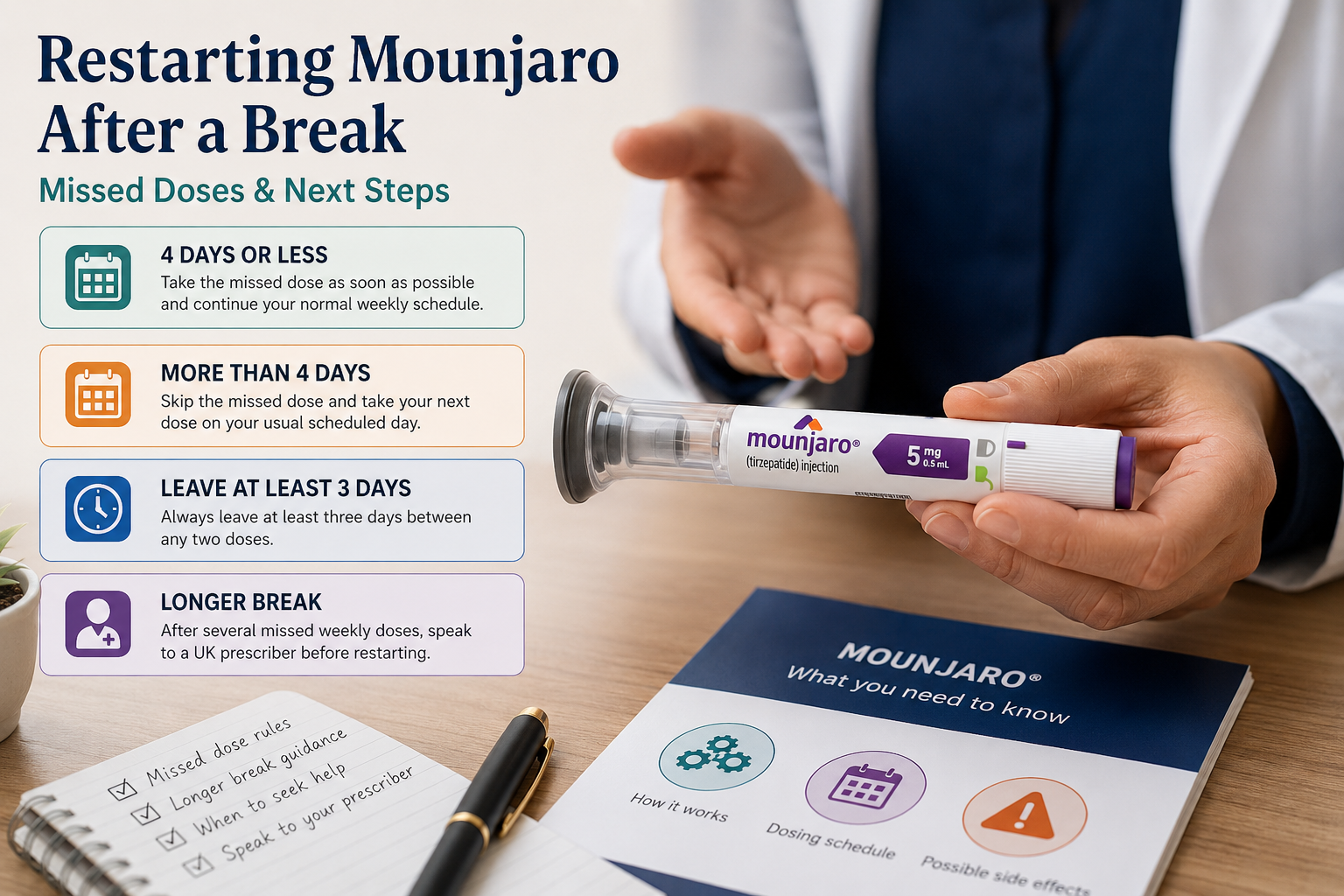
In short: If one Mounjaro dose is missed, take it as soon as possible if four days or less have passed. If more than four days have passed, skip it and take your next dose on your usual scheduled day. Leave at least three days between doses. After several missed weekly doses, do not automatically resume your previous dose; contact your prescriber for an individual assessment before restarting.
Unsure what to do after your break? A UK prescriber can review your situation.
Can you restart Mounjaro after a break?
In many cases, yes — but restarting after anything more than a single missed dose is a clinical decision, not a case of simply picking up your last dose. Tirzepatide has an elimination half-life of approximately five days, so the amount present in the body decreases gradually after the last dose. The UK product information does not set a universal restart dose according to the number of weeks missed. After several missed doses, the prescriber should consider the reason for stopping, previous dose, treatment response, adverse effects and current health. NICE specifically lists these individual factors when considering whether and how to restart tirzepatide.
📋 Worked example: the 96-hour rule
- Remember within 96 hours of your usual injection time? Take the missed dose as soon as possible, then continue your normal weekly schedule.
- More than 96 hours have passed? Skip the missed dose and wait until your next scheduled day.
- Leave at least three days between any two doses.
What to do if you miss one weekly dose
If four days or less have passed since your scheduled injection day, take the missed dose as soon as possible. You can then continue with your usual once-weekly schedule, provided there are at least three days between two doses. If more than four days have passed, skip the missed dose entirely and take your next dose on your usual scheduled day. This instruction covers a single missed dose only; it does not extend to prolonged interruptions of several weeks or more, which are covered below.
How a Mounjaro restart is assessed after a longer break
NICE’s guidance on prescribing, reviewing and stopping tirzepatide sets out the factors a prescriber should weigh when someone wants to restart, rather than a single fixed schedule:
- Why treatment was stopped
- Whether pancreatitis was suspected or confirmed
- Whether other adverse effects occurred, and how significant they were
- Previous weight-loss response to treatment
- How long treatment was taken for, and the highest dose reached
- Engagement with diet and lifestyle measures during previous treatment
- Whether a slower dose titration is appropriate this time
| Situation | What to do |
|---|---|
| One dose missed, four days or less passed | Take it as soon as possible. Continue the usual once-weekly schedule, provided there are at least three days between two doses. |
| More than four days have passed | Skip the missed dose and take the next dose on the usual day. |
| More than one weekly dose missed | Contact the prescriber before restarting. Do not automatically resume the previous dose. |
| Treatment stopped because of side effects | The symptoms and previous dose should be clinically reviewed before restarting. |
| Recent illness, dehydration, admission or surgery | Restart timing should be agreed with the relevant clinical team. |
| Suspected pancreatitis | Stop treatment and obtain urgent medical assessment. |
| Confirmed pancreatitis | Tirzepatide must not be restarted. |
This reflects the official UK missed-dose instruction (take within four days, otherwise skip, leave at least three days between doses) plus the individual factors NICE sets out for a longer break. It is general information, not a substitute for your own assessment.
Resuming a dose that is no longer well tolerated may increase the likelihood of gastrointestinal adverse effects such as nausea, vomiting and diarrhoea. This is why patients should not select their own restart dose after a prolonged interruption.
Not sure which situation applies to you? A UK prescriber can review your break length and health history and confirm the right next step.
Can you restart if your BMI is now lower?
Your current BMI is only one part of a restart assessment. A prescriber will also consider your starting BMI, previous treatment response, weight history, relevant health conditions, and evidence that you previously received treatment legitimately. Having used Mounjaro before does not automatically mean treatment can restart — a new clinical assessment is required to confirm it remains suitable.
What evidence may be needed before restarting?
| Evidence type | Why it’s requested |
|---|---|
| Photo of dispensing label or pen box | Confirms the medicine and dose previously supplied |
| Order confirmation or prescription record | Verifies treatment history |
| Date of last injection | Informs the individual assessment |
| Previous side-effect history | Informs titration pace on restart |
| Current weight and recent history | Confirms continued clinical suitability |
Requirements can differ between providers.
Can you change provider when restarting?
Yes. You don’t have to restart with the pharmacy that issued your previous prescription. See our guide on switching to Slinic from another weight loss provider for the full process. Changing provider doesn’t bypass a clinical assessment — the new prescriber must independently confirm treatment remains suitable and agree the right restart dose with you.
Switching provider to restart? See what information you may need and how the switching process works.
Restarting after side effects
Stopping because of nausea, vomiting, diarrhoea or another adverse effect does not necessarily mean treatment can never be restarted. The severity, duration and possible cause of the symptoms should first be assessed. Depending on the circumstances, a prescriber may delay treatment, use a different dose, consider slower titration, or recommend stopping treatment. NICE advises not increasing the dose until adverse effects have resolved or become tolerable, and says dose reduction may be considered if they do not resolve. See our full Mounjaro side effects guide for detailed management by symptom.
| Symptom | What it is | Next step |
|---|---|---|
| Nausea | A recognised gastrointestinal adverse effect that may occur during treatment or dose escalation | Eat smaller meals, avoid foods that worsen symptoms, maintain hydration, contact the prescriber if persistent or severe |
| Vomiting or diarrhoea | Can cause dehydration, especially if prolonged | Maintain fluids where possible; get clinical advice if severe, persistent, or causing reduced urine output, dizziness or inability to drink |
| Constipation | A recognised adverse effect | Increase fluids and appropriate dietary fibre where tolerated; ask a pharmacist or prescriber before using any medication |
| Injection-site reaction | Local redness, soreness or itching can occur | Rotate sites and seek advice if reactions are severe, spreading or persistent — see our injection technique guide |
The standard escalation intervals are minimum intervals rather than a requirement to increase at every opportunity. If adverse effects occur, NICE advises delaying an increase until they have resolved or become tolerable. Any slower titration plan should be agreed with the prescriber.
Restarting after illness or surgery
If you paused treatment due to illness — particularly one involving vomiting, diarrhoea or reduced food intake — let your prescriber know when you request to restart, so they can confirm you’ve recovered.
Restarting after surgery depends on your procedure, recovery, and any guidance from your surgical team. Tell your surgical and anaesthetic team that you use or recently used a GLP-1/GIP medicine. Speak to your prescriber before resuming rather than restarting independently.
Restarting after pregnancy or breastfeeding
Tirzepatide should not be used during pregnancy. If pregnancy occurs, stop treatment and contact your prescriber. If you are planning a pregnancy, tirzepatide should be stopped at least one month beforehand. Current UK product information states that tirzepatide may be considered during breastfeeding following an individual clinical assessment; however, Slinic’s clinical policy is not to recommend restarting Mounjaro while breastfeeding. Speak to your prescriber, who can discuss the options appropriate for you. See our dedicated guide on Mounjaro and pregnancy.
Restarting with type 2 diabetes
People with type 2 diabetes restarting Mounjaro face an additional consideration: the interaction between tirzepatide’s glycaemic effects and any concurrent diabetes medication. See our guide on Mounjaro and type 2 diabetes for the full picture.
When tirzepatide is used with insulin or a sulphonylurea, the risk of hypoglycaemia may increase. A clinician may consider reducing those medicines, supported by blood-glucose monitoring. Do not alter insulin or other diabetes medicines yourself — discuss restart timing with your GP or diabetes team before your first injection back.
Restarting after weight regain
Weight regain after stopping tirzepatide is well documented and is one of the more common reasons people consider restarting. In the SURMOUNT-4 trial, participants who stopped tirzepatide after 36 weeks regained an average of around 14% of their body weight within the following year, although at 88 weeks the group that stopped had still maintained around 10% of their original weight loss overall. This pattern reflects the underlying biology of appetite regulation rather than a lack of effort or a failure of the medication.
If you’re restarting mainly because of weight regain, this is a relevant factor for your prescriber to know, alongside your break length and previous tolerance — it helps inform the discussion about your restart dose and ongoing treatment plan, rather than changing the four-day missed-dose rule or the individual-assessment principle covered above.
What else your prescriber may ask about
Alongside break length, previous dose, tolerance and reason for stopping, a thorough restart assessment may also cover:
- Any personal or family history of medullary thyroid carcinoma or MEN2 syndrome, which are contraindications to tirzepatide
- Any new medicines started during your break, including other diabetes treatments, oral contraceptives or medicines with a narrow therapeutic index
- Whether you’ve lost less than 5% of your initial body weight after 6 months at your highest tolerated dose in the past — NICE guidance advises reviewing whether continued treatment remains appropriate in this situation
- Any planned surgery, anaesthesia or upcoming medical procedures
What to verify before restarting with any provider
Unregulated and counterfeit weight-loss medicines are a recognised patient-safety risk. Before ordering, verify that the provider and pharmacy are appropriately registered and that treatment is prescribed following a proper clinical assessment.
| What to check | Why it matters |
|---|---|
| GPhC registration | Verify that the dispensing pharmacy is registered with the GPhC and check its registration details on the official register. |
| Registered independent prescriber | Every prescription must be issued by an appropriately qualified and registered independent prescriber acting within their competence. Pharmacist prescribers are registered with the GPhC; other eligible prescribers may be regulated by different professional bodies. |
| Authorised medicine supply chain | The medicine should be a UK-authorised Mounjaro product obtained through a legitimate and appropriately licensed supply chain. Falsified pens have been identified in the UK, so patients should avoid unregulated sellers. |
| Independent verification of weight, height and BMI | Independent verification of key information such as identity, weight, height, BMI and relevant medical history may be required as part of a safe online prescribing process. GPhC inspections have identified inadequate independent verification of BMI and other clinical information as a patient-safety concern in some online weight-management services. |
Checked the basics? See what a proper restart assessment actually involves, step by step.
What an assessment for restarting involves
- Complete the clinical assessment and provide your previous dose, last injection date, reason for stopping, current weight, health changes and adverse-effect history.
- A registered prescriber reviews the information and any evidence of previous treatment.
- Further information, independent verification or a consultation may be required.
- If treatment is clinically appropriate, a prescription may be issued and the dispensing process begins.
- Delivery timing depends on approval, stock, cut-off times and the delivery service used.
- Ongoing clinical reviews assess progress, tolerability and whether the dose remains appropriate. Patients should continue to report any new side effects, changes in medication or significant health changes during treatment so their prescriber can review whether treatment remains appropriate.
Assessment does not guarantee approval, prescribing, stock availability or delivery timescale. Current prices, stock availability, service terms and delivery options are shown during the assessment and ordering process — see current Mounjaro, Wegovy injection and Wegovy tablet product pages.
When should you seek urgent medical help?
⚠ Important safety information
Seek urgent medical attention if you develop severe and persistent abdominal pain, particularly if it radiates to the back or is accompanied by nausea or vomiting, as this may indicate acute pancreatitis. Stop using tirzepatide while urgent assessment is arranged.
Call 999 for a life-threatening emergency, including collapse, breathing difficulty or a severe allergic reaction.
For urgent symptoms that are not immediately life-threatening, contact NHS 111 or an urgent medical service — for example, symptoms of gallbladder problems such as upper right abdominal pain, fever, or yellowing of the skin or eyes, or severe vomiting or diarrhoea leading to dehydration.
If pancreatitis is confirmed, tirzepatide must not be restarted.
Questions to ask before restarting
- How long has it been since my last dose, and what does that mean for my restart assessment?
- Did I have side effects before, and how should that change my restart plan?
- Has anything about my health or medicines changed since I stopped?
- Do I need any additional monitoring (for example, if I have type 2 diabetes)?
- What evidence of my previous treatment do I need to provide?
Key takeaways
- ✓ A single missed dose and a prolonged treatment break are not the same situation.
- ✓ Take a missed dose within 4 days; after 4 days, skip it. Leave at least 3 days between doses.
- ✓ After several missed weeks, don’t automatically return to your previous dose.
- ✓ A prescriber should review your treatment history, current health and previous tolerance before you restart.
- ✓ You may be asked to provide evidence of your previous prescription and dose.
- ✓ You can change provider, but a new clinical assessment is still required.
- ✓ If pancreatitis is confirmed, tirzepatide must not be restarted.
Summary
A single missed dose has a clear four-day rule. A longer break calls for an individual clinical assessment of your dose, your health, and what changed while you were off treatment. A clinical review reduces the risk of restarting in a way that is unsuitable for your current circumstances.
Request a Mounjaro Restart Assessment
A UK prescriber will assess whether treatment remains suitable and determine the appropriate next step. Current prices, stock and delivery options are shown during the assessment.
Start Your Clinical Assessment
Assessment does not guarantee approval or prescribing.
Frequently asked questions
Can I restart Mounjaro after missing one dose?
If four days or less have passed since your scheduled injection day, take the missed dose as soon as possible, then resume your normal weekly schedule. If more than four days have passed, skip the missed dose entirely and take your next dose on your usual scheduled day. Leave at least three days between doses.
What should I do if more than four days have passed since my missed dose?
Skip the missed dose completely and wait for your next scheduled injection day. Do not double up to make up for it.
Can I take two doses close together to catch up?
No. Leave at least three days between doses. If you’ve missed a dose, follow the four-day rule above rather than trying to catch up by injecting early or doubling a dose.
Do I have to restart at 2.5mg after several weeks off?
There is no single restart dose that applies to everyone after several missed weeks. The UK product information provides instructions for one missed dose but does not give a universal prolonged-break schedule. A prescriber should consider your previous dose, treatment duration, tolerance, reason for stopping and current circumstances before deciding the next step.
Can I restart at my previous dose after several weeks?
Do not automatically resume your previous dose after several missed weekly injections. A prescriber should assess whether treatment remains suitable and whether your previous dose is still appropriate.
Can I restart after stopping because of side effects?
Restarting may be possible, but it depends on the adverse effect, its severity and whether it has resolved. Your prescriber may recommend a different dose, slower titration, additional symptom management or stopping treatment. If pancreatitis was confirmed, tirzepatide must not be restarted.
Can I restart after vomiting or dehydration?
Speak to your prescriber before restarting if you’ve had significant vomiting or dehydration. They’ll want to confirm you’ve recovered and that restarting is appropriate given your current health and hydration status.
Can I restart after surgery?
This depends on your procedure, anaesthesia and recovery. Tell your surgical and anaesthetic team you use or recently used a GLP-1/GIP medicine, and speak to your prescriber before resuming — don’t restart independently around surgery.
Can I restart after pregnancy?
Tirzepatide should not be used during pregnancy. If pregnancy occurs, stop treatment and contact your prescriber. If you are planning a pregnancy, tirzepatide should be stopped at least one month beforehand. Current UK product information states that tirzepatide may be considered during breastfeeding following an individual clinical assessment; however, Slinic’s clinical policy is not to recommend restarting Mounjaro while breastfeeding. Speak to your prescriber, who can discuss the options appropriate for you.
Can I restart if I’ve changed pharmacy or provider?
Yes. You don’t have to restart with the same provider who issued your previous prescription. A new regulated provider can assess you, but will usually ask for evidence of your previous dose and treatment history before confirming your restart dose.
What evidence of my previous dose may be required?
Providers may ask for a photo of your previous dispensing label or pen box, an order confirmation or prescription record, your previous dose, the date of your last injection, and details of any side effects. Requirements can differ between providers.
What happens if I restart at too high a dose?
Resuming a dose that is no longer well tolerated may increase the likelihood of gastrointestinal adverse effects such as nausea, vomiting and diarrhoea. This is why patients should not select their own restart dose after a prolonged interruption.
Can I restart after confirmed pancreatitis?
No. If pancreatitis is confirmed, tirzepatide must not be restarted. If pancreatitis is only suspected, treatment should be stopped immediately and urgent medical assessment obtained before any decision about restarting.
Should I speak to my GP before restarting, not just my prescriber?
If you have type 2 diabetes and take insulin or a sulphonylurea, or if you’ve had any significant health changes during your break, speak to your GP or diabetes team as well as your Mounjaro prescriber, since dose coordination across your medicines may be needed.
What if I only missed one weekly dose?
If you have missed one weekly dose, follow the official four-day rule. If more than one weekly dose has been missed, contact your prescriber before restarting rather than assuming your previous dose remains appropriate. The decision will depend on your previous dose, tolerance, reason for stopping and any changes to your health or medicines.
Will I regain weight if I stop, and does that affect restarting?
Weight regain after stopping tirzepatide is common and well documented in clinical trial data, reflecting the biology of appetite regulation rather than a lack of effort. If you’re restarting mainly because of weight regain, this is useful information for your prescriber, alongside your break length and previous tolerance, when planning your restart.
What if Mounjaro wasn’t working well for me before I stopped?
NICE guidance advises reviewing whether continued treatment remains appropriate if less than 5% of initial body weight was lost after 6 months on the highest tolerated dose. If this applied to you previously, mention it at your restart assessment so your prescriber can factor it into the discussion.
Still unsure whether you can restart Mounjaro? Our UK clinicians can review your treatment history, previous dose and current health before advising on the next step.
Related Treatment Guides
- Missed Mounjaro Dose UK — the four-day rule in full detail, for a single missed injection.
- Mounjaro Side Effects: A Specialist Clinical Guide — full symptom-by-symptom management.
- Mounjaro Injection Technique Guide — site rotation and reducing discomfort.
- Switching Provider — the process if you’re restarting with a new pharmacy.
- Switching Between Mounjaro and Wegovy — if you’re considering a different medicine rather than restarting the same one.
- Mounjaro and Type 2 Diabetes — glycaemic coordination in full.
- Mounjaro NHS 2026 — eligibility and NHS pathway guide.
- Mounjaro — current pricing and product information.
- How to Store Mounjaro — clinical best practices for maintaining efficacy after your medication arrives.
- All Treatment Guides — browse Slinic’s full library of clinical guides.
Published Clinical Evidence Referenced in This Guide
- Eli Lilly and Company Limited. Mounjaro KwikPen 2.5 mg Summary of Product Characteristics. Electronic Medicines Compendium. Accessed 19 July 2026.
- Eli Lilly and Company Limited. Mounjaro KwikPen 2.5 mg Patient Information Leaflet. Electronic Medicines Compendium. Accessed 19 July 2026.
- NICE. Prescribing, reviewing and stopping tirzepatide — practical guide (TA1026 resources). nice.org.uk/guidance/ta1026/resources
- MHRA. GLP-1 receptor agonists and dual GLP-1/GIP receptor agonists: strengthened warnings on acute pancreatitis, including necrotising and fatal cases. Drug Safety Update, 29 January 2026. gov.uk/drug-safety-update
- NICE. Tirzepatide for managing overweight and obesity (TA1026). nice.org.uk/guidance/ta1026
- GPhC. Weight management medicines and services: a review of GPhC inspections and concerns. April 2026. pharmacyregulation.org
- MHRA. Yellow Card Scheme — report a side effect. yellowcard.mhra.gov.uk
- GPhC Register — pharmacy verification. pharmacyregulation.org
- Aronne LJ, Sattar N, Horn DB, et al. Continued Treatment With Tirzepatide for Maintenance of Weight Reduction in Adults With Obesity: The SURMOUNT-4 Randomized Clinical Trial. JAMA. 2024;331(1):38-48. doi:10.1001/jama.2023.24945
- NICE. Tirzepatide for managing overweight and obesity (TA1026). nice.org.uk/guidance/ta1026
References were checked on 19 July 2026. Product information and clinical guidance may change, and this guide will be reviewed sooner if relevant UK guidance is updated.
About This Guide
Written and clinically approved by: Shadeia Younis, Independent Prescribing Pharmacist and Superintendent Pharmacist
Last clinically reviewed: 19 July 2026
Next review due: 19 January 2027, or sooner if the SmPC, NICE or MHRA guidance changes
This article is checked against current UK product information, NICE guidance, MHRA safety communications and Slinic’s clinical-governance procedures.
For educational and informational purposes only. Mounjaro is a prescription-only medicine. Eligibility and suitability for restarting require individual clinical assessment by a registered prescriber. This content does not constitute medical advice. Always consult a qualified prescriber before restarting any prescription medication after a break.