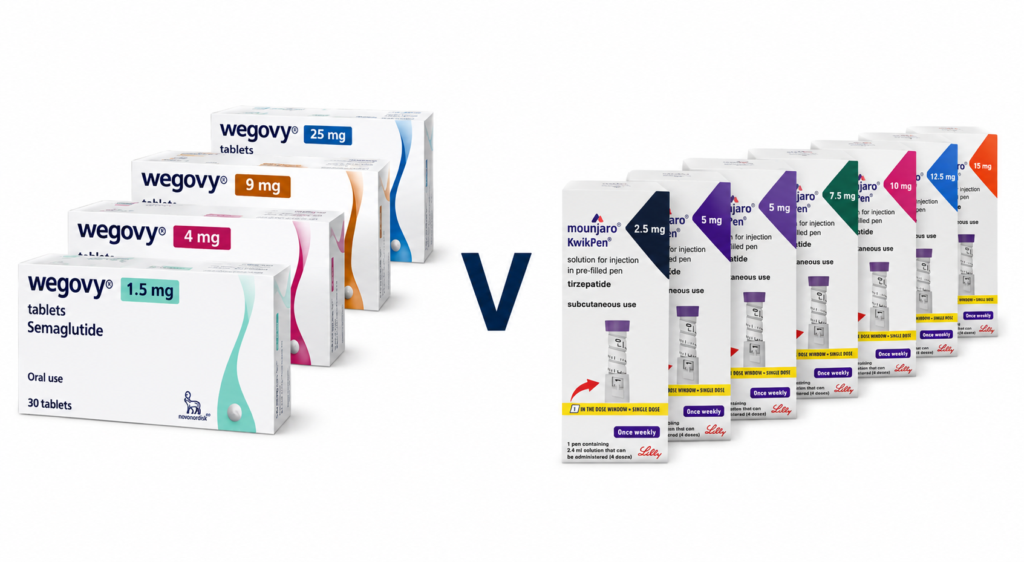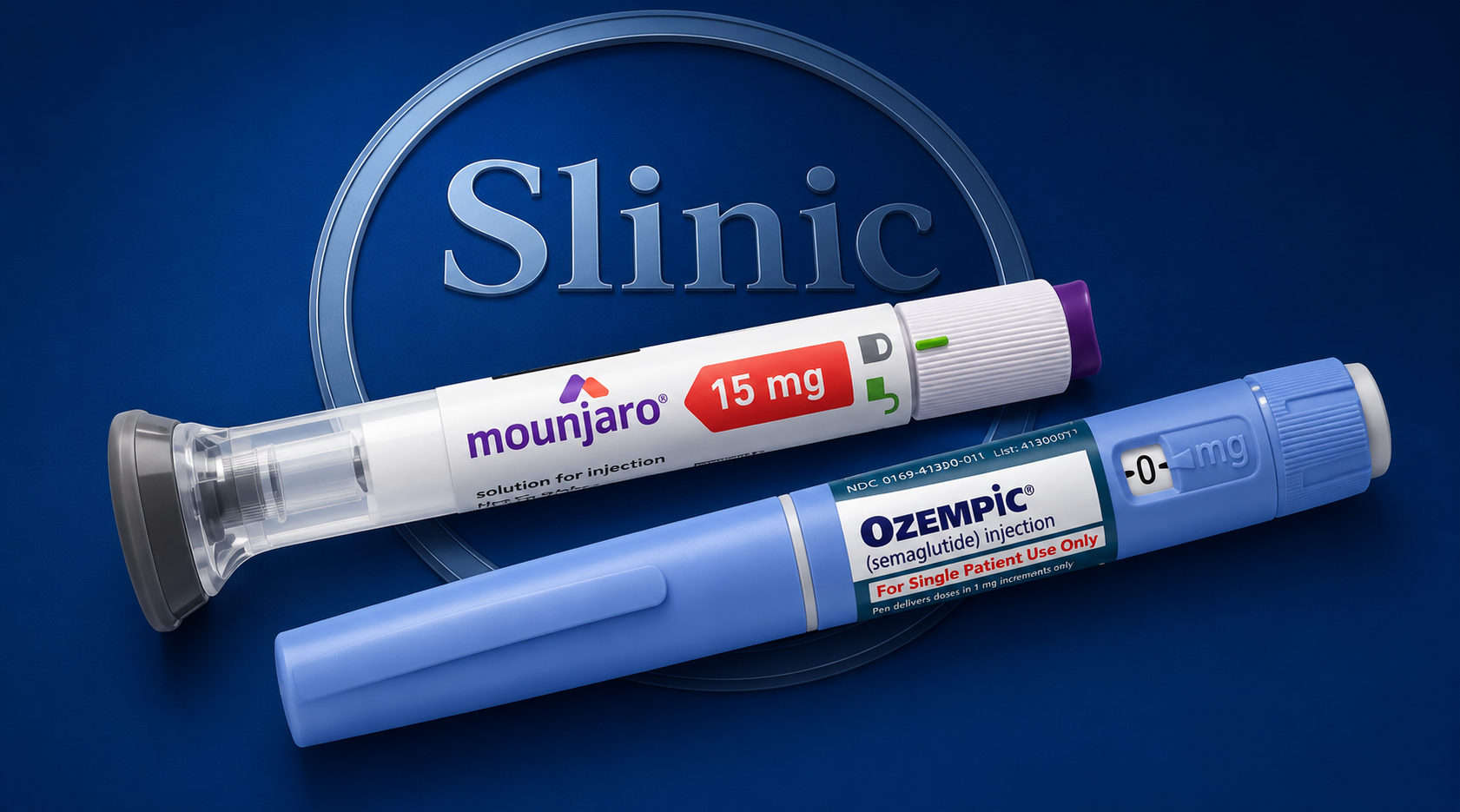
Quick answer: Ozempic (semaglutide) is licensed in the UK for type 2 diabetes, not weight loss; the weight loss version of semaglutide is Wegovy. Mounjaro (tirzepatide) is licensed for weight management and produced more weight loss in trials. At Slinic, Mounjaro costs from £129 a month.
Check if you qualify in 2 minutes
Trusted by 5,000+ patients · free online assessment
- ✓ First month from £73: Mounjaro £119, Wegovy and Foundayo £73, Wegovy pill £82 (£10 new-patient discount included)
- ✓ Low fixed prices: no subscription, no contract, no cancellation fee
- ✓ £10 off your first order
- ✓ Award-winning, pharmacist-led care with free ongoing monthly clinical support
- ✓ UK prescriber reviews every order · GPhC-registered, NHS-contracted pharmacy
- ✓ Discreet, tracked 24-hour delivery
Already a patient? Reorder in 1 minute →
Ozempic vs Mounjaro: quick answer
Mounjaro from £119 for your first month (£10 off), then £129 to £267 by dose. Wegovy from £73 first month. No subscription. Rated Excellent on Trustpilot.
Is Ozempic or Mounjaro better for weight loss?
Mounjaro is licensed for weight loss and gives more weight loss on average. Ozempic is licensed for type 2 diabetes; for weight loss, the same medicine is prescribed as Wegovy.
Ozempic and Mounjaro are both weekly injections that copy gut hormones, but they are different medicines licensed for different things in the UK. Ozempic contains semaglutide and is licensed only for type 2 diabetes, at doses up to 2mg a week. Mounjaro contains tirzepatide, which acts on two hormones (GLP-1 and GIP), and is licensed for both type 2 diabetes and weight management, at doses up to 15mg. For weight loss, the semaglutide option is Wegovy, not Ozempic. In head-to-head trials, tirzepatide led to more weight loss and bigger blood sugar reductions than semaglutide: in SURPASS-2 in type 2 diabetes, and in SURMOUNT-5 in obesity (20.2% against 13.7% average weight loss). This guide compares the two in plain English: what they are, how they work, doses, results, side effects, who can have them, cost, and what to do if you have been offered or are taking Ozempic for weight loss.
Ozempic vs Mounjaro at a glance
| Ozempic | Mounjaro | |
|---|---|---|
| Active ingredient | Semaglutide | Tirzepatide |
| Hormones copied | GLP-1 | GLP-1 and GIP |
| UK licence | Type 2 diabetes only | Type 2 diabetes and weight management |
| How often | Once a week | Once a week |
| Doses | 0.25mg, 0.5mg, 1mg, 2mg | 2.5mg, 5mg, 7.5mg, 10mg, 12.5mg, 15mg |
| Weight-loss version of the same medicine | Wegovy (semaglutide up to 2.4mg, 7.2mg for some) | Mounjaro itself |
| Head-to-head result in obesity (SURMOUNT-5) | Semaglutide 13.7% | Tirzepatide 20.2% |
| Missed dose window | 5 days | 4 days |
| Available privately for weight loss | No (use Wegovy) | Yes |
What is Ozempic?
Ozempic is the brand name for semaglutide when it is used to treat type 2 diabetes. It is made by Novo Nordisk and is taken as a weekly injection, alongside diet and exercise, and often with other diabetes medicines. It lowers blood sugar and, in people with type 2 diabetes and heart disease, has been shown to reduce the risk of heart attacks and strokes. Many people taking Ozempic also lose weight, which is why it became widely talked about as a “weight loss injection”. However, in the UK it is licensed only for type 2 diabetes. The same medicine, at higher doses and in a different pen, is licensed for weight management as Wegovy.
During the shortages of 2023 and 2024, UK regulators and professional bodies warned against prescribing Ozempic for weight loss, to protect supplies for people with diabetes. Reputable UK pharmacies prescribe Wegovy, not Ozempic, for weight management.
What Mounjaro costs at Slinic
Fixed prices at every dose: no subscription, no contract, no cancellation fee, and £10 off your first order.
| Dose | 1 pen (4 weekly doses) | 2 pens |
|---|---|---|
| 2.5mg (starting dose) | £129.00 | £258.00 |
| 5mg | £155.00 | £310.00 |
| 7.5mg | £206.00 | £412.00 |
| 10mg | £230.00 | £460.00 |
| 12.5mg | £247.00 | £494.00 |
| 15mg | £267.00 | £534.00 |
✓ Cheaper than Superdrug, Asda Online Doctor, Juniper, Voy and Simple Online Pharmacy at every Mounjaro dose.
What is Mounjaro?
Mounjaro is the brand name for tirzepatide, made by Eli Lilly. It is the first medicine to act on two gut hormone receptors at once: GLP-1 and GIP. It was first licensed for type 2 diabetes and then for weight management in adults with a BMI of 30 or more, or 27 or more with a weight-related condition. It is taken as a weekly injection using a KwikPen that holds four fixed doses. In the UK, NICE recommends it for weight management on the NHS (TA1026), with a phased rollout through GPs.
A short history
GLP-1 medicines were first developed for type 2 diabetes in the 2000s. Doctors noticed that people taking them often lost weight, which led to trials of higher doses specifically for weight management. Semaglutide was licensed for type 2 diabetes as Ozempic in 2018, and at a higher dose for weight management as Wegovy in 2021. Tirzepatide, the first medicine acting on both GLP-1 and GIP, was licensed for type 2 diabetes in 2022 and for weight management in 2023, both under the Mounjaro name. In the UK, NICE recommended Wegovy for specialist weight services (TA875) in 2023 and Mounjaro for weight management (TA1026) in 2024.
Why Ozempic became so well known
Ozempic became a household name through social media and celebrity stories about weight loss, long before Wegovy was widely available. Many people now use “Ozempic” to mean any weight loss injection. The surge in demand led to shortages that affected people with diabetes who relied on it. In the UK, regulators and professional bodies advised that Ozempic should be prescribed only for its licensed use in type 2 diabetes, and that Wegovy should be used for weight management. That is still the position for reputable pharmacies.
Ozempic vs Wegovy: same medicine, different uses
Ozempic and Wegovy both contain semaglutide, but they are separate products:
- Licence: Ozempic for type 2 diabetes; Wegovy for weight management (and, in some countries, heart risk reduction).
- Doses: Ozempic up to 2mg weekly; Wegovy up to 2.4mg weekly, with 7.2mg approved for some people.
- Pens: different pens with different dose steps, which shouldn’t be used interchangeably.
- Prescribing: Ozempic usually through your GP or diabetes team; Wegovy through NHS specialist weight services or private pharmacies.
So when people compare “Ozempic vs Mounjaro” for weight loss, the practical comparison is Wegovy vs Mounjaro.
How they work
Both medicines copy hormones that your gut releases after eating.
- GLP-1 (both medicines): reduces appetite through the brain, slows stomach emptying so you feel full longer, increases insulin release when blood sugar is high and lowers glucagon.
- GIP (Mounjaro only): also helps insulin release, and appears to add to the effect on appetite and to influence how fat tissue handles energy.
Acting on both receptors is thought to be why tirzepatide generally produces larger reductions in weight and blood sugar than semaglutide at the doses studied. Both are long-acting: semaglutide’s half-life is about a week, tirzepatide’s about five days, which is why both are taken weekly.
Results in type 2 diabetes: SURPASS-2
The SURPASS-2 trial compared tirzepatide (5mg, 10mg and 15mg) with semaglutide 1mg (an Ozempic dose) in adults with type 2 diabetes taking metformin, over 40 weeks.
| Treatment | Average HbA1c reduction | Average weight loss |
|---|---|---|
| Semaglutide 1mg | About 1.86 percentage points | About 5.7 kg |
| Tirzepatide 5mg | About 2.01 percentage points | About 7.6 kg |
| Tirzepatide 10mg | About 2.24 percentage points | About 9.3 kg |
| Tirzepatide 15mg | About 2.30 percentage points | About 11.2 kg |
All doses of tirzepatide lowered blood sugar and weight more than semaglutide 1mg. Ozempic is now also available at 2mg, which wasn’t included in that comparison.
Results for weight loss
For weight loss, the fair comparison is Mounjaro against Wegovy (semaglutide 2.4mg), because Ozempic isn’t licensed for weight management. In the SURMOUNT-5 trial in adults with obesity but without diabetes, average weight loss over 72 weeks was 20.2% with tirzepatide and 13.7% with semaglutide. In separate trials, Mounjaro led to 15% to 20.9% weight loss over 72 weeks (SURMOUNT-1) and Wegovy 2.4mg to 14.9% over 68 weeks (STEP 1). People with type 2 diabetes generally lose a little less weight on either medicine than people without diabetes.
Weight loss in people with type 2 diabetes
People with type 2 diabetes generally lose less weight on these medicines than people without diabetes. In SURMOUNT-2, adults with obesity and type 2 diabetes taking tirzepatide 10mg or 15mg lost on average about 13% to 15% of their body weight over 72 weeks. In STEP 2, adults with type 2 diabetes taking semaglutide 2.4mg (the Wegovy dose) lost about 10% over 68 weeks. At the lower Ozempic doses used for diabetes, weight loss is usually smaller still. For someone with diabetes who also wants significant weight loss, Mounjaro or higher-dose semaglutide (Wegovy) are therefore usually more effective than standard Ozempic doses.
Can either put type 2 diabetes into remission?
Remission means blood sugar staying below the diabetes range without diabetes medicines. It is most likely with substantial weight loss, especially within a few years of diagnosis. Both medicines can help people lose enough weight to reach that point, though while you are taking the medicine it is treatment rather than remission. The NHS also offers a low-calorie meal-replacement programme for some people with recently diagnosed type 2 diabetes. Talk to your diabetes team if remission is your goal.
Blood pressure and cholesterol
Both medicines lower blood pressure and improve blood fats as weight falls, with tirzepatide generally showing slightly larger effects in trials, in line with its greater weight loss. If you take blood pressure medicines, you may need lower doses as your weight falls; tell your GP if you feel dizzy, especially on standing.
Fatty liver
Fatty liver disease is common in people with type 2 diabetes and obesity. Both medicines reduce liver fat. In trials of people with the inflammatory form of fatty liver disease, semaglutide (ESSENCE) and tirzepatide (SYNERGY-NASH) both led to resolution in many more people than placebo.
Sleep apnoea
Obstructive sleep apnoea often improves with weight loss. In the SURMOUNT-OSA trials, tirzepatide roughly halved the number of breathing interruptions per hour in adults with obesity and moderate to severe sleep apnoea.
Heart and other health outcomes
Semaglutide has strong evidence for heart protection. In people with type 2 diabetes and heart disease (SUSTAIN-6), and in people with overweight and heart disease without diabetes (SELECT), semaglutide reduced major heart events such as heart attacks and strokes. Large heart outcome trials of tirzepatide are under way. Both medicines improve blood pressure, cholesterol and markers of fatty liver as weight falls, and tirzepatide has been shown to reduce sleep apnoea severity in people with obesity.
Doses and how they are increased
Ozempic
Ozempic starts at 0.25mg once a week for 4 weeks, then 0.5mg. If more blood sugar control is needed, it can increase to 1mg and then 2mg, with at least 4 weeks between increases.
Mounjaro
Mounjaro starts at 2.5mg for 4 weeks, then 5mg. It can go up by 2.5mg no more often than every 4 weeks, to 7.5mg, 10mg, 12.5mg and a maximum of 15mg.
The milligram numbers can’t be compared directly, because the medicines are different molecules with different strengths.
The pens
Ozempic comes in a pre-filled pen that delivers a set dose each week; different pens are used for different dose levels. Mounjaro comes as a KwikPen containing four fixed weekly doses of a single strength, with a new pen needle attached each week. Both are injected under the skin of the stomach area, thigh or upper arm, on the same day each week, at any time, with or without food. Always follow the instructions for use in your pack.
Storage
Unused pens of both medicines should be kept in the fridge at 2°C to 8°C, in their box, and never frozen. Before first use, a Mounjaro pen can be kept below 30°C for up to 30 days. For Ozempic, follow the leaflet for how long the pen can be kept out of the fridge once in use. Don’t use any pen that has been frozen or left in heat.
Missed doses
For Ozempic, a missed dose can be taken within 5 days of the usual day; after that, skip it and carry on as normal. For Mounjaro, the window is 4 days. Never take two doses together. If you have missed doses for two weeks or more, speak to your prescriber before restarting, as you may need a lower dose.
NHS access
Ozempic is widely prescribed on the NHS for type 2 diabetes, usually when other medicines haven’t controlled blood sugar well enough. Mounjaro is also used on the NHS for type 2 diabetes, and, for weight management, is being rolled out in phases through GPs to adults with a BMI of 35 or more and weight-related conditions under NICE TA1026. Wegovy is available for weight management through specialist NHS services for up to 2 years under NICE TA875.
Kidney outcomes
In people with type 2 diabetes and chronic kidney disease, the FLOW trial found that semaglutide reduced the risk of serious kidney outcomes, kidney failure and death from kidney or heart causes compared with placebo. Trials of tirzepatide in kidney disease are ongoing. If you have kidney disease, your diabetes and kidney teams will consider this when choosing a medicine. Severe vomiting or diarrhoea on either medicine can cause dehydration, which can worsen kidney function, so drink plenty.
Eyesight
In people with diabetic retinopathy, a rapid improvement in blood sugar with either medicine can occasionally cause temporary worsening. Keep your diabetic eye screening appointments. Very rarely, sudden sight loss in one eye (NAION) has been reported with semaglutide. Seek urgent help for any sudden change in vision.
Low blood sugar
On their own, neither medicine usually causes low blood sugar, because they increase insulin only when blood sugar is raised. But if you also take insulin or a sulfonylurea such as gliclazide, the risk of hypos rises. Your diabetes team may lower those doses when you start or increase Ozempic or Mounjaro. Know the signs (shaking, sweating, confusion, fast heartbeat) and keep a fast-acting sugar with you.
Switching from Ozempic to Mounjaro in diabetes
If you have type 2 diabetes and your blood sugar or weight isn’t where you would like on Ozempic, your diabetes team may suggest switching to Mounjaro. There is no exact dose conversion. You usually stop Ozempic and start Mounjaro about a week later, often at 2.5mg or 5mg depending on your Ozempic dose and blood sugar, then increase every 4 weeks. Blood sugar is monitored closely during the switch. Don’t make this change yourself or combine the two.
Side effects
Both have similar side effects, mostly digestive: nausea, diarrhoea, constipation, vomiting, indigestion and reduced appetite. These are usually mild to moderate, most common in the first weeks and after dose increases, and ease over time. Rare but serious risks for both include pancreatitis, gallbladder problems and dehydration leading to kidney problems. In people with diabetic eye disease, a rapid improvement in blood sugar can temporarily worsen it. Seek urgent help for severe, persistent stomach pain.
One important difference: Mounjaro can make the contraceptive pill less effective for 4 weeks after starting and after each dose increase, so extra contraception is needed at those times. Neither medicine should be used in pregnancy. Stop Mounjaro at least 1 month, and semaglutide at least 2 months, before trying to conceive.
Side effect rates in the head-to-head diabetes trial
In SURPASS-2, the most common side effects for both medicines were digestive. Nausea was reported by roughly 17% to 22% of people on tirzepatide, depending on dose, and about 18% on semaglutide 1mg; diarrhoea by about 13% to 16% on tirzepatide and about 12% on semaglutide; and vomiting by about 6% to 10% on tirzepatide and about 8% on semaglutide. Most were mild to moderate and happened while the dose was being increased. The proportion stopping because of side effects was similar and low on both. These figures are rounded and come from people with type 2 diabetes; rates in weight management trials, which used higher doses, were somewhat higher.
Managing nausea and constipation
For nausea, eat smaller meals slowly, stop as soon as you feel full, avoid greasy, fried and very sweet foods, sip water or ginger or peppermint tea, and stay upright after eating. Choosing a dose day when you can take it easy the next day helps. For constipation, drink plenty, add fibre gradually from vegetables, fruit, oats and beans, and walk every day; a pharmacist can suggest a gentle laxative. If nausea stops you eating or drinking, or lasts more than two weeks on the same dose, talk to your prescriber.
Surgery and procedures
Both medicines slow stomach emptying, which can increase the risk of inhaling stomach contents during a general anaesthetic or deep sedation. If you are having an operation, endoscopy or procedure under sedation, tell the surgical and anaesthetic team well in advance that you take Ozempic or Mounjaro. They will advise whether and when to pause it.
Interactions with other medicines
Because both slow stomach emptying, they can affect how some tablets are absorbed. This matters most for Mounjaro and the contraceptive pill. For medicines where precise levels are important, such as warfarin, your GP may want to check you more closely when you start or change the dose. Tell your prescriber about every medicine you take, and never combine two GLP-1 medicines.
Hair, skin and other effects
With significant weight loss on either medicine, some people notice temporary hair shedding a few months in, usually linked to rapid weight loss rather than the medicine itself; it grows back. Mild redness, itching or bruising where you inject can happen and fades within a day or two. Tiredness in the first weeks is common and usually comes from eating less. Some people notice changes in their face as they lose weight, which reflects fat loss rather than a direct effect of the medicine.
Choosing your dose day
Both medicines are taken once a week on the same day. Choose a day when you can take it easy the following day, as appetite is lowest and nausea most likely in the first day or two, especially after dose increases. Many people choose Friday evening or Saturday. You can change the day if needed, as long as there are at least 3 days between two doses.
Questions people with diabetes often ask
Will I still need my other diabetes medicines? Often yes, at least at first, though doses of insulin or sulfonylureas may be lowered. Will my blood sugar go too low? On their own, these medicines rarely cause hypos, but the risk rises with insulin or sulfonylureas. Can I use them if I have kidney disease? Usually yes, with monitoring, and semaglutide has shown kidney benefits in the FLOW trial. Do I still need eye checks? Yes, keep your diabetic eye screening appointments.
Who can have each one
Ozempic
Adults with type 2 diabetes, usually when other treatments aren’t enough, as decided by their GP or diabetes team. It isn’t prescribed for weight loss alone in the UK.
Mounjaro
For type 2 diabetes, as decided by the diabetes team. For weight management, adults with a BMI of 30 or more, or 27 or more with a weight-related condition, with thresholds usually 2.5 lower for some ethnic groups. Privately, it can be prescribed after a health assessment. On the NHS, it is being rolled out in phases to adults with a BMI of 35 or more and weight-related conditions.
Not suitable for either
People who are pregnant or breastfeeding, or who have a personal or family history of medullary thyroid cancer or MEN2. Extra care is needed with a history of pancreatitis, gallbladder disease, severe digestive problems or eating disorders.
Cost
Ozempic is prescribed on the NHS for type 2 diabetes; in England you pay the usual prescription charge unless exempt, and many people with diabetes are exempt. Slinic doesn’t supply Ozempic, because it isn’t licensed for weight management. For weight loss, Slinic offers Mounjaro and Wegovy at fixed 2026 prices with no subscription:
| Mounjaro dose | Price | Wegovy dose | Price |
|---|---|---|---|
| 2.5mg | £129 (£119 first order) | 0.25mg | £83 (£73 first order) |
| 5mg | £155 | 0.5mg | £93 |
| 7.5mg | £206 | 1mg | £93 |
| 10mg | £230 | 1.7mg | £144 |
| 12.5mg | £247 | 2.4mg | £196 |
| 15mg | £267 | 7.2mg | £350 |
Delivery is £4.99. In the Medino comparison of 29 UK providers on 2 November 2026, Slinic was the lowest-priced for a first Mounjaro order at every dose.
What a year costs privately
At Slinic’s fixed 2026 prices, a year on Mounjaro 5mg costs £1,860 for the medicine, 10mg £2,760 and 15mg £3,204. A year on Wegovy 2.4mg costs £2,352. Most people spend the first few months moving up through lower doses, which cost less. Delivery adds £4.99 a month, and there is no subscription or consultation fee.
Tablet options
For people who would rather not inject, two daily tablets are available for weight management. The Wegovy pill contains oral semaglutide, the same medicine as Ozempic and Wegovy, taken each morning on an empty stomach with a small sip of water; in OASIS 4 it led to about 13.6% average weight loss. Foundayo contains orforglipron, a different GLP-1 medicine that can be taken at any time with or without food; it led to about 12% in its main trial. At Slinic, the Wegovy pill costs £92 to £164 a month and Foundayo £83 to £140. On average, Mounjaro injections give more weight loss than either tablet.
How private prescribing works
To get Mounjaro or Wegovy privately, you complete an online health assessment covering your height, weight, health conditions and medicines. Your identity and weight are checked, and new patients at Slinic have a short video consultation. A UK prescriber reviews everything before deciding whether to prescribe. If approved, the medicine is usually dispatched within 24 hours by tracked delivery. Each reorder includes a short check-in so the prescriber can review your progress and side effects before the next supply.
Support during treatment
At Slinic, you can message the pharmacy team at any time about side effects, missed doses, dose changes or travel. The prescriber can keep you on a dose for longer, step you down or suggest other options, at no extra charge.
Work and daily life
Most people carry on working normally on either medicine. Taking your dose at the end of the week means early side effects fall at the weekend. Plan dose increases for quieter weeks, take small, plain lunches in the first weeks, and keep water with you.
If neither medicine works well enough
Most people lose a meaningful amount of weight on Mounjaro or Wegovy, but a small proportion respond less. If you have been on a suitable dose for several months with little change, the prescriber may review your eating, activity, sleep and other medicines, check for conditions such as an underactive thyroid, consider switching to the other medicine, or discuss other options with your GP, including NHS specialist weight services or, for severe obesity, assessment for surgery.
Who decides in diabetes care
If you have type 2 diabetes, the choice between Ozempic, Mounjaro and other medicines is usually made with your GP, practice nurse or diabetes specialist. They will consider your HbA1c, weight, heart and kidney health, other medicines, side effects and preferences, as well as NHS guidance. If you are also thinking about private weight loss treatment, tell your diabetes team first, so your care is joined up and you never end up taking two similar medicines.
If you are taking Ozempic for diabetes
If Ozempic is prescribed by your GP or diabetes team for type 2 diabetes, keep taking it as prescribed. If you would like to discuss switching to Mounjaro, for example because your blood sugar or weight isn’t where you want it, talk to your diabetes team. Never take Ozempic and Mounjaro together, and don’t add a private weight loss medicine on top of Ozempic.
If you have been sold Ozempic for weight loss
If you have been offered Ozempic for weight loss through social media, a salon, a gym or a website that didn’t ask detailed health questions, be very cautious. Fake “Ozempic” pens have been seized in the UK, some containing the wrong medicine, insulin or no active ingredient. Stop using any product you aren’t sure about, report it to the MHRA Yellow Card scheme, and get proper advice. If you want to lose weight with a medicine, a regulated pharmacy can assess you for Wegovy or Mounjaro.
Mounjaro vs Wegovy for weight loss, in more detail
Because Ozempic isn’t a weight loss option in the UK, most people weighing up “Ozempic or Mounjaro” are really choosing between Wegovy and Mounjaro. In SURMOUNT-5, the only large head-to-head trial in people with obesity, tirzepatide led to an average 20.2% weight loss and semaglutide 13.7% over 72 weeks. More people on tirzepatide lost at least 15%, 20% and 25% of their weight, and waist size fell more. Side effects were broadly similar, mostly digestive. Wegovy’s advantages are its lower price at lower doses, its longer track record and its proven heart benefit in the SELECT trial. Some people simply respond better, or tolerate one better, than the other, so either can be the right choice.
Results over time
With either medicine, appetite usually starts to fall within days, but weight loss builds gradually because both start on low doses. A typical first month brings 1% to 4% weight loss. Results become steadier as the dose rises over the first three to four months, and weight usually levels off after about a year to 18 months. In type 2 diabetes, blood sugar improvements show on HbA1c tests after about three months.
Who tends to respond more strongly
People without type 2 diabetes usually lose more weight than people with it, on either medicine. Higher doses generally produce more weight loss. Consistent weekly dosing, a diet with enough protein and fewer ultra-processed foods, regular activity and good sleep all help. Some medicines, hormonal conditions and genetics can mean a slower response. If one medicine isn’t working well after several months on a suitable dose, switching to the other is an option to discuss.
Eating on either medicine
Both medicines reduce appetite and slow stomach emptying, so smaller meals eaten slowly are best. Put protein first at each meal, from eggs, fish, chicken, beans, lentils, tofu or Greek yoghurt, and fill half the plate with vegetables. Keep portions of rice, pasta, bread and potatoes moderate, and cut back on sugary drinks and snacks. Greasy, fried and very sweet foods are the most common triggers for nausea. Drink 6 to 8 glasses of fluid a day. If you have diabetes, spread carbohydrates evenly across the day and don’t skip meals, especially if you take insulin or a sulfonylurea.
Protecting muscle
With significant weight loss, some muscle is lost along with fat. Eating around 20 to 30g of protein per meal and doing strength exercise two or three times a week help protect muscle, which matters for strength, balance and metabolism, especially in older adults. Walking most days helps too.
Stopping and weight regain
Both medicines work while you take them. In trials of stopping semaglutide (STEP 4) and tirzepatide (SURMOUNT-4), people who switched to placebo regained much of the weight they had lost within a year. In type 2 diabetes, blood sugar also rises again after stopping. Decisions about stopping should be made with your prescriber or diabetes team, ideally with a plan to keep healthy habits going.
Pregnancy, fertility and PCOS
Neither medicine should be used in pregnancy or while breastfeeding. Weight loss can improve fertility, particularly in women with polycystic ovary syndrome, so pregnancy can become more likely than expected. Mounjaro can reduce the effect of the contraceptive pill for 4 weeks after starting and after each dose increase, so extra protection or a non-oral method is needed. Stop Mounjaro at least 1 month, and semaglutide at least 2 months, before trying to conceive. If you have diabetes and are planning a pregnancy, talk to your diabetes team well in advance.
Older adults
Both medicines can be used in older adults, but dehydration, dizziness, muscle loss and interactions with other medicines need extra attention. Slower dose increases, enough fluids and protein, and strength and balance exercise help. Blood pressure and diabetes medicines may need adjusting as weight falls.
Mood and mental health
Most people feel better as their weight and blood sugar improve. If you notice low mood, anxiety around eating or thoughts of self-harm while taking either medicine, speak to your GP straight away. Tell your prescriber if you have ever had an eating disorder.
Alcohol
Alcohol can worsen nausea and reflux on both medicines, adds calories and can increase the risk of low blood sugar in people taking insulin or sulfonylureas. Many people find they want less alcohol on treatment. Keep within 14 units a week, spread over several days.
Travel
Keep pens in your hand luggage, never in the hold where they can freeze, and carry the pharmacy label or prescription. Keep them out of direct sun and hot cars. If you cross time zones, take your dose on the same day of the week at a convenient local time.
How to spot fake or unsafe supply
- no health assessment or prescriber review;
- sold through social media, messaging apps, salons or gyms;
- “semaglutide” or “tirzepatide” sold as vials, powders or patches;
- pens without a sealed manufacturer’s box, batch number, leaflet or pharmacy label;
- prices far below normal;
- no GPhC registration number, or one that doesn’t match the register.
Only use a GPhC-registered pharmacy. Slinic’s registration number is 1033729.
Example situations
These examples are made up, but reflect common questions.
“My friend lost weight on Ozempic. Can I have it?”
A 42-year-old woman without diabetes and a BMI of 32 asks for Ozempic. Ozempic isn’t licensed for weight loss, so she is assessed for Wegovy and Mounjaro instead. She chooses Mounjaro for its larger average effect.
“I’m on Ozempic for diabetes and still gaining weight.”
A 60-year-old man with type 2 diabetes on Ozempic 1mg has an HbA1c above target and has gained weight. His diabetes team switches him to Mounjaro, starting at 5mg, and lowers his gliclazide. Over six months his HbA1c falls and he loses 8 kg.
“I have heart disease. Which is better?”
A 58-year-old woman with a previous heart attack and a BMI of 34 discusses options. Because of semaglutide’s proven heart benefit, she and her prescriber choose Wegovy.
Myths
- “Ozempic is a weight loss drug.” In the UK it is licensed only for type 2 diabetes; Wegovy is the weight loss version.
- “Mounjaro is just a stronger Ozempic.” It is a different molecule that acts on two hormones, not one.
- “The higher the number, the stronger the medicine.” Milligram doses can’t be compared between the two.
- “You can switch between them whenever you like.” Switching should be planned by a prescriber, with no overlap.
Questions to ask your prescriber or diabetes team
- Which medicine suits my health, weight and blood sugar best?
- What dose would I start on, and how would it increase?
- Do any of my other medicines need changing?
- What results should I expect, and when?
- What should I do about contraception?
Meals if you have type 2 diabetes
On either medicine, smaller meals with protein and vegetables help both blood sugar and side effects. Spread carbohydrates evenly over the day, choosing wholegrains, beans and lentils over white bread, white rice and sugary foods. Don’t skip meals, particularly if you take insulin or a sulfonylurea, as eating much less can cause low blood sugar. Check your blood sugar more often in the first weeks after starting or increasing the dose, and keep glucose tablets with you.
Exercise and low blood sugar
Regular activity improves blood sugar control and protects muscle during weight loss. If you take insulin or a sulfonylurea, blood sugar can fall during and after exercise, especially when you are eating less. Check your levels before and after exercise when you first start, carry a fast-acting sugar, and talk to your diabetes team about adjusting doses if you have hypos.
Injection technique
For both medicines, inject into clean skin on the stomach area at least 5 cm from the belly button, the front of the thigh or the back of the upper arm, and change the exact spot each week to avoid soreness and lumps. Use a new needle each time where your pen needs one. Follow the instructions for use in your pack, which differ between the Ozempic pen and the Mounjaro KwikPen.
Keeping track
Weigh yourself once a week at the same time, measure your waist once a month, and, if you have diabetes, keep a record of your home blood sugar readings and HbA1c results. Note side effects and how long they last after each dose change. This makes reviews with your prescriber or diabetes team quicker and more useful.
Keeping your GP informed
If you start Mounjaro or Wegovy privately, tell your GP, so your medical record is complete and your other medicines can be reviewed as your weight and blood sugar change. This is especially important if you have type 2 diabetes, heart disease, kidney disease or take several medicines.
What to expect in your first three months
On either medicine, the first month is spent on a low starting dose, so appetite changes are often noticeable within days while weight loss is modest, typically 1% to 4%. Side effects such as nausea are most likely in the first weeks and for a few days after each dose increase. Over months two and three, as the dose rises, appetite control usually strengthens and weight loss becomes steadier; many people on Mounjaro have lost around 6% to 9% by the end of month three. If you have type 2 diabetes, blood sugar readings often improve within the first weeks, and your first HbA1c check after about three months usually shows a clear fall. Keep in touch with your prescriber or diabetes team throughout, especially if side effects don’t settle or blood sugar runs low.
Making a safe choice
Whichever medicine you end up taking, the safest route is through your GP, your diabetes team or a GPhC-registered pharmacy that carries out a proper health assessment, checks your identity and weight, and reviews you before every supply. Be honest about your health conditions and medicines, keep the leaflet that comes with your pens, and get in touch early if anything worries you. Never buy either medicine from social media, salons or websites that don’t ask health questions, and never use a pen that arrives without a sealed box and pharmacy label.
In summary
Ozempic and Mounjaro are both effective weekly injections, but they aren’t interchangeable. Ozempic is semaglutide for type 2 diabetes; for weight loss, semaglutide is prescribed as Wegovy. Mounjaro is tirzepatide, licensed for both type 2 diabetes and weight management, and in head-to-head trials it led to more weight loss and larger blood sugar reductions than semaglutide. Semaglutide has the stronger heart outcome evidence so far. Both share similar, mainly digestive side effects. The right choice depends on whether you have diabetes, your weight loss goals, your heart health, your budget and how you tolerate each medicine, and it should always be made with a qualified prescriber who knows your full medical history and reviews you regularly.
Which is right for you?
- You have type 2 diabetes: both are options; your diabetes team will choose based on your blood sugar, weight, heart health and other medicines.
- You want to lose weight and don’t have diabetes: the choice is Mounjaro or Wegovy, not Ozempic. Mounjaro gives more weight loss on average; Wegovy usually costs less at lower doses and has proven heart benefits.
- You have heart disease: semaglutide’s heart outcome evidence may be an important factor.
- You would rather not inject: daily tablets such as the Wegovy pill (oral semaglutide) and Foundayo (orforglipron) are options for weight management.
Ozempic vs Mounjaro: your questions
Is Ozempic the same as Mounjaro?
No. Ozempic contains semaglutide (GLP-1 only); Mounjaro contains tirzepatide (GLP-1 and GIP).
Which is better for weight loss, Ozempic or Mounjaro?
Mounjaro. Ozempic isn’t licensed for weight loss in the UK. For weight loss, compare Mounjaro with Wegovy: 20.2% against 13.7% in SURMOUNT-5.
Can I get Ozempic for weight loss in the UK?
Not from a reputable pharmacy. For weight loss, semaglutide is prescribed as Wegovy.
Is Ozempic the same as Wegovy?
Same medicine (semaglutide), different licence, doses and pen. Ozempic is for diabetes; Wegovy is for weight management.
Can I switch from Ozempic to Mounjaro?
If you have diabetes, discuss it with your diabetes team. Never take both together.
Which has more side effects?
They are broadly similar, mainly digestive. Some people tolerate one better than the other.
Does Mounjaro lower blood sugar more than Ozempic?
In the SURPASS-2 trial, all tirzepatide doses lowered HbA1c more than semaglutide 1mg.
Which is better for the heart?
Semaglutide has proven heart benefits from the SUSTAIN-6 and SELECT trials. Heart outcome trials of tirzepatide are under way.
Will I regain weight if I stop either one?
Many people regain a large part of their weight within a year of stopping. Plan stopping with your prescriber.
Can I take Ozempic and Mounjaro together?
No. They work in a similar way, and combining them increases side effects and risks.
Do people with diabetes lose less weight on these medicines?
Yes, on average. In SURMOUNT-2, tirzepatide led to about 13% to 15% weight loss in people with type 2 diabetes.
Can Mounjaro or Ozempic help fatty liver?
Both reduce liver fat, and trials have shown improvement in inflammatory fatty liver disease with both semaglutide and tirzepatide.
Does Ozempic or Mounjaro cause hair loss?
Some people notice temporary shedding with significant weight loss on either. It usually grows back.
References
- Frías JP et al. Tirzepatide versus semaglutide once weekly in patients with type 2 diabetes (SURPASS-2). N Engl J Med 2021. nejm.org
- Aronne LJ et al. Tirzepatide as compared with semaglutide for the treatment of obesity (SURMOUNT-5). N Engl J Med 2025. nejm.org
- Jastreboff AM et al. Tirzepatide once weekly for the treatment of obesity (SURMOUNT-1). N Engl J Med 2022. nejm.org
- Lincoff AM et al. Semaglutide and cardiovascular outcomes in obesity without diabetes (SELECT). N Engl J Med 2023. nejm.org
- Electronic medicines compendium. Ozempic and Mounjaro: summaries of product characteristics. medicines.org.uk
- NICE. Tirzepatide for managing overweight and obesity (TA1026). nice.org.uk
Start today in 3 simple steps
- Free 2-minute online assessment
- A UK prescriber reviews your answers
- Discreet tracked delivery, dispatched within 24 hours of approval
✓ Trusted by 5,000+ patients ✓ £10 off your first order ✓ No subscription ✓ Award-winning, pharmacist-led care
Already a patient? Reorder in 1 minute →
More questions people ask
What is the UK equivalent of Ozempic for weight loss?
Wegovy. It contains the same medicine (semaglutide) and is licensed for weight management.
Is Ozempic or Mounjaro better for weight loss?
Mounjaro produced more weight loss in trials than semaglutide, and it's licensed for weight loss in the UK, which Ozempic isn't.
How much is Mounjaro compared with Ozempic in the UK?
Ozempic isn't prescribed privately for weight loss. Mounjaro costs from £129 a month and Wegovy from £83 at Slinic.