


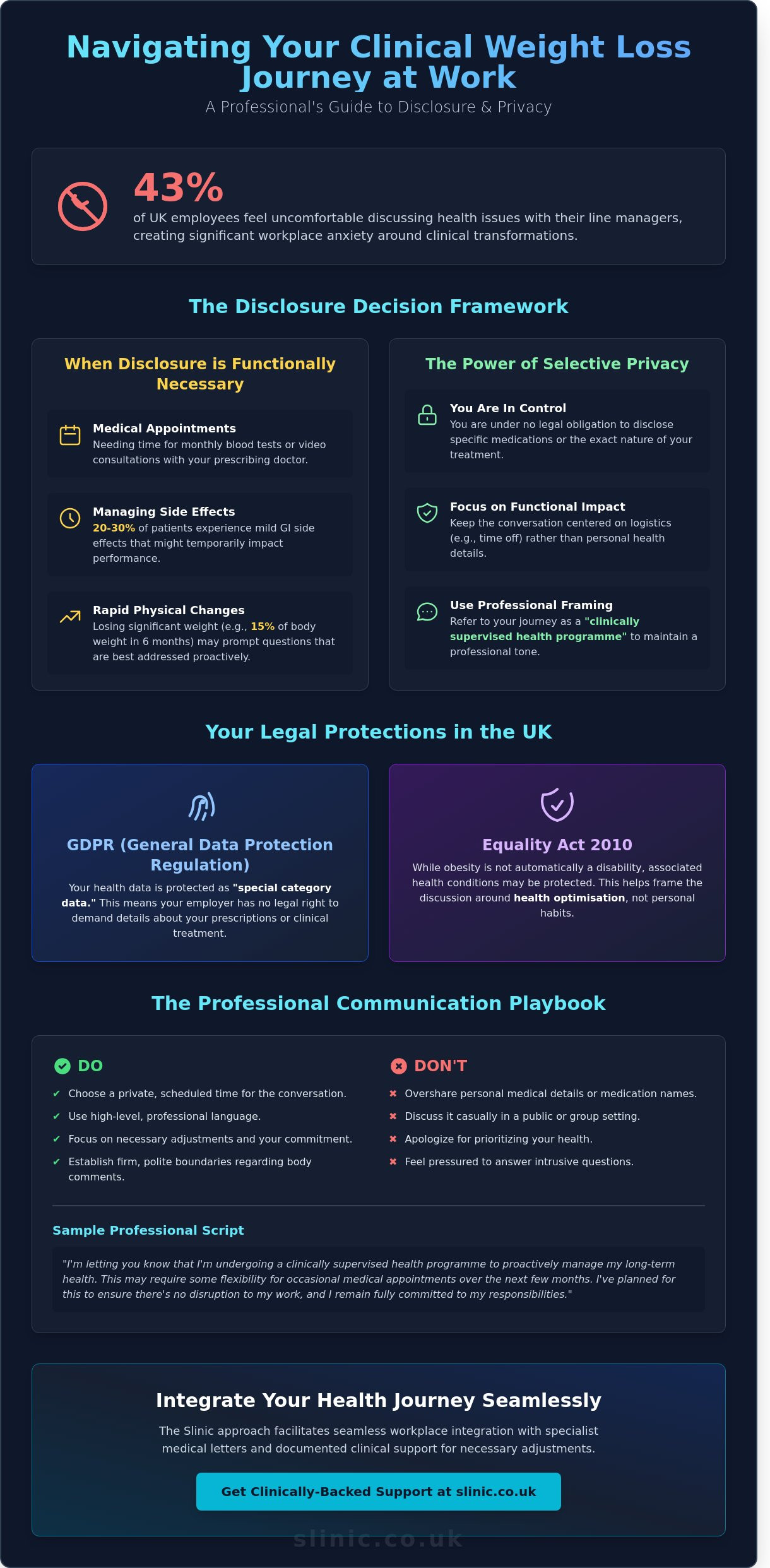
When a 2023 survey by People Management found that 43% of UK employees feel uncomfortable discussing health issues with their line managers, the prospect of explaining a clinical health transformation becomes a source of significant workplace anxiety. You might worry that rapid physical changes will lead to unwanted speculation or that managing side effects like nausea will impact your professional standing. It’s natural to feel hesitant when considering how to tell my boss about my weight loss journey, especially when your treatment involves specialist weight loss injections that require a structured clinical approach.
At Slinic, we believe that medical transparency shouldn’t come at the cost of your professional credibility. This guide provides a clinical framework for balancing your right to privacy with the practicalities of workplace flexibility. You’ll learn how to secure necessary time for medical appointments, manage potential side effects with discreet confidence, and establish firm boundaries regarding body-related comments. We’ll outline a structured approach to ensure your health transformation remains a foundation for long-term confidence rather than a distraction from your career excellence.
Key Takeaways
- Understand how to evaluate the professional necessity of disclosure by distinguishing between social sharing and the requirement for clinical transparency.
- Gain clarity on your legal protections under the UK Equality Act 2010 and GDPR to ensure your sensitive medical data is handled with the highest level of confidentiality.
- Master how to tell my boss about my weight loss journey using bespoke, professionally-templated scripts that balance personal privacy with workplace requirements.
- Identify the optimal timing and communication mediums for health-related discussions to maintain a polished, professional tone throughout your clinical journey.
- Discover how the Slinic approach facilitates seamless workplace integration through specialist medical letters and documented clinical support for necessary adjustments.
For a full comparison of UK Mounjaro providers including pricing, see:
⇒Slinic’s Top UK Mounjaro Providers Guide
Deciding Whether to Share Your Weight Loss Journey at Work
The decision to disclose a personal medical path is rarely simple. In the UK, approximately 26% of adults live with obesity, yet the subject remains shrouded in outdated social stigma. Adopting a clinical-first mindset shifts the narrative from a lifestyle choice to a structured medical intervention. This professional framing is essential when considering how to tell my boss about my weight loss journey. By viewing your treatment through the lens of medical weight loss, you establish a foundation of health management rather than personal vulnerability.
Your disclosure strategy should depend on the intersection of clinical requirements and workplace culture. If your manager prioritizes data and efficiency, a brief, functional update may suffice. Conversely, in environments that champion Workplace wellness programs, a more collaborative conversation could unlock additional support. You don’t need to share every detail of your weight loss treatment to remain professional. You are managing a biological condition with specialist oversight.
When Disclosure is Functionally Necessary
Clinical governance requires regular monitoring. You might need time off for monthly blood tests or video consultations with your prescribing doctor. Clinical trials for treatments like tirzepatide show that 20% to 30% of patients experience mild gastrointestinal side effects during the initial titration phase. If these symptoms impact your daily performance, a proactive conversation prevents misunderstandings. Rapid physical changes, such as losing 15% of body weight over six months, can also prompt concern from colleagues. Addressing this early ensures your team views your transformation as a positive, supervised health milestone rather than a result of illness.
The Power of Selective Privacy
UK employees are under no legal obligation to disclose specific medications or the exact nature of their treatment. You can maintain professional transparency by stating you are under the care of a registered pharmacist or doctor for a long-term health plan. This approach protects your privacy while explaining any logistical needs. Identifying safe colleagues for social support is different from formal reporting lines. When thinking about how to tell my boss about my weight loss journey, focus on the functional impact on your role. Keep the specialist details of your care personal, sharing only the outcomes that affect your professional output and biological resilience.
Your Rights and Privacy: The Clinical Framework in the UK
Understanding the legal landscape is the first step in deciding how to tell my boss about my weight loss journey. In the UK, your health data is protected under the General Data Protection Regulation (GDPR) as “special category data.” This classification provides a high level of security, meaning your employer has no legal right to demand details about your specific prescriptions or the clinical nature of your treatment. When you choose a pharmacist-led service, you’re supported by a framework of clinical governance that ensures your medical history remains between you and your prescriber.
The Equality Act 2010 serves as a vital safeguard. While obesity itself isn’t automatically classified as a disability, the health conditions associated with it, such as Type 2 diabetes or severe joint issues, often meet the legal criteria for protection. Knowing how to approach your manager with this context allows you to frame the conversation around health optimization rather than personal habit. This distinction is crucial for maintaining professional boundaries while ensuring you receive the respect any patient undergoing medical treatment deserves.
GDPR and Medical Confidentiality
Your employer can’t legally ask to see your private prescriptions for Mounjaro or Wegovy. If you need to disclose that you’re on a medical plan, phrase it as a “clinically supervised health programme.” This terminology shifts the focus from “dieting” to a formal medical intervention. Always keep digital copies of your consultation notes and dispensing labels from your specialist pharmacy. These documents serve as evidence of your clinical oversight should you ever need to justify a brief absence for a follow-up appointment or a video consultation.
Navigating the Equality Act 2010
Protection under the Equality Act 2010 triggers when a health condition has a “substantial and long-term adverse effect” on your ability to carry out daily activities. If your weight loss journey involves managing these comorbidities, your employer is legally required to consider “reasonable adjustments.” This might include:
- Flexible start times if you experience morning nausea during the initial titration phase of weight loss injections.
- Adjusted break schedules to ensure consistent hydration and nutrition.
- Private spaces for administering medication if your clinical protocol requires it during working hours.
Treating your journey with the same rigor as any other medical treatment prevents weight bias from creeping into professional evaluations. Slinic’s clinical team provides the structured oversight needed to validate your journey as a legitimate medical process. If you’re unsure about your eligibility for specific treatments, you can view our eligibility guide to understand the clinical criteria used in the UK.
Choosing Your Script: Scenarios for Every Professional Situation
Tailoring your message is essential for maintaining professional standing while embarking on a clinical treatment plan. You don’t need to disclose every medical detail to your employer. Instead, focus on how your journey supports your long-term output and presence. Deciding how to tell my boss about my weight loss journey involves a strategic balance between personal privacy and professional transparency. Your communication should be as precise as your clinical protocol, ensuring your manager feels informed but not overwhelmed by personal data.
A bespoke communication strategy allows you to control the narrative. If you prefer minimal disclosure, a “General Health Update” focuses on your commitment to wellness without naming specific treatments. For those requiring practical adjustments, a “Side Effect Management” script addresses operational needs directly. If colleagues begin to comment on your changing appearance, a “Boundary Setting” script preserves your professional dignity. These scripts ensure that your medical weight loss journey remains a private foundation for your public success.
Script A: The Proactive Health Management Approach
This approach focuses on “optimising long-term health” rather than “losing weight.” By using clinical language, you establish authority and signal that your journey is a disciplined, specialist-led process. You might state that you’re working with a clinical team to improve your biological architecture and energy levels. This framing links your health journey to increased focus and future performance. It suggests that your proactive steps today prevent health-related absenteeism tomorrow. You’re not just changing your diet; you’re investing in your professional longevity.
Script B: Explaining Clinical Side Effects
When starting treatments like Mounjaro, you may experience temporary fatigue or nausea during the titration phase. It’s often helpful to mention a “metabolic health plan” to explain these shifts. This professional terminology commands respect and avoids the stigma sometimes associated with weight management. You can request flexible hours or remote work by focusing on the solution. A sample script might be:
- “I’m currently managing a temporary medication adjustment under clinical supervision.”
- “To ensure my performance remains at its peak, I’d like to work from home on the day following my treatment.”
- “This specialist-led plan is designed to improve my overall metabolic health and sustained energy.”
This level of transparency demonstrates high professional accountability. It shows you’ve considered the impact on the business and have a plan to mitigate any disruptions. By following the Slinic experience of structured care and clinical governance, you position yourself as a responsible professional who values both health and career excellence.
Executing the Conversation: Timing, Medium, and Tone
Deciding how to tell my boss about my weight loss journey requires the same level of precision as the medical treatment itself. This isn’t a casual update for the communal kitchen; it’s a professional disclosure regarding your health architecture. Data from UK workplace studies suggests that 10:00 AM on a Tuesday or Wednesday is the optimal window for these discussions. At this time, peak cognitive focus is high, and the initial rush of the week has subsided. This ensures your manager can process the clinical context with the necessary attention.
The medium you choose dictates the gravity of the message. A face-to-face meeting in a private space or a secure video call is the gold standard for maintaining a tone of quiet confidence. While a formal email is excellent for documenting facts, the nuances of your commitment to professional excellence are best conveyed through direct dialogue. You’re not asking for permission; you’re providing a specialist briefing on your proactive health management.
The 5-Step Meeting Preparation
Preparation is the foundation of clinical success. Use this structured framework to ensure the conversation remains focused on your professional capacity and the Slinic approach to long-term well-being.
- Step 1: Define your one-sentence goal. Clearly state that you’re undergoing a pharmacist-led weight management programme to enhance your long-term health and energy.
- Step 2: Anticipate capacity questions. Have a specific summary of your current projects ready. Explain how your treatment, such as medical weight loss injections, is integrated into your routine without disrupting your output.
- Step 3: Prepare clinical context. Mention the rigorous clinical governance and safety protocols you’re following, including regular video consultations and medical oversight.
- Step 4: Practice boundary-setting. If questions become too personal, have a phrase ready: “I prefer to keep the medical specifics between myself and my clinical team.”
- Step 5: Document the outcome. Send a brief follow-up email to yourself or your manager summarising the meeting. This creates a professional record of your disclosure and any agreed-upon adjustments.
Handling Unsolicited Office Comments
As your biological architecture changes, colleagues may offer unsolicited feedback. Maintaining aesthetic harmony in the office means redirecting these comments back to professional matters. If “diet talk” arises in the communal kitchen, shift the focus to your performance or a shared project. You’re a master craftsman of your own career; your physical transformation is simply a supportive foundation for your professional excellence.
- Redirect body-focused comments: “I’m feeling much more focused lately, which has been great for the Q3 targets.”
- Shut down kitchen talk: “I’ve found a structured clinical plan that works for me, so I don’t really follow general diet trends.”
- Maintain confidence: Your journey is backed by the 2024 MHRA guidance and pharmacist-led safety standards, giving you the authority to own your narrative.
Take the first step toward a structured, clinician-led transformation by starting your online weight loss consultation today.
Integrating Clinical Support into Your Professional Life
A successful medical weight loss journey requires more than just willpower; it demands a robust clinical foundation that respects your professional commitments. Slinic provides this structure by offering a seamless intersection between specialist healthcare and your career. When you consider how to tell my boss about my weight loss journey, having a clinical partner ensures you’re supported by evidence-based protocols and professional documentation that validate your health priorities.
Slinic’s model is built on rigorous clinical governance. We provide medical letters and formal support for workplace adjustments, such as flexible break times for medication or hydration needs. Our discreet, nationwide delivery service ensures that treatments like weight loss injections arrive at your preferred location without interrupting your working day. This level of privacy allows you to maintain professional boundaries while pursuing significant health improvements. We believe that your health is the ultimate asset for your career longevity, providing the energy and focus required for high-level performance.
Specialist Oversight for Working Professionals
Managing a medical weight loss programme while maintaining high performance at work is achievable through pharmacist-led consultations. These specialists provide the clinical oversight necessary to monitor your progress and adjust treatment plans in real-time. This structured monitoring reduces the risk of side effects that could lead to workplace disruption, such as fatigue or gastrointestinal issues. By utilizing our comprehensive weight loss treatment guides, you stay informed about your biological architecture and what to expect at every stage of your journey. Our safety-first approach means we provide clear escalation pathways, ensuring you’re never navigating your treatment in isolation.
Next Steps: Your Clinical Path Forward
Transitioning from a state of worry about your health to taking decisive action requires a partner who understands the high stakes of professional life. It’s time to prioritize your long-term biological health over superficial, short-term fixes. Viewing your health as a primary career asset ensures longevity and sustained productivity. Slinic’s approach combines some of the most competitive pricing in the UK with the highest standards of safety and clinical excellence. We focus on restorative health that supports your overall well-being and self-image.
You don’t have to navigate the complexities of how to tell my boss about my weight loss journey alone. With a dedicated team of prescribing doctors and pharmacists, you gain the confidence to manage both your health and your professional reputation. Start your clinically supervised journey with Slinic today and build a foundation for a healthier, more vibrant future.
Empowering Your Professional and Clinical Transformation
Navigating the intersection of your career and health requires a strategy built on clinical precision and personal agency. You’ve learned that your rights in the UK workplace are protected by robust privacy frameworks, ensuring any disclosure remains entirely at your discretion. By selecting a tailored script and timing your conversation effectively, you maintain professional authority while securing the adjustments you need during your medical weight loss treatment.
Success in this transition depends on more than just office logistics; it relies on high-standard medical oversight. Understanding how to tell my boss about my weight loss journey becomes much simpler when you’re backed by a structured, pharmacist-led programme that prioritises your safety and long-term biological health. Slinic provides the expert clinical governance necessary for a seamless experience, combining medical rigor with the convenience of modern care.
Discover our specialist-led weight loss programmes at Slinic. As a GPhC Registered Pharmacy, we offer expert clinical oversight by prescribing doctors and provide discreet nationwide UK delivery to support your goals. It’s a significant step toward a healthier future, and you don’t have to manage it alone.
Frequently Asked Questions
Do I legally have to tell my boss I am taking Mounjaro or Wegovy?
You aren’t legally required to disclose specific medications like Mounjaro or Wegovy to your employer under the Equality Act 2010. Your medical history remains confidential unless your condition or treatment impacts your ability to perform safety-critical tasks. If your role involves operating heavy machinery or driving, check your contract for specific health disclosure requirements. Most office-based professionals maintain full privacy regarding their clinical weight management protocols.
How can I explain my weight loss without mentioning medication?
You can frame your progress as a structured health improvement plan under clinical supervision. If you’re wondering how to tell my boss about my weight loss journey without naming drugs, focus on the lifestyle pillars. Mention you’ve adopted a bespoke nutritional framework and a specialist-led wellness routine. This approach highlights your commitment to long-term biological health while keeping the technical details of your medical weight loss treatment private and professional.
What should I do if my boss asks for proof of my medical treatment?
Employers generally can’t demand specific details of your medication or diagnosis under UK GDPR guidelines. If your health affects your performance, they may request a fit note from a registered GP or specialist. This document confirms your fitness for work or suggests adjustments without needing to name specific injections. Slinic provides structured clinical oversight to ensure your journey remains a private matter between you and your healthcare provider.
Can I request remote work if I am experiencing side effects from weight loss injections?
You’re entitled to request flexible working or reasonable adjustments if side effects impact your daily routine. Under the Employment Relations (Flexible Working) Act 2023, employees have a statutory right to request flexible working from day one of employment. Present your request as a temporary measure to maintain productivity while your body adjusts to a new clinical protocol. This ensures your professional output remains high while you prioritise your restorative health.
How do I handle colleagues who constantly ask for ‘my secret’ to weight loss?
Establish clear boundaries by attributing your results to a comprehensive, specialist-led health programme. You might say, “I’m following a bespoke clinical plan tailored to my biological needs,” which discourages further casual questioning. It’s helpful to pivot the conversation back to work tasks. Maintaining this professional distance ensures your aesthetic transformation doesn’t overshadow your specialist expertise or workplace contributions.
Is it better to tell my boss before I start the treatment or after I see results?
Timing depends entirely on whether you anticipate needing workplace adjustments. If you’re concerned about how to tell my boss about my weight loss journey, consider waiting until you’ve established a stable routine. Data indicates that 45% of patients find that side effects are most prominent in the first 4 weeks. If you require time off for clinical monitoring, a proactive discussion before starting is advisable to ensure seamless business continuity.
What happens if my weight loss journey is perceived as a distraction at work?
Combat any perception of distraction by demonstrating how improved health enhances your professional performance. Clinical data suggests that successful weight management can reduce absenteeism by up to 15% annually. Frame your journey as an investment in your long-term vitality and focus. By maintaining a steady, informative dialogue about your high energy levels, you position your health journey as a foundation for greater professional excellence.
Can my employer fire me for having side effects from a weight loss drug?
Your employer cannot legally dismiss you simply for experiencing side effects from a prescribed medical treatment. Under the Employment Rights Act 1996, such an action could constitute unfair dismissal or disability discrimination if the condition is long-term. Slinic’s pharmacists provide robust safety netting and side-effect advice to help you manage symptoms discreetly. If side effects persist, we recommend a formal review to adjust your clinical pathway while protecting your employment status.