

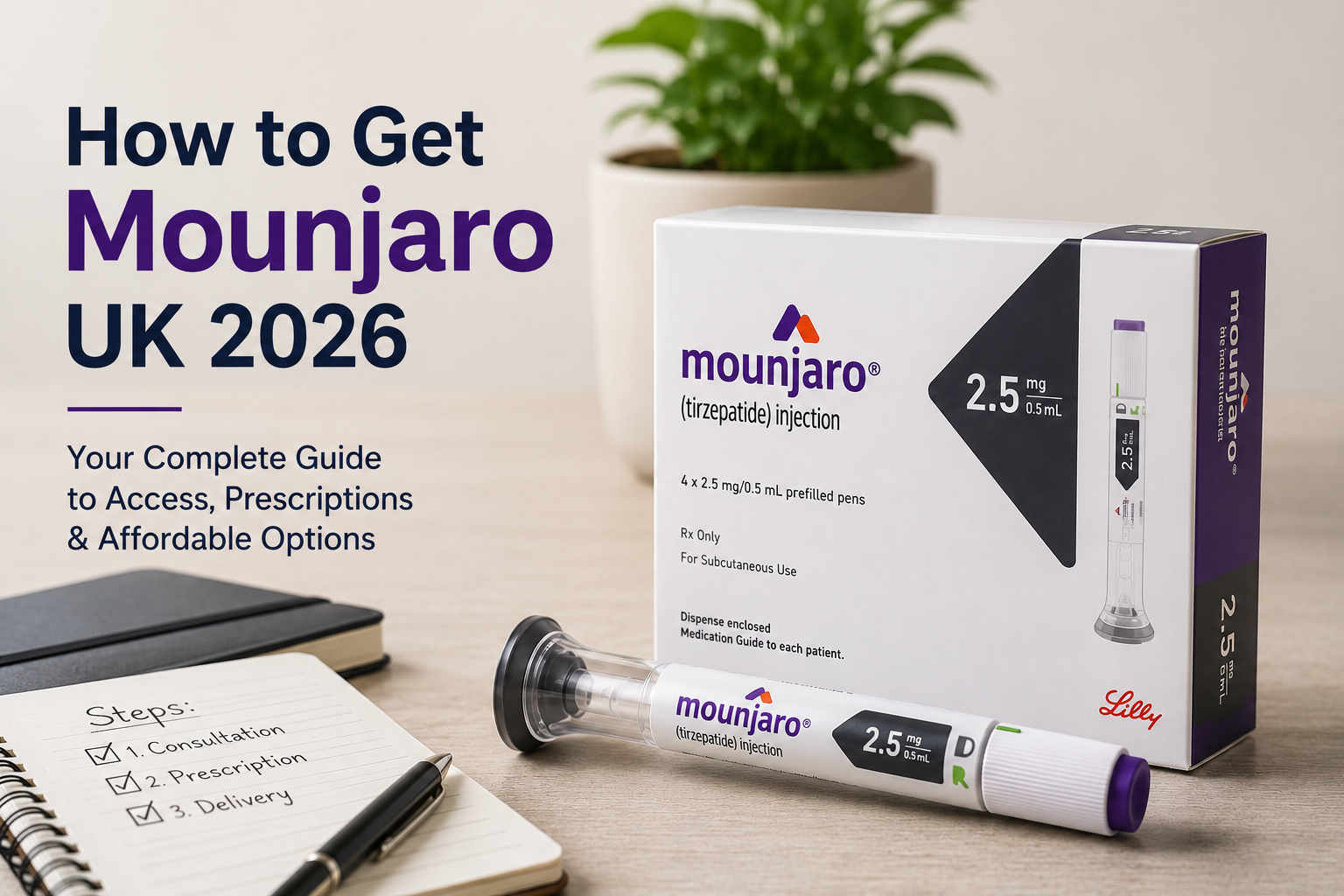
Home › Blog › Weight Loss › How to Get Mounjaro UK
How to Get Mounjaro UK: Every Route, Eligibility, Costs and How to Choose a Provider Safely
Mounjaro (tirzepatide) is a prescription-only medicine in the UK. It cannot legally be supplied without a prescription issued by a qualified prescriber following a clinical assessment — there is no over-the-counter route and no legitimate way around that. There are three legal routes: the NHS, a private prescriber, or a GPhC-registered online pharmacy. This guide explains all three, what eligibility looks like for each, what the process actually involves, and how to tell a properly regulated provider from one that is not.
Quick verdict
Three legal routes, very different criteria. NHS access is phased and narrow. Private prescribing works to the wider licensed criteria — BMI 30 or above, or 27 to 29.9 with a weight-related condition.
A prescription is always required. Any website or seller offering Mounjaro without a clinical assessment and a prescriber is operating outside UK medicines law, whatever the packaging looks like.
A questionnaire alone is not enough. GPhC guidance is explicit that for high-risk medicines like tirzepatide, prescribing cannot rest solely on an online form — the prescriber must independently verify what you have told them.
Meeting the criteria does not guarantee approval. A prescriber can decline, and a provider that promises approval before assessing you is telling you something about how seriously it takes the assessment.
Compare providers on the programme, not the medicine. The licensed product is identical wherever it comes from. What varies is the assessment, who reviews it, what support follows, and the total cost over a year.
About the author
Shadeia Younis is the founder and Superintendent Pharmacist of Slinic (GPhC No. 2052119), with 25 years of clinical pharmacy experience. She has owned and operated NHS-contracted community pharmacies in Lancashire since 2008, oversees the clinical governance of Slinic’s prescribing service, and holds SCOPE certification in obesity management. She has been recognised as a finalist or winner across 19 national and European awards spanning healthcare and business.
Pharmacy Premises GPhC No. 1033729
NHS-Contracted
SCOPE Certified
LegitScript Certified
19 Awards Finalist / Winner
25+ Years Experience
Sources used
GPhC guidance for registered pharmacies providing pharmacy services at a distance, including on the internet · NHS England interim commissioning guidance on NICE TA1026 · NICE TA1026, TA875, TA1152 and NG246 · Mounjaro Summary of Product Characteristics (electronic Medicines Compendium) · MHRA guidance on GLP-1 medicines and enforcement communications · SURMOUNT-1 and SURMOUNT-5. Full list in the references at the end.
Find out whether treatment is right for you
Free two-minute assessment, reviewed by a UK-registered prescriber the same working day.
Check If I Qualify →
Free · 2 minutes · Reviewed by an experienced UK-registered doctor or pharmacist prescriber
GPhC Registered Pharmacy · No Subscription · Monthly Clinical Reviews Included
Jump to
The three routes
Route 1: NHS
Route 2: private prescriber
Route 3: online pharmacy
What the law requires
Who may be eligible
Who may not be suitable
The process step by step
What you’ll be asked
If you’re declined
Verifying a provider
What to avoid
What it costs
Where hidden costs come from
Year one cost
Delivery and storage
Your first injection
Reordering
Switching provider
Restarting after a break
Keeping your GP informed
Other treatment options
Common mistakes
When it isn’t the answer
FAQs
Summary
References
Getting Mounjaro in the UK at a glance
| Key fact | Details |
|---|---|
| Active ingredient | Tirzepatide, a dual GIP and GLP-1 receptor agonist |
| Legal status | Prescription-only medicine (POM) |
| Safety status | Black Triangle medicine — additional MHRA safety monitoring |
| Legal routes | NHS, private prescriber, or GPhC-registered online pharmacy |
| Licensed criteria | BMI 30 or above, or 27 to 29.9 with at least one weight-related condition |
| NHS primary care criteria | Considerably narrower — phased cohorts requiring four qualifying comorbidities |
| Prescription required | Always, on every route, including repeat supply |
| Assessment standard | An online questionnaire alone is not sufficient — independent verification is required |
| Administration | Once-weekly subcutaneous injection, same day each week |
| Storage | Refrigerated 2–8°C before first use; check the leaflet for in-use conditions |
| Slinic price range | £129.00 to £267.00 per pen, plus £4.99 delivery |
| Typical time to first supply at Slinic | Usually a few days from assessment, subject to clinical approval |
This guide has been written and clinically reviewed by UK-registered pharmacy professionals at Slinic. Treatment is supplied through Brierfield Late Night Pharmacy, GPhC-registered premises No. 1033729.
The three legal routes
| Route | Eligibility | Typical wait | Cost to you | Who it tends to suit |
|---|---|---|---|---|
| NHS | Phased and narrow in primary care; broader in specialist weight management services | Varies widely by area; often a year or more via specialist services | Prescription charge in England unless exempt; free in the other UK nations | Anyone who meets the criteria and can wait |
| Private prescriber | Licensed criteria | Days to weeks, depending on appointment availability | Consultation fee plus the medicine, charged separately | People who want face-to-face assessment, or who have complex histories |
| GPhC-registered online pharmacy | Licensed criteria | Usually days, subject to clinical approval | Published per-pen price plus delivery | Most people, provided the provider is properly regulated |
Route 1: the NHS
NHS access in England runs on two tracks, and conflating them is the source of most confusion.
In specialist weight management services, the full NICE TA1026 criteria apply — a BMI of at least 35 with at least one weight-related comorbidity, with a 2.5 kg/m² reduction for South Asian, Chinese, other Asian, Middle Eastern, Black African and African-Caribbean backgrounds. ICBs may choose to prioritise access using the same cohorting approach used in primary care, so capacity still matters.
In primary care, access is phased through prioritised cohorts, which are considerably narrower and require four qualifying comorbidities. Cohort II, live since 23 June 2026, covers BMI 35–39.9.
NHS England has asked patients not to contact their GP to request Mounjaro by name. A conversation about your weight, the conditions it is affecting, and what support is available locally is far more productive — and worth having alongside a question about referral to specialist weight management services, which a lot of people never ask.
For the full picture including comorbidity definitions and the cohort timeline, see our Mounjaro NHS guide.
Route 2: a private prescriber
A private GP or other independent prescriber can assess you and issue a private prescription, which is then dispensed by a pharmacy.
How it works
- Book an appointment with a private prescriber
- They assess eligibility, medical history, current medicines and contraindications
- If appropriate, they issue a private prescription
- You have it dispensed by a registered pharmacy
Things to weigh up
- The consultation fee is charged on top of the medicine, and review appointments add to that over time
- Prescriber and dispensing pharmacy may be separate, so ask who is responsible for what if something goes wrong
- This route suits people who want an in-person assessment, or whose medical history is complex enough that face-to-face review is genuinely valuable
Route 3: a GPhC-registered online pharmacy
This is how most people access private treatment in the UK, and when the provider is properly regulated it is a legitimate route with the same professional standards as a high-street pharmacy.
Registered online pharmacies can arrange prescribing following an online clinical assessment, provided that assessment is reviewed by a UK-registered prescriber and meets the standards required for a high-risk medicine. The critical word there is reviewed — the assessment is the input to a clinical decision, not the decision itself.
What UK law and regulation actually require
Four requirements apply on every legitimate route. If any is missing, something is wrong.
A prescription from a qualified prescriber. A UK-registered doctor, pharmacist prescriber or nurse prescriber, registered with the GMC, GPhC or NMC. Not an algorithm, and not a “clinical team” with no named professionals.
A genuine clinical assessment before that prescription. Covering medical history, current medicines, pregnancy status and contraindications.
Independent verification. The prescriber must not rely on the questionnaire alone. In practice this means verifying your identity and your weight, and being able to check what you have said against another source.
A registered pharmacy dispensing it. GPhC-registered premises, with a named superintendent pharmacist and a real UK address.
Assessed by a prescriber, not an algorithm
Every Slinic assessment is reviewed by a UK-registered doctor or pharmacist prescriber before any supply.
Start Your Free Assessment →
Free · 2 minutes · Reviewed by an experienced UK-registered doctor or pharmacist prescriber
GPhC Registered Pharmacy · No Subscription · Monthly Clinical Reviews Included
Who may be eligible privately
Private eligibility follows the licensed criteria, then narrows according to each provider’s clinical governance.
| BMI | Additional requirement | Typically eligible privately? |
|---|---|---|
| 30 or above | None required | Yes, subject to full clinical assessment |
| 27 to 29.9 | At least one weight-related condition | Yes, subject to full clinical assessment |
| 27 to 29.9 | No weight-related condition | No |
| Below 27 | — | No |
Weight-related conditions commonly recognised at BMI 27–29.9
- Type 2 diabetes
- Prediabetes
- High blood pressure
- Dyslipidaemia, including raised cholesterol
- Obstructive sleep apnoea
- Cardiovascular disease
For people from South Asian, Chinese, other Asian, Middle Eastern, Black African and African-Caribbean backgrounds, a lower BMI threshold is commonly applied in weight management practice — usually reduced by around 2.5 kg/m² — because cardiometabolic risk occurs at lower BMI in these populations.
Who may not be suitable
The Summary of Product Characteristics and the Patient Information Leaflet are the definitive source, and you should read the leaflet supplied with your medicine in full. The areas that come up most often at assessment:
- Personal or family history of medullary thyroid carcinoma, or Multiple Endocrine Neoplasia syndrome type 2
- Pregnancy — not recommended. Establish pregnancy status and plans before starting, not after
- Breastfeeding — discuss with your prescriber
- History of pancreatitis — requires careful individual assessment
- Severe gastrointestinal disease, including gastroparesis
- Insulin or sulfonylurea use — substantially increased hypoglycaemia risk; those doses need review by whoever manages your diabetes
- Another GLP-1 medicine — never use two together
- Planned surgery or sedation — delayed gastric emptying raises aspiration risk; tell your surgical and anaesthetic team well in advance
- Current or past eating disorder — prescribers are specifically asked to consider overall wellbeing where eating disorders, body dysmorphia or mental health are factors
Individual providers also apply their own additional criteria based on the limits of a remote service. Those are legitimate clinical decisions rather than universal medical facts, which is why one clinic may decline where another accepts.
The process, step by step
Complete the clinical assessment
An online questionnaire covering your height and weight, medical history, current medicines and any contraindications. It is free and there is no obligation to proceed. Answer it fully — the assessment only protects you if it is complete, and omissions are the most common cause of delay.
Identity and weight verification
You will be asked to verify who you are and confirm your current weight rather than simply stating it. This is a regulatory expectation for online weight management prescribing, not an optional extra. A provider that skips it is not meeting the standard.
Review by a UK-registered prescriber
A prescriber reviews your assessment against the eligibility criteria, checks for contraindications and reviews your medicines for interactions. Where more information is needed, they will come back to you — by message, phone or video consultation depending on the pathway.
A prescribing decision
The outcome is approval, a request for further information, or a decision that treatment is not appropriate. That last outcome is not a rejection of you — it is the assessment doing its job, and a good provider will explain why and suggest a sensible next step.
Dispensing and delivery
If approved, your medicine is dispensed by the registered pharmacy and sent in temperature-controlled packaging. At Slinic, delivery is £4.99 per order and needles are included with each pen.
Ongoing clinical review
Before each repeat supply, your progress, tolerance and readiness for any dose change are reviewed. Dose increases should follow that review rather than happening automatically on a calendar.
What you’ll be asked — and why
Knowing what is coming makes it easier to answer properly, and answering properly is what makes it safe.
Your details and measurements
Name, date of birth, address and contact details, so your identity can be verified and the medicine goes to the right person. Then your current height and weight — measured, not estimated.
Medical history
Including thyroid conditions and any family history of medullary thyroid carcinoma, pancreatitis, gastrointestinal conditions, kidney and liver disease, diabetic retinopathy, cardiovascular disease, mental health history and any eating disorder history.
Every medicine you take
Prescription medicines, over-the-counter products, herbal remedies and supplements. Interactions that get checked include insulin and sulfonylureas, oral contraceptives, thyroid replacement, anticoagulants and anything with a narrow therapeutic index. Because tirzepatide slows gastric emptying — particularly after the first dose — it can affect how quickly oral medicines are absorbed, which matters most where rapid onset or precise levels are important.
Pregnancy status and plans
Established before treatment, not after. If you are planning a pregnancy, discuss timing with your prescriber.
Surgery and procedures
Anything planned that involves sedation or anaesthesia.
If you’re declined
A good provider will explain the reason and suggest a next step. Common ones:
- Something needs investigating first. Unexplained symptoms should have a diagnosis before a weight management medicine is layered on top.
- A medicine needs reviewing. Insulin or sulfonylurea doses, for instance, may need adjusting by the clinician who manages them before treatment can safely start.
- A different treatment would suit better. That may be another medicine, or a non-pharmacological route.
- A temporary contraindication. Recent surgery or pregnancy plans may mean the answer is “not now” rather than “not ever”.
Decisions are clinical and should be explained. If a provider declines without any explanation at all, that is worth questioning.
How to verify a provider properly
Legitimate and illegitimate providers can look similar at a glance. Here is what actually distinguishes them.
- Find the GPhC registration number and look it up yourself on the GPhC register. A number displayed on a website proves nothing until you verify it independently.
- Check the named superintendent pharmacist, and that there is a real UK address and a working phone number. Be cautious of a provider reachable only through a web form.
- Confirm a genuine clinical assessment happens. A handful of questions is not a clinical assessment.
- Confirm a prescription is required. If it is not, stop.
- Check who the prescriber is and that they are registered with the GMC, GPhC or NMC.
- Check that verification happens. If nobody asks you to confirm your weight or identity, the provider is not meeting current standards.
- Read the payment terms before ordering. Subscription? Minimum term? Cancellation window? Does the price change after month one?
- Check what ongoing support is included — who reviews dose increases, who you contact about side effects, whether there is a review before each repeat.
- Be wary of guarantees. Nobody can promise approval before assessing you.
- Weigh the regulatory signals correctly. GPhC registration is the statutory requirement and matters most. LegitScript certification is a useful additional signal but is a private scheme, not a substitute for statutory regulation.
Slinic dispenses through Brierfield Late Night Pharmacy, GPhC-registered premises No. 1033729. Our Superintendent Pharmacist is personally registered under GPhC No. 2052119. Premises registration and individual professional registration are two different things, and both can be checked on the GPhC register.
A GPhC-registered pharmacy you can verify
Premises No. 1033729. NHS-contracted. SCOPE certified. LegitScript certified. Check any of it yourself.
Check If I Qualify →
Free · 2 minutes · Reviewed by an experienced UK-registered doctor or pharmacist prescriber
GPhC Registered Pharmacy · No Subscription · Monthly Clinical Reviews Included
What to avoid
Demand has created a substantial illegitimate market, and the MHRA has repeatedly warned about falsified products reaching UK patients through unofficial channels. Treat the following as absolute.
Social media sellers. Instagram, TikTok, Facebook groups and messaging apps are not legal supply routes for prescription medicines.
Any offer to supply without a prescription. This is the single clearest indicator that what arrives did not come through the authorised supply chain.
Overseas websites shipping to the UK. Products may not be licensed here and may not be what the packaging claims.
“Research peptide” or “not for human consumption” products. These are not medicines, are not made to pharmaceutical standards, and there is no way to know what is in them.
Anyone else’s medication. It was dispensed after an assessment of their history, not yours.
Prices far below the market range. Genuine licensed stock has a wholesale cost.
If you have already used a product bought outside the regulated route, speak to a pharmacist or your GP. If you have symptoms that concern you, contact NHS 111, or 999 in an emergency.
What it costs at Slinic
| Dose | Price per pen (4 weekly doses) |
|---|---|
| 2.5 mg (starting dose) | £129.00 |
| 5 mg | £155.00 |
| 7.5 mg | £206.00 |
| 10 mg | £230.00 |
| 12.5 mg | £247.00 |
| 15 mg | £267.00 |
Delivery is £4.99 per order. Needles are included with each pen. Monthly clinical reviews are included. No subscription and no minimum term. All supply is subject to clinical approval. Fixed 2026 prices, last verified 4 August 2026.
Where unexpected cost comes from
The advertised price and the actual cost are frequently different things. The usual sources:
Dose-based pricing. Almost every provider charges more for higher doses, and everyone starts at the lowest. The advertised price is usually the least you will ever pay.
Consultation fees charged separately by some providers.
Delivery excluded from the headline figure.
Subscriptions with minimum terms or cancellation windows.
First-order discount codes that revert from month two. Extremely common, and the biggest single distorter of comparisons.
Consumables charged as extras — needles, sharps disposal.
The only meaningful comparison is total cost over twelve months at the dose you are likely to be on, including everything.
What a year actually costs
A worked example at Slinic, assuming one dose step per month up to the maximum and then maintenance. Your own titration may be slower, and staying longer at a lower dose is both clinically reasonable and cheaper.
| Period | Dose | Cost including delivery |
|---|---|---|
| Month 1 | 2.5 mg | £133.99 |
| Month 2 | 5 mg | £159.99 |
| Month 3 | 7.5 mg | £210.99 |
| Month 4 | 10 mg | £234.99 |
| Month 5 | 12.5 mg | £251.99 |
| Months 6–12 | 15 mg × 7 | £1903.93 |
| Approximate year one total | ~£2895.88 | |
Fixed prices that don’t change mid-treatment
No subscription, no minimum term, no discount code that quietly reverts from month two.
Check My Options →
Free · 2 minutes · Reviewed by an experienced UK-registered doctor or pharmacist prescriber
GPhC Registered Pharmacy · No Subscription · Monthly Clinical Reviews Included
Delivery, storage and what arrives
Mounjaro requires temperature-controlled handling, so it is dispatched in insulated packaging designed to hold the required range in transit.
Your order includes the KwikPen, needles, the patient information leaflet and storage instructions. Read the leaflet before your first dose — it is the definitive source, and it is specific to the product you have received.
Storage
- Refrigerate at 2–8°C before first use. Do not freeze, and do not store against the back wall of the fridge where it can drop below 2°C.
- Check the leaflet for in-use storage conditions and the maximum time out of the fridge, as this differs between products and presentations.
- Keep it in the original packaging, out of sight and reach of children.
- Do not use a pen that has been frozen, looks damaged, or is past its expiry date.
Your first injection
Follow the instructions in your patient information leaflet, which is the authoritative source. In general terms:
- Take the pen out of the fridge shortly before injecting — many people find a cold injection more uncomfortable
- Inject into the abdomen, thigh or upper arm, rotating the site each week
- Inject on the same day each week, at any time of day, with or without food
- Dispose of needles immediately in a sharps bin, never in household waste
- Never share a pen, even with a new needle
If you are unsure about technique, ask before your first dose rather than after. This is exactly what the clinical support is for.
Reordering
Repeat supply is not automatic and should not be. Before each order, your progress, tolerance and readiness for any dose change should be reviewed.
Dose increases follow that review rather than a fixed schedule. Staying longer at a dose is a legitimate clinical decision, and often the right one where side effects have not settled. Increasing while symptoms persist usually makes them worse without adding benefit.
There is no minimum commitment at Slinic. If you need to pause — for surgery, pregnancy plans, cost or side effects — you simply do not reorder, though it is worth telling your prescriber why rather than disappearing, because some of those reasons have solutions.
Switching provider
People move between providers regularly, usually over cost, service quality, supply reliability or subscription terms. It is a normal thing to do.
You will need to evidence your current treatment. A dispensing label, a prescription record, a letter from your previous provider or an order history showing dose and dates. Without evidence, a prescriber cannot safely continue you at a higher dose.
A prolonged gap may mean restarting lower. That is a safety decision, not an administrative one.
Check your existing terms first. If you are in a minimum-term subscription, check the cancellation position before ordering elsewhere.
No supply is guaranteed until the assessment is complete, even if you have been on treatment for months.
Restarting after a break
Returning after a gap is not always as simple as picking up where you left off. Tolerance can reduce during a break, so going straight back to your previous dose can produce side effects considerably worse than you remember.
How much this matters depends on how long the gap was, what dose you were on, how well you tolerated it, and what has changed about your health meanwhile. Do not simply resume without a review. See our guide to restarting safely.
Keeping your GP informed
If you are treated privately, tell your GP. This is not a courtesy — it is clinically necessary.
Tirzepatide affects blood glucose and blood pressure, can alter the absorption of oral medicines, and matters for any surgery or procedure involving sedation. Your GP needs it in your record so that it is taken into account at any review, and so that other prescribers can see it.
It also matters in the other direction. As weight falls, blood pressure and lipid profiles commonly improve, and existing medicines may need reviewing. Dizziness on standing is the usual first sign of being over-treated for blood pressure — report it rather than accepting it. Thyroid replacement requirements can also change with significant weight change.
Other treatment options worth knowing about
Mounjaro is not the only option, and it is not automatically the right one for everyone.
| Option | Format | Worth considering if |
|---|---|---|
| Wegovy (semaglutide) injection | Weekly injection | Cost is a significant factor, or you have established cardiovascular disease — semaglutide is the only weight management medicine with a NICE-recommended cardiovascular indication (TA1152) |
| Wegovy pill (oral semaglutide) | Daily tablet | You cannot or will not inject, and a strict morning fasting protocol fits your routine |
| Orforglipron (Foundayo) | Daily tablet | You cannot or will not inject and the fasting protocol does not fit — no food or water restrictions. MHRA authorised 10 August 2026. |
| Specialist weight management services | Multidisciplinary programme | You may be eligible on the NHS under the full TA1026 criteria — worth asking about before paying privately |
See our Mounjaro vs Wegovy comparison for the full clinical picture.
Common mistakes when getting Mounjaro
Buying outside the regulated supply chain. The most dangerous item on this list.
Leaving something off the assessment. It only protects you if it is complete.
Choosing on the headline price alone. Compare twelve months at your likely dose, including everything.
Not checking the subscription terms. Minimum terms and reverting discount codes are the most common source of unexpected cost.
Assuming approval is guaranteed. It is not, and a provider that implies otherwise is worth avoiding.
Not telling your GP. Creates real risk around interactions and surgery.
Planning against the starting price. Budget for maintenance.
Escalating dose on a calendar rather than on response. Faster is not better.
Using two GLP-1 medicines together. Never.
Not asking about NHS routes first. Especially specialist weight management services, where the criteria are wider than most people realise.
When Mounjaro isn’t the answer
A page like this has an obvious commercial incentive to present treatment as the solution. It is not always.
If your BMI is below the licensed threshold, no legitimate provider will supply it, and that is correct.
If your relationship with food or your body is the primary problem, a medicine that suppresses appetite may make things worse. Eating disorders need addressing with appropriate support first, and a good assessment will screen for this.
If you want a short-term fix before an event, this is the wrong tool. Meaningful change takes months, it costs money throughout, and stopping is commonly followed by regain.
If you cannot sustain the cost, starting and stopping repeatedly is worse than not starting.
If a symptom needs investigating, that comes first.
If you may be eligible on the NHS, that route is substantially cheaper and comes with mandated wraparound care. Ask before paying.
Frequently asked questions
Summary
There are three legal routes to Mounjaro in the UK, and all of them require a clinical assessment and a prescription. NHS access is narrower than the licence, particularly in primary care, though specialist weight management services work to wider criteria than most people realise. Private prescribing works to the licensed criteria of BMI 30 or above, or 27 to 29.9 with a weight-related condition.
Getting it safely comes down to using a properly regulated provider, completing a genuine assessment honestly, and understanding that a questionnaire alone is not sufficient for a medicine like this. Price matters, but compare twelve months at your likely dose rather than the headline figure — and plan against the maintenance price, not the starting one.
Mounjaro is a prescription-only medicine and is not suitable for everyone. This guide is general information and does not replace an individual clinical assessment by a UK-registered prescriber.
Find out whether treatment is right for you
Complete Slinic’s free two-minute assessment. If treatment is clinically appropriate, you’ll be reviewed by a UK-registered prescriber before any medicine is supplied.
- ✅ Mounjaro from £129 · Fixed 2026 prices · No subscription
- ✅ GPhC-registered pharmacy premises No. 1033729 — verifiable at pharmacyregulation.org
- ✅ NHS-contracted community pharmacy, led by a SCOPE-certified pharmacist
- ✅ Every assessment reviewed by a UK-registered doctor or pharmacist prescriber
- ✅ Monthly clinical reviews included · Needles included · No minimum term
Related guides and treatment pages
References
- General Pharmaceutical Council — guidance for registered pharmacies providing pharmacy services at a distance, including on the internet; and the register of pharmacies and pharmacy professionals.
- NHS England — interim commissioning guidance, implementation of NICE TA1026 (tirzepatide).
- NICE TA1026 — Tirzepatide for managing overweight and obesity.
- NICE TA875 — Semaglutide for managing overweight and obesity.
- NICE TA1152 — Semaglutide for reducing the risk of major adverse cardiovascular events.
- NICE NG246 — Overweight and obesity management.
- Mounjaro (tirzepatide) Summary of Product Characteristics — electronic Medicines Compendium.
- MHRA — GLP-1 medicines for weight loss and diabetes: what you need to know.
- MHRA — the Black Triangle scheme.
- Jastreboff AM, Aronne LJ, Ahmad NN, et al; SURMOUNT-1 Investigators. Tirzepatide once weekly for the treatment of obesity. N Engl J Med. 2022;387(3):205–216. doi:10.1056/NEJMoa2206038
- Aronne LJ, Horn DB, le Roux CW, et al; SURMOUNT-5 Investigators. Tirzepatide as compared with semaglutide. N Engl J Med. 2025. doi:10.1056/NEJMoa2416394
- MHRA — Yellow Card scheme for reporting suspected adverse drug reactions.