
Home › Weight Loss › Mounjaro UK › Buy Mounjaro UK
Buy Mounjaro From £129-£267 | Cheapest Fixed Prices Online UK | Slinic
Looking to buy Mounjaro in the UK? This guide explains exactly how to do it safely from a GPhC-registered pharmacy: who is eligible, what the clinical assessment involves, how your identity and weight are verified, how prescriptions are approved and why they are sometimes declined, and what happens from your first consultation through to tracked delivery. Mounjaro is a prescription-only medicine, so buying it means being assessed and prescribed for rather than simply adding it to a basket.
✍️ Written and clinically reviewed by Shadeia Younis, Superintendent Pharmacist (GPhC No. 2052119) · SCOPE certified in obesity management · 25 years’ pharmacy experience
Last reviewed: 3rd August 2026 · Prices last verified: 3rd August 2026
The short answer
Important
Mounjaro (tirzepatide) is a prescription-only medicine. This page is general information and does not replace advice from a qualified healthcare professional. Treatment is supplied only after an individual clinical assessment by a UK-registered prescriber, is licensed for use alongside a reduced-calorie diet and increased physical activity, and is not suitable for everyone. Individual results vary.
If you experience severe abdominal pain, particularly persistent pain or pain radiating to the back, persistent vomiting, difficulty breathing, or swelling of the face, lips, tongue or throat, seek urgent medical advice or contact emergency services immediately.
Check your eligibility
The assessment is free and usually reviewed the same working day. You are not charged for treatment that is not approved.
Free clinical assessment · Reviewed by a UK-registered prescriber · No subscription
Dispensed from GPhC-registered premises No. 1033729 · Subject to eligibility and prescriber approval
Completing an assessment does not guarantee that treatment will be supplied.
On this page
Can you buy it in the UK?Where to buy safelyWho can buy itHow to buy, step by stepWhat the assessment asksIdentity & weight checksSummary Care Record & your GPWhich dose you will getWhy prescriptions are declinedAfter approvalDispensing & deliveryWhat arrives in the boxYour first injectionMonthly reviewsReorderingSwitching providerRestarting after a breakPrices at a glanceBuying without a subscriptionNHS versus privateSafety & side effectsFAQsReferences
Can you buy Mounjaro in the UK?
Yes, on prescription. Mounjaro (tirzepatide) is a prescription-only medicine in the UK, which means it can only be supplied against a prescription written by a registered prescriber who has assessed you1. That is not a formality and it is not something a legitimate provider can skip.
What that means in practice
Three things have to happen before a pen can lawfully reach you. A prescriber has to assess whether the medicine is safe and appropriate for you specifically. A prescription has to be issued. And a registered pharmacy has to dispense it. A provider offering to bypass any of those is not operating within UK medicines law, whatever their website says.
The three routes
| Route | How it works | Who it suits |
|---|---|---|
| NHS | Prescribed through a phased rollout with prioritised cohorts, or through specialist weight management services. Access is considerably narrower than the licence3 | People meeting the current NHS funding criteria who can wait for local availability |
| Private, in person | A face-to-face consultation with a private clinic or pharmacy | People who want an in-person assessment and have a provider locally |
| Private, online | An online clinical assessment reviewed by a UK-registered prescriber, dispensed and delivered by a registered pharmacy | Most people buying privately. This is what the rest of this guide covers |
Buying online is not a lesser route. A regulated online pharmacy works to the same standards as a high-street one, is on the same register, and is inspected by the same regulator5. What differs is convenience and, frequently, price. Our price comparison guide covers the cost side in detail.
🩺 Clinical insight: the pen is identical, the service is not
Every regulated UK provider dispenses the same licensed medicine through the same authorised supply chain. The pen is identical wherever you buy it.
What varies between providers is everything around it — the depth of the assessment, who reviews your case, whether anyone follows up, and what happens when something goes wrong. Those are the things worth comparing, and they are considerably harder to see from a pricing page than the number is.
Where to buy Mounjaro safely in the UK
Demand has created a market operating outside the regulated supply chain. The MHRA has taken enforcement action against falsified and unlicensed weight-loss injections entering the UK and has issued public warnings about buying from unregulated sources6. The difficulty for a patient is that a legitimate and an illegitimate provider can look similar at a glance.
Nine checks before you order anywhere
| # | Check | What good looks like |
|---|---|---|
| 1 | Verify GPhC registration yourself | Find the registration number and look it up on the GPhC register. A number printed on a website proves nothing until you have checked it. Slinic’s premises registration is 1033729. |
| 2 | Check the superintendent pharmacist is named | A registered pharmacy has a superintendent pharmacist accountable for it, named and independently checkable. Ours is registered under GPhC No. 2052119. |
| 3 | Look for a real address and phone number | Not just a contact form. If something goes wrong with a temperature-sensitive medicine, you need to reach somebody the same day. |
| 4 | Confirm a prescription is required | If a site will sell you tirzepatide without an assessment and a prescriber, stop there regardless of price. |
| 5 | Expect a proper assessment | Detailed questions about medical history, every medicine you take, pregnancy status and plans, and any history of disordered eating — not a three-question form. |
| 6 | Expect your weight to be verified | GPhC guidance for services provided at a distance sets expectations around independent verification rather than a self-reported figure5. |
| 7 | Ask how the cold chain is handled | Tirzepatide is temperature-sensitive. Ask what packaging is used and what happens if a delivery is delayed. |
| 8 | Check what happens after the first order | Who reviews a dose increase, and who you contact when side effects appear. A renewal process consisting solely of a payment page is not clinical care. |
| 9 | Read the payment terms before paying | Subscription, minimum term, cancellation policy, and whether the advertised price is a first-order rate that reverts. |
Absolute red flags
Social media and messaging apps. Instagram, TikTok, Facebook groups and WhatsApp sellers are not legal supply routes for prescription medicines in the UK. A seller operating there is by definition operating outside medicines law.
Any offer to supply without a prescription. There is no exception to this and no legitimate reason for it.
Product imported from abroad. Medicine sourced outside the UK may not be licensed here, may not be the formulation approved for UK use, and carries no assurance that cold chain was maintained.
Somebody else’s medication. Pens must never be shared even with a new needle, because of blood-borne infection risk.
A price dramatically below the regulated UK market. That should prompt additional checks about the seller, the prescription process and the authenticity of the product.
‘Compounded’ or ‘generic’ tirzepatide. There is no licensed generic tirzepatide in the UK. Anything marketed that way is not a UK-licensed medicine.
✓ If you have already bought outside the regulated route
Speak to a pharmacist or your GP. If you have symptoms that concern you, contact NHS 111, or 999 in an emergency.
Suspected side effects can be reported through the MHRA Yellow Card scheme, whether or not the product came from a regulated source. Reporting matters even if you feel foolish about where it came from — it is how falsified supply gets traced.
LegitScript certification is a useful additional signal, but it is a private certification scheme rather than UK regulation. GPhC registration is the statutory requirement and the one that matters most.
Who can buy Mounjaro?
Private eligibility follows the terms of the UK licence, then narrows according to each provider’s clinical governance. Two people with identical BMIs can get different answers, and that is the assessment working rather than failing. If you are weighing tirzepatide against semaglutide first, see our Mounjaro versus Wegovy comparison.
| BMI | Additional requirement | Typically eligible privately? |
|---|---|---|
| 30 or above | No additional weight-related condition required | Yes, subject to full clinical assessment |
| 27 to under 30 | At least one weight-related health condition | Yes, subject to full clinical assessment |
| 27 to under 30 | No weight-related condition | No |
| Below 27 | — | No |
Weight-related conditions that may qualify at BMI 27 to under 30
- Type 2 diabetes
- Prediabetes
- High blood pressure
- Dyslipidaemia, including raised cholesterol
- Obstructive sleep apnoea
- Cardiovascular disease
Lower BMI thresholds are commonly applied for some ethnic backgrounds, in line with NICE guidance on assessing BMI2. Your prescriber will apply the criteria that fit your individual assessment. Our full eligibility guide covers this in more depth, including how private criteria differ from the NHS funding criteria.
🩺 Clinical insight: meeting the threshold is the start, not the answer
BMI determines whether you can be considered. Your medical history determines whether you should be treated.
A prescriber can decline because of something in your history, because a symptom needs investigating first, or because another treatment would be safer for you. A provider that guarantees approval before assessing you is telling you something important about how seriously it takes the assessment.
How to buy Mounjaro online, step by step
The whole process at Slinic, from first click to your medicine arriving.
Complete the online clinical assessment
A structured questionnaire covering your height and weight, weight history, previous weight-loss attempts, full medical history, every medicine you take, pregnancy status and plans, alcohol intake, any history of disordered eating, and any planned surgery. It takes a couple of minutes if you have your information to hand. It is free, and you are not charged for treatment that is not approved.
Identity and weight verification
We confirm who you are and check your weight rather than accepting a self-reported figure. This is a requirement of safe distance prescribing, not an obstacle, and it is one of the clearest differences between a regulated provider and one that is not.
Clinical review by a UK-registered prescriber
An appropriately qualified prescriber reads your submission and decides whether treatment is appropriate. The outcome is approval, a request for more information, a video consultation, or a decision that treatment is not suitable for you.
Video consultation where needed
Free, and arranged where our clinical pathway requires one or where you would like one. There is no separate consultation charge at any point in your treatment.
Prescription issued and dispensed
If treatment is judged appropriate, a private prescription is issued and dispensed from our GPhC-registered premises. Your medicine is prepared with needles, alcohol swabs, and on a first order your free starter pack.
Tracked delivery to your door
Dispatched in insulated packaging on a tracked service, £4.99 per order. Dispatch follows clinical approval and is subject to stock, identity verification and courier cut-off times.
Free monthly clinical check-in
Every month, covering weight change, tolerability, whether the dose is right, any new symptoms or medicines, and anything you want to raise. Included in the price, not charged separately and not skipped at renewal.
Start your free clinical assessment
Usually reviewed the same working day. You are not charged for treatment that is not approved.
Free clinical assessment · Reviewed by a UK-registered prescriber · No subscription
Dispensed from GPhC-registered premises No. 1033729 · Subject to eligibility and prescriber approval
Completing an assessment does not guarantee that treatment will be supplied.
What the clinical assessment actually asks
People often worry about this part, usually because they are unsure how much detail is expected or whether something in their history will rule them out. It is worth being clear about what is asked and why, because the assessment only protects you if it is complete.
| What is asked | Why it matters |
|---|---|
| Height, current weight and weight history | Establishes BMI and whether the licensed criteria are met, and gives a baseline to measure against |
| Previous weight-loss attempts, including medication | Response to one GLP-1 does not predict response to another. What you have tried changes the advice |
| Full medical history | Pancreatitis, gallbladder disease, severe gastrointestinal conditions, kidney or liver problems, diabetic retinopathy and thyroid history all change the picture |
| Every medicine you take | Prescription, over-the-counter, herbal and supplements. Insulin and sulfonylureas in particular need dose review |
| Pregnancy status and plans | Tirzepatide is not recommended in pregnancy, and weight reduction can restore ovulation unexpectedly |
| Any history of disordered eating | A medicine that suppresses appetite can make some difficulties worse rather than better |
| Planned surgery or procedures | Delayed gastric emptying increases aspiration risk under sedation or anaesthesia |
| Alcohol intake | Relevant to tolerability, and to pancreatic and liver risk |
| Any current GLP-1 treatment | Two GLP-1 medicines should not be taken at the same time |
| Relevant personal and family medical history | Helps the prescriber identify conditions or symptoms requiring further assessment before treatment |
What to have ready before you start
- An accurate current weight — weigh yourself rather than estimating
- A list of your medicines with doses and the times of day you take them
- Photo ID
- If you are transferring from another provider: your current strength, how long you have been on it, the date of your last dose, and evidence such as a dispensing label or order history
🩺 Clinical insight: complete answers matter more than fast ones
Leaving something out does not improve your chance of approval in any way that helps you. It raises the chance of being prescribed a medicine that interacts badly with something you take, or that worsens a condition you have.
Incomplete assessments usually generate a request for more information, which delays things rather than speeding them up.
Identity and weight verification
Two checks that separate a regulated provider from one cutting corners, and the two most people are least expecting.
Why identity is checked
A prescription is a legal document issued to a named individual. Verifying identity confirms that the person being assessed is the person receiving the medicine, prevents a prescription being obtained on someone else’s behalf, and protects against age-related and duplicate-supply risks. Methods vary between providers — photo identification, video consultation, or both.
Why weight is verified independently
BMI determines eligibility, and eligibility determines whether a prescription can lawfully be issued. A provider that prescribes on a self-reported figure alone has no way of knowing whether the criteria are actually met. GPhC guidance for pharmacy services provided at a distance sets expectations here5, and it is one of the most common areas where less careful providers fall short.
🩺 Clinical insight: the check most worth insisting on
Current GPhC safeguards for remote weight-management services expect independent verification of weight, height and/or BMI, and state that a telephone call alone is not appropriate.
In practice this usually means a photograph showing your weight on scales, a video consultation, or both. It takes a minute. If a provider does not independently verify the information used to establish eligibility, that is a meaningful signal about the rest of their process.
Summary Care Record checks and your GP
A common question, and one where practice varies between providers.
What a Summary Care Record is
An electronic summary of key information from your GP record — current medicines, allergies and previous adverse reactions as a minimum, with additional information where you have consented to it7. It exists so that a clinician treating you outside your GP practice can see the essentials.
How it is used in private prescribing
Where a provider has access and you consent, checking it corroborates what you have reported: the medicines you are taking, allergies, and relevant conditions. It is a safety check rather than a hurdle, and it is one of the ways a remote assessment can be made closer to a face-to-face one. Access requires your consent and is not automatic.
Telling your GP
You are not obliged to, and a private prescription does not require GP involvement. But there are situations where it genuinely matters:
- If you have type 2 diabetes or take insulin or a sulfonylurea, whoever manages your diabetes needs to know, because those doses may need adjusting. This is a safety requirement rather than a courtesy.
- If you take blood pressure medicines, weight reduction often lowers blood pressure and you may become over-treated as you lose weight.
- If you are having surgery or any procedure under sedation, your surgical and anaesthetic team need to know well in advance.
- If a new symptom appears that needs investigating independently of your weight-management treatment.
Most people find it simplest to tell their GP practice at the outset, so that anything appearing later is interpreted with the full picture in view.
Which dose will you be prescribed?
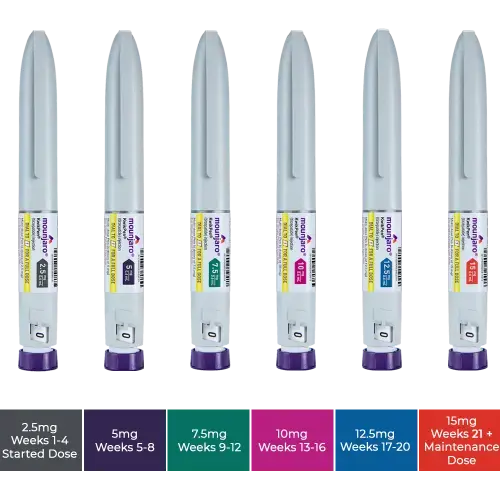
For a new Mounjaro initiation, the licensed starting dose is 2.5 mg once weekly1. You do not choose your starting strength, and you should be wary of any provider that lets you.
| Strength | Role in treatment | Earliest a step up may be considered |
|---|---|---|
| 2.5 mg | Treatment-initiation dose. Used for the first four weeks to let the body adjust | After four weeks |
| 5 mg | Licensed maintenance dose. Some people stay here for the whole of treatment | After four weeks at 5 mg |
| 7.5 mg | Titration step | After four weeks at 7.5 mg |
| 10 mg | Licensed maintenance dose, and a common settling point | After four weeks at 10 mg |
| 12.5 mg | Titration step | After four weeks at 12.5 mg |
| 15 mg | Licensed maintenance dose, maximum strength | — |
Dose increases may be considered in 2.5 mg steps after at least four weeks at the current strength, depending on tolerability, response and the prescriber’s assessment. They are not automatic, and the minimum interval is a minimum rather than a schedule. Staying longer at a strength, or staying there permanently, is a legitimate clinical outcome. Our dose schedule guide covers each step in detail.
🩺 Clinical insight: reaching 15 mg is not the goal
The maximum licensed strength is a ceiling, not a target, and reaching it is not a marker of doing treatment properly.
If your appetite is well controlled and your weight is coming down steadily at 5 mg or 10 mg, your prescriber may decide there is no need to escalate. A provider that moves everybody up on a fixed calendar is running a schedule rather than making a decision about you.
Why prescriptions are declined
Most requests are approved. Some are not, and it is worth knowing why in advance so that a decline reads as the process working rather than a rejection of you.
| Reason | What it means |
|---|---|
| BMI below the licensed threshold | Below 27, or 27 to under 30 without a qualifying weight-related condition. Slinic does not routinely prescribe outside the licensed weight-management criteria. |
| A contraindication or significant caution | Known hypersensitivity to tirzepatide or any excipient, a history of pancreatitis, or severe gastrointestinal disease including gastroparesis. |
| Pregnancy, breastfeeding or planning to conceive | Tirzepatide is not recommended in pregnancy, and this needs establishing before treatment rather than after. |
| A current or past eating disorder | A medicine that suppresses appetite can worsen some difficulties. This needs appropriate support rather than a prescription. |
| Already taking another GLP-1 medicine | Two should not be taken at the same time, including switching without a planned transition. |
| A symptom that needs investigating first | Unexplained weight change or abdominal pain needs a diagnosis before a weight-management medicine is layered on top. |
| Information that does not add up | Where a self-reported weight cannot be verified, or answers conflict, a prescriber will ask rather than assume. |
| A situation better managed face to face | Complex polypharmacy, or a clinical picture where a remote service is not the right setting. This is a judgement about the setting, not about you. |
You are not charged for treatment that is not approved. Where a decline is about missing information rather than suitability, you will usually be asked for more detail rather than refused outright. And a decline from one provider does not always mean a decline everywhere, because provider-specific criteria go beyond the licence and differ between clinics.
What happens after your prescription is approved
The part most providers say least about, and the part that determines whether your medicine arrives in a usable condition.
Prescription issued
Your prescriber issues a private prescription for the strength assessed as appropriate for you. There is no separate prescription fee.
Dispensed and clinically checked
Dispensed at our GPhC-registered premises and checked before it leaves. Your pen is picked at the correct strength, with needles, alcohol swabs, and on a first order the free starter pack.
Packed for cold chain
Tirzepatide is temperature-sensitive. Your order is packed in insulated packaging designed for medicine delivery, with cooling included as required for the journey.
Dispatched on a tracked service
£4.99 per order. You receive tracking so you know when it will arrive, which matters more for a refrigerated medicine than for an ordinary parcel.
Delivered and refrigerated
Open it promptly on arrival and refrigerate the pen as directed in the patient information leaflet supplied with your medicine.
Dispatch follows clinical approval and is subject to stock, identity verification and courier cut-off times. We do not promise a guaranteed delivery window, because a provider that does is making a promise about a courier network it does not control.
Dispensing, packaging and delivery
Why cold chain matters
Mounjaro is stored in a refrigerator between 2°C and 8°C before first use and must not be frozen. A pen that has been too warm or has frozen at any point cannot be identified by looking at it, which is why the handling between pharmacy and door matters and why buying from an unregulated seller carries a risk you cannot inspect for.
What to do when it arrives
- Open it promptly and refrigerate the pen as directed in your patient information leaflet
- Do not freeze it, and do not use a pen that has been frozen at any point, even if it has thawed and looks normal
- Inspect the pen — do not use it if the liquid is discoloured or contains particles, or if the pen looks damaged
- Keep it in the original carton to protect it from light
- Never store the pen with a needle attached
- Follow the storage temperatures and in-use period stated in your current UK patient information leaflet rather than any figure quoted elsewhere
If a delivery is delayed or the packaging looks wrong
Contact us before using the medicine rather than using it and hoping. Do not use a pen that may have frozen or exceeded its stated temperature range, because that cannot be identified by looking at it.
That is the whole point of a tracked, insulated service — there is somebody to call and a record of what happened.
Travelling with it
Carry the pen in hand luggage rather than the hold, which is not temperature controlled. Use a cool bag with a temperature pack, without the pen touching the pack directly. Take a travel sharps container and check disposal arrangements at your destination. Our travel and cold chain guide and storage guide go into detail.
What arrives in the box
| Item | First order | Every repeat order |
|---|---|---|
| Mounjaro KwikPen at your prescribed strength | Yes | Yes |
| Pen needles | Yes | Yes |
| Alcohol swabs | Yes | Yes |
| Sharps container | Yes, in the starter pack | On request |
| Tape measure | Yes, in the starter pack | — |
| Instruction booklet | Yes, in the starter pack | — |
| Manufacturer’s patient information leaflet | Yes | Yes |
One KwikPen provides four once-weekly doses and normally covers four weeks of treatment when used as prescribed. You need one pen per month at your current strength, not one per injection.
💡 Why there is a tape measure in the box
Weight on the scales moves unevenly week to week — fluid, hormonal cycles, salt and bowel habit all shift the number independently of fat loss.
Waist measurement often moves more steadily, and it is a useful second marker on the weeks when the scales stall and you are tempted to conclude that nothing is happening.
Your first injection
This is an overview. The Instructions for Use supplied with your pen are the authoritative source and should be read fully before your first injection.
- Once weekly, the same day each week. Any time of day, with or without food.
- Check the pen before use. The liquid should be clear and colourless.
- Use a new needle every time. Reusing needles blunts the tip, increases pain and injection-site reactions, and risks blockage.
- Inject subcutaneously — into the fat layer just under the skin — into the abdomen avoiding the area immediately around the navel, the front of the thigh, or the upper arm.
- Rotate sites with each injection. Repeated use of the same spot can cause lumps or hardening, which affects absorption.
- Hold the pen in place for the full count specified in the Instructions for Use, so the complete dose is delivered.
- Remove the needle immediately afterwards and put it straight into your sharps container.
- Never share your pen, even with a new needle.
🩺 Clinical insight: ask before you inject, not after
You have direct access to a pharmacist throughout treatment, and a free video consultation is available if you would rather be talked through the first one.
Most people find the first injection is considerably less of an event than they expected, but there is no reason to guess. Our KwikPen administration guide covers the sequence step by step.
Your free monthly clinical review
Included in the price at every stage, not charged separately and not skipped at renewal.
What it covers
- Weight change, and over what period rather than week to week
- Whether side effects are settling, persisting or worsening
- Whether the current strength is right, or whether staying longer is better than escalating
- Any new symptoms, particularly abdominal pain
- Any new medicines, and whether existing ones need reviewing as your weight changes — blood pressure and diabetes medicines in particular
- Eating pattern, protein intake and activity
- Anything you want to raise, including cost
What to report between reviews rather than waiting
Severe abdominal pain, persistent vomiting, signs of dehydration, reduced urine output, symptoms of an allergic reaction, or sudden visual changes. Those need attention when they happen rather than at your next scheduled review.
Reordering and repeat supply
You order the strength you have been prescribed, when you need it. There is no automatic billing, no minimum term and no cancellation fee, so if you pause you simply do not place the next order.
Complete your monthly review
Before each repeat supply, so that dose and tolerability are actually assessed rather than assumed.
Your prescriber confirms the strength
Continuing at the same strength, stepping up, or stepping down — a clinical decision based on your response, not a calendar.
Order and dispatch
Dispensed and sent on the same tracked, insulated service as your first order.
🩺 What a repeat should never be
A supply issued on the strength of a payment alone is not clinical care.
If a provider’s renewal process consists solely of a payment page, nobody is checking whether the treatment is still safe or still appropriate for you — which is precisely the point at which most things that go wrong in a course of treatment would have been caught.
Ordering more than one pen
Sometimes possible, subject to clinical assessment and the reason for the request. Supplying several future strengths in advance is usually avoided, because your prescribed dose may change and you could be left with medicine you no longer need. Additional supply may occasionally be considered for circumstances such as extended travel. Approval is not guaranteed.
Buy without a subscription
Order when you need to. No automatic billing, no minimum term, no cancellation fee. Free monthly reviews and free video consultations throughout.
Free clinical assessment · Reviewed by a UK-registered prescriber · No subscription
Dispensed from GPhC-registered premises No. 1033729 · Subject to eligibility and prescriber approval
Completing an assessment does not guarantee that treatment will be supplied.
Switching to Slinic from another provider
Transferring is common and does not usually mean starting the titration again — but it is a clinical decision rather than an administrative one.
What you will need
- Your current strength and how long you have been on it
- The date of your most recent dose
- Evidence of current treatment — a dispensing label, prescription record, letter from your previous provider or order history showing dose and dates
- How you have tolerated treatment and any side effects
- Your current medicines and full medical history
- Weight verification as part of the assessment
You do not need a letter of release from your previous provider, and you do not need an NHS referral.
What the prescriber decides
Whether it is safe to continue at the same strength, reduce it, or restart titration — based on the gap in treatment, the evidence supplied, tolerability and your clinical history. Without evidence of what you have been taking, a prescriber cannot safely continue you at a higher strength, which is why the dispensing label matters. Our guide to switching provider sets out what to bring.
💡 If you are currently on a subscription elsewhere
Check the cancellation terms before ordering here. In most cases you can cancel from the next billing date and place your first order once the current period ends, avoiding an overlap and a wasted payment.
Ask specifically what happens if you stop mid-term, because that is where minimum-term clauses bite.
Restarting after a break
People pause treatment for all sorts of reasons — surgery, pregnancy planning, side effects, supply, cost, or simply life. Restarting is straightforward, but it is not always a case of picking up where you left off.
Why a step back is often recommended
Tolerance to the gastrointestinal effects builds during treatment and reduces during a break. Returning directly to a strength you previously tolerated well can produce side effects markedly worse than you remember from the first escalation. A short step back is usually the difference between a comfortable restart and a difficult fortnight, and it is a safety decision rather than an administrative one.
What the prescriber weighs
- How long the gap was
- What strength you were on when you stopped
- Why you stopped, particularly if it was side effects
- Whether anything has changed medically since
- Whether your weight has changed materially
Our guide to restarting after a break covers the clinical reasoning in more detail.
Mounjaro prices at Slinic
A summary. For the full picture — cost per weekly injection, six and twelve-month totals, and a comparison against other UK providers — see our Mounjaro price comparison guide.
| Dose | Pen price | Delivery | Total per order |
|---|---|---|---|
| 2.5 mg | £129.00 | £4.99 | £133.99 |
| 5 mg | £155.00 | £4.99 | £159.99 |
| 7.5 mg | £206.00 | £4.99 | £210.99 |
| 10 mg | £230.00 | £4.99 | £234.99 |
| 12.5 mg | £247.00 | £4.99 | £251.99 |
| 15 mg | £267.00 | £4.99 | £271.99 |
Medicine prices are fixed for 2026 and were last verified on 3 August 2026. Delivery charges and availability remain subject to review. The same published price applies to new and returning patients — no code required and no introductory rate that reverts at month two.
Buying Mounjaro without a subscription
Both models are widely used by regulated UK providers and neither is inherently better. They behave very differently, though, and the difference matters most at the point you want to stop.
| Subscription | Pay per order | |
|---|---|---|
| Billing | Automatic on a cycle | You order when you need to |
| Pausing | May require cancellation, and a minimum term may apply | Simply do not place the next order |
| Price as your dose rises | May stay flat, or rise by plan tier | Follows the strength you are receiving |
| What is bundled | Often coaching, app access and tracking | Medicine and clinical care |
| Suits | People who want reminders and structured support built in | People who want control over each order and no commitment |
Slinic operates a pay-per-order model. No automatic billing, no minimum term, no cancellation fee. That is genuinely useful if you may need to pause for surgery, pregnancy planning, side effects or cost — and a meaningful number of people do, at some point in a course of treatment measured in months.
Buying privately versus getting Mounjaro on the NHS
If you qualify for NHS treatment and can access it without a prohibitive wait, that is the right route. Most people currently buying privately do not qualify.
How NHS access works
NICE recommended tirzepatide for weight management in TA1026 in December 20242. NHS England subsequently applied a funding variation allowing a phased implementation across specialist weight management services and primary care rather than immediate universal access3. In the first primary-care cohort, NHS England has stated access is initially for people with a BMI of 40 or more, adjusted for ethnicity, who have been diagnosed with four of the listed weight-related health problems. Cohorts widen sequentially.
🩺 Clinical insight: the practical gap
Someone with a BMI of 33 and high blood pressure meets the licensed criteria and can be assessed for private treatment. They are unlikely to be eligible for NHS prescribing in the current phase.
That gap — availability rather than any judgement about quality of care — is the whole reason the private route exists. If your BMI and conditions might meet the current criteria, ask your GP practice about the tirzepatide pathway in your area before paying privately. It costs nothing and the saving is substantial if you qualify.
NHS prescription charges may apply in England unless you are exempt. Prescriptions are free in Scotland, Wales and Northern Ireland. Our NHS eligibility guide covers both routes.
Safety, side effects and who should not buy Mounjaro
This is a summary. The authoritative source is the current UK Summary of Product Characteristics and the patient information leaflet supplied with your medicine1.
Contraindication
Tirzepatide must not be used by anyone with known hypersensitivity to the active substance or to any of the excipients in the product.
Situations requiring particular caution
- A history of pancreatitis, or symptoms suggestive of it during treatment
- Severe gastrointestinal disease, including gastroparesis, since gastric emptying is slowed
- Diabetic retinopathy, where rapid improvement in glycaemic control has been associated with temporary worsening
- Dehydration risk and kidney function, particularly after a period of vomiting or diarrhoea
- Planned surgery or any procedure involving sedation or anaesthesia — tell your surgical and anaesthetic team well in advance
- Gallbladder disease, since rapid weight loss from any cause increases gallstone risk
Common side effects and how to reduce them
Most are gastrointestinal, most appear during titration or shortly after a dose increase, and most settle as the body adjusts. Nausea, diarrhoea, vomiting, constipation, indigestion, burping, headache, fatigue and injection-site reactions are the ones most people encounter.
- Eat smaller portions — the single most effective adjustment for most people
- Eat slowly and stop when full; fullness arrives earlier than you are used to
- Avoid very fatty and fried food, particularly in the days after a dose increase
- Keep fluids up. Reduced appetite usually reduces drinking too, and mild dehydration worsens nausea, fatigue and constipation
- Do not increase your dose while significant symptoms persist — raise it at your review instead
Pregnancy, breastfeeding and contraception
Tirzepatide is not recommended in pregnancy. If you are planning to conceive, discuss timing with your prescriber in advance, and discuss breastfeeding before starting. Weight reduction can also restore ovulation in people who were not previously ovulating, so contraception is worth planning before your first dose rather than after.
Interactions
Risk of low blood sugar rises substantially when tirzepatide is used alongside insulin or a sulfonylurea, and those doses may need adjusting by the clinician managing your diabetes. Delayed gastric emptying can affect the absorption of some oral medicines. Tirzepatide should not be used at the same time as another GLP-1 receptor agonist or another tirzepatide-containing medicine.
Seek urgent medical advice
If you experience severe abdominal pain, particularly persistent pain or pain radiating to the back, persistent vomiting, difficulty breathing, swelling of the face, lips, tongue or throat, or signs of a serious allergic reaction, seek urgent medical advice or contact emergency services immediately.
Our full side-effect guide covers management in detail, and our complete Mounjaro guide covers how the medicine works and what to expect from treatment.
Frequently asked questions about buying Mounjaro
Can I buy Mounjaro over the counter in the UK?
Is it legal to buy Mounjaro online in the UK?
Do I need a prescription to buy Mounjaro?
Do I need to see a doctor in person?
How much does it cost to buy Mounjaro at Slinic?
How quickly can I get it?
Am I eligible to buy Mounjaro?
What if my prescription is declined?
Will you check my weight?
Do I need to tell my GP?
Which dose will I be prescribed first?
How often do I need to order?
Is there a subscription?
Can I buy more than one pen at a time?
What comes in the box?
Are needles included?
How is it delivered and kept cold?
What if my delivery is late or arrives warm?
Can I switch to Slinic from another provider?
Can I restart after stopping for a while?
Can I buy Mounjaro from abroad more cheaply?
How do I know a seller is legitimate?
Can I get Mounjaro on the NHS instead?
What happens at the monthly review?
Do I have to reach the 15 mg dose?
What if I miss a dose?
Can I stop whenever I want?
Is Slinic a registered UK pharmacy?
Who reviews my prescription?
Buy Mounjaro from a registered UK pharmacy
From £129 per pen plus £4.99 delivery. No subscription, no minimum term. Free video consultations, free monthly reviews, needles and swabs included.
Free clinical assessment · Reviewed by a UK-registered prescriber · No subscription
Dispensed from GPhC-registered premises No. 1033729 · Subject to eligibility and prescriber approval
Completing an assessment does not guarantee that treatment will be supplied.
About the author
Shadeia Younis is the founder and Superintendent Pharmacist of Slinic, registered with the General Pharmaceutical Council under No. 2052119, with 25 years of pharmacy experience. She has owned and operated community pharmacies in Lancashire since 2008, oversees the clinical governance of Slinic’s prescribing service and holds SCOPE certification in obesity management. She has received or been shortlisted for national and European pharmacy and healthcare awards.
Treatment is dispensed from GPhC-registered premises No. 1033729. The dispensing pharmacy also provides NHS pharmacy services. More about Slinic and our clinical team.
Related guides
References
Numbered citations in the text link to the sources below.
- electronic Medicines Compendium — Mounjaro (tirzepatide) KwikPen, Summary of Product Characteristics and Patient Information Leaflet.
- NICE TA1026 — Tirzepatide for managing overweight and obesity, December 2024.
- NHS England — Interim commissioning guidance for NICE TA1026 (tirzepatide), reviewed April 2026.
- General Pharmaceutical Council — registers of pharmacies and pharmacy professionals.
- General Pharmaceutical Council — guidance for registered pharmacies providing pharmacy services at a distance, including on the internet.
- MHRA — guidance and enforcement activity on falsified and unlicensed weight-management medicines.
- NHS England Digital — Summary Care Records.
- Jastreboff AM, et al. Tirzepatide once weekly for the treatment of obesity (SURMOUNT-1). N Engl J Med. 2022;387(3):205–216.
- MHRA Yellow Card scheme — reporting suspected adverse drug reactions.
Sources accessed 3 August 2026. Where sources conflict, current UK product information and MHRA guidance are treated as the source of truth. Slinic medicine prices are fixed for 2026 and were last verified on 3 August 2026.
Written and clinically reviewed by Shadeia Younis, Superintendent Pharmacist (GPhC No. 2052119) · Last reviewed 3 August 2026. This page is general information and does not replace advice from a qualified healthcare professional. Mounjaro (tirzepatide) is a prescription-only medicine, is supplied only after an individual clinical assessment by a UK-registered prescriber, and is not suitable for everyone. It is licensed for use alongside a reduced-calorie diet and increased physical activity. Individual results vary.