

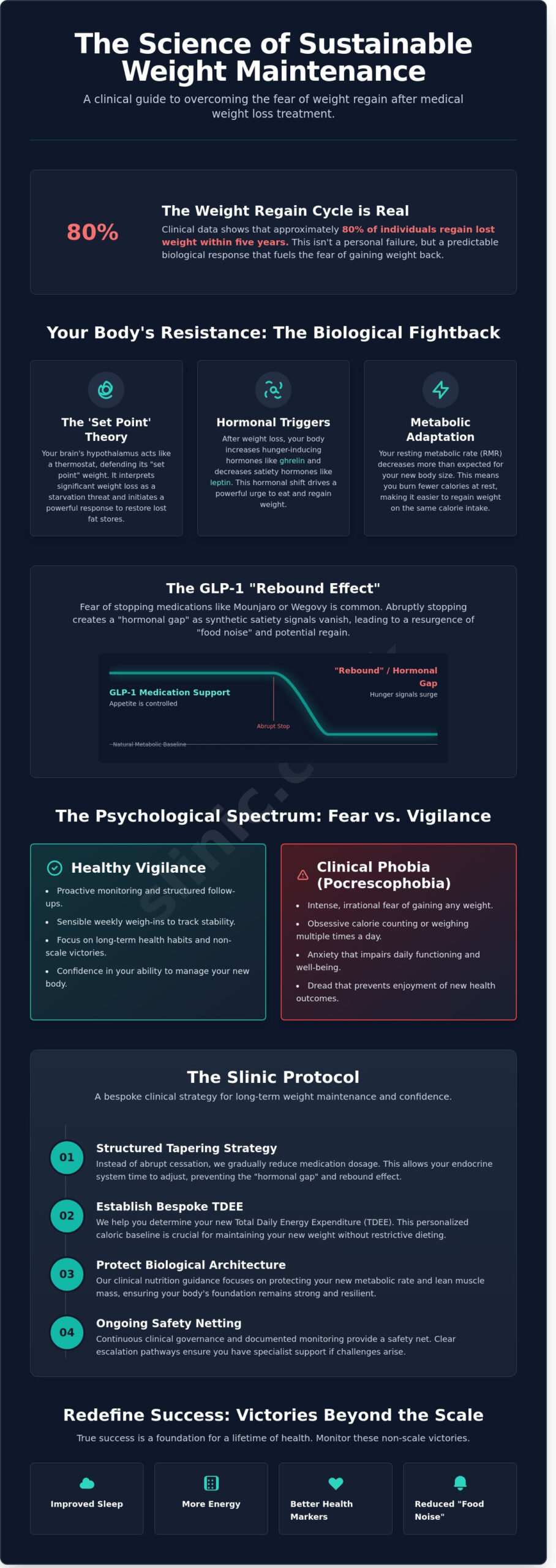
What if the anxiety you feel upon reaching your goal weight isn’t a sign of personal failure, but a predictable biological response to your body’s internal “set point”? Clinical data suggests that approximately 80% of individuals who lose weight through traditional methods regain it within five years, which often fuels a persistent fear of gaining weight back. You’ve likely felt that regain is an inevitable cycle, especially when the initial phase of your medical weight loss journey concludes or when you consider transitioning off weight loss injections like Mounjaro.
At Slinic, we believe sustainable health requires more than a temporary fix; it demands a bespoke clinical strategy. This guide will help you decode the metabolic and psychological roots of maintenance anxiety while outlining the specialist protocols used by our prescribing doctors to secure your long-term success. You’ll discover how a structured maintenance plan, supported by rigorous clinical governance and ongoing safety netting, transforms a fleeting result into a permanent biological foundation. We’ll examine the specific roles of weight loss treatment in this transition, ensuring you have the expert reassurance needed to maintain your quality of life with quiet confidence.
Key Takeaways
- Understand the biological drivers behind the fear of gaining weight back and learn to distinguish between common anxiety and clinical obesophobia.
- Explore the ‘rebound’ effect associated with ceasing GLP-1 medications and how our specialist prescribing doctors address the hormonal gap to ensure a seamless transition.
- Discover the Slinic Protocol for sustainable maintenance, focusing on establishing your bespoke TDEE and protecting your biological architecture through clinical nutrition.
- Learn to identify the clinical thresholds for specialist intervention, ensuring your mental well-being is prioritised alongside your physical transformation.
- Reframe your definition of success by monitoring non-scale victories and health markers that signify a foundation for a lifetime of health and confidence.
For a full comparison of UK Mounjaro providers including pricing, see:
⇒Slinic’s Top UK Mounjaro Providers Guide
Table of Contents
- Understanding the Psychology and Biology of Weight Regain Anxiety
- The ‘Rebound’ Effect: Why We Fear Stopping Weight Loss Medication
- Clinical vs. Emotional Fear: When to Seek Specialist Support
- The Slinic Protocol for Long-Term Weight Maintenance
- Navigating the Future: Your Journey Beyond the Scale
Understanding the Psychology and Biology of Weight Regain Anxiety
Reaching a target weight through a structured medical weight loss programme is a significant clinical milestone. However, for many patients, the achievement is often shadowed by a persistent fear of gaining weight back. This anxiety isn’t merely a lack of confidence; it’s a documented psychological response to the substantial biological and lifestyle shifts that occur during treatment. At Slinic, our Specialist clinicians recognise that this fear exists on a spectrum. It ranges from healthy vigilance to clinical obesophobia, where the dread of weight return begins to impair daily functioning and mental well-being. Validating this emotional burden is a core part of our patient-focused care, as we understand that maintaining a major life transformation requires as much psychological fortitude as it does biological intervention.
The Biological Resistance to Maintenance
Your body operates with a sophisticated biological thermostat, often referred to as the ‘Set Point’ Theory. Adipose tissue isn’t just stored energy; it’s an active endocrine organ that communicates with the brain via hormones like leptin and ghrelin. When you lose weight through treatments like Mounjaro, the hypothalamus may interpret the reduced calorie intake as a starvation event. This triggers a defensive response, increasing hunger signals to restore previous fat stores. Metabolic adaptation is the physiological process where your resting metabolic rate decreases more than expected based on your new body composition, effectively reducing your total daily energy expenditure.
Distinguishing Healthy Vigilance from Clinical Phobia
It’s vital to distinguish between proactive monitoring and pocrescophobia, the intense, irrational fear of weight gain. Healthy vigilance involves structured follow-ups and weekly weigh-ins to ensure your maintenance phase remains stable. Conversely, clinical phobia often manifests as obsessive calorie counting or weighing oneself multiple times a day, which can lead to significant distress. We implement robust safety netting protocols to help patients navigate this transition safely. If you find your fear of gaining weight back is preventing you from enjoying your restorative health outcomes, our prescribing doctors provide clear escalation pathways and Specialist support. This ensures your journey remains a foundation for a lifetime of health rather than a source of ongoing anxiety.
Our clinical team provides nationwide care across the UK, ensuring that every patient has access to professional monitoring and discreet home delivery. By combining competitive pricing with high clinical standards, we prioritise your long-term biological health and aesthetic harmony.
The ‘Rebound’ Effect: Why We Fear Stopping Weight Loss Medication
Many patients experience a profound fear of gaining weight back as they approach the conclusion of their primary treatment cycle. This anxiety isn’t unfounded; it’s a biological response to the anticipated removal of exogenous GLP-1 receptor agonists. When medical weight loss treatments like Mounjaro or Wegovy are withdrawn, the body faces a “hormonal gap.” This occurs because synthetic signals for satiety vanish before the body’s natural metabolic baseline has fully recalibrated to its new, lower weight.
The Slinic approach prioritises a structured tapering strategy over cold-turkey cessation. Stopping weight loss injections abruptly can trigger a sharp resurgence of “food noise,” which often leads to the very rebound effect patients dread. By gradually reducing the dosage, we allow your endocrine system the necessary time to adjust, maintaining the aesthetic harmony and functional health you’ve worked hard to achieve. Our clinicians focus on this biological architecture to ensure your results are restorative rather than temporary.
We frequently address the objection that hunger will return to overwhelming, pre-treatment levels. While some increase in appetite is a natural physiological response, it doesn’t have to result in regain. Our clinical team provides a safety net through documented monitoring and clear escalation pathways to manage this transition safely and with quiet confidence.
Managing the Transition from Active Loss to Maintenance
A structured step-down programme is a clinical necessity to avoid rapid regain. Ongoing clinical reviews at Slinic help identify early signs of weight creep, ensuring that your progress remains stable. For detailed insights into our safety protocols and UK-specific regulations, please refer to our Specialist Clinical Guide to Weight Management. This specialist oversight is vital for transitioning from active loss to a stable, long-term maintenance phase.
The Role of Appetite Suppression in Long-Term Success
GLP-1 medications are transformative because they quiet the intrusive food noise that often derails traditional dieting. To sustain these results, we implement strategies focused on high-protein nutrition and increased fibre intake to naturally promote satiety. Mounjaro regulates blood sugar and fullness cues by slowing gastric emptying and mimicking the body’s natural incretin hormones. Combining this biological support with specialist guidance ensures you don’t face the fear of gaining weight back alone. If you’re ready to discuss a bespoke maintenance plan, you can start your clinical consultation with our prescribing team today.
Clinical vs. Emotional Fear: When to Seek Specialist Support
It’s natural to feel a sense of vigilance after achieving significant results. However, a distinct line exists between maintaining healthy habits and experiencing a debilitating fear of gaining weight back. When anxiety begins to dictate your social schedule or triggers a cycle of extreme calorie restriction, it’s no longer a motivational tool; it’s a clinical concern that requires professional oversight. At Slinic, our prescribing doctors and pharmacists act as your first line of defence, ensuring your journey remains focused on long-term biological health rather than temporary fixes.
We don’t view medical weight loss as a simple transaction. Instead, we provide a foundation for a lifetime of health by monitoring your mental well-being alongside your physical progress. This safety-first approach means we’re trained to identify the threshold where anxiety begins to impair your quality of life. Our clinicians provide the necessary “safety netting,” offering clear instructions on when to pause treatment or seek urgent mental health support if your relationship with food becomes distressed.
Signs You Need Professional Intervention
Intervention is necessary when your relationship with food becomes adversarial. You might find yourself withdrawing from social gatherings to avoid unmonitored food environments, or engaging in excessive exercise as a direct response to minor scale fluctuations. If persistent intrusive thoughts about body shape consume more than 60 minutes of your day, your emotional fear has crossed into clinical territory. These patterns often signal disordered eating, and our specialist team is here to guide you toward restorative care before these habits become entrenched.
The Importance of Audit-Ready Clinical Governance
Safety is the cornerstone of the Slinic experience. Our robust eligibility assessments ensure that weight loss injections are only prescribed when clinically appropriate for your specific profile. We utilise video consultations as a vital tool to assess a patient’s relationship with food, looking for nuances that a text-based form might miss. This high level of professional oversight is a core part of the Slinic consultation process. By maintaining documented, audit-ready processes, we protect patients from inappropriate treatment and ensure that every step of your journey is backed by specialist precision and clinical accountability.
- Expert Monitoring: Regular check-ins with UK-registered pharmacists to track psychological impact.
- Escalation Pathways: Pre-defined clinical steps to support patients showing signs of disordered eating.
- Bespoke Care: Tailored advice on Mounjaro or Wegovy that prioritises your overall well-being.
The Slinic Protocol for Long-Term Weight Maintenance
The transition from active weight loss to long-term stability requires a shift from a temporary “diet” to a structured clinical framework. At Slinic, our Specialist clinicians move beyond the scale to focus on metabolic preservation. This protocol is designed to eliminate the fear of gaining weight back by replacing uncertainty with data-driven clinical governance. Our five-step approach ensures your results are built on a foundation of biological health rather than willpower alone.
- Step 1: Establishing your maintenance TDEE. We calculate your Total Daily Energy Expenditure based on your new body composition. This isn’t a static number; it’s a dynamic baseline that guides your daily caloric intake to prevent accidental surplus.
- Step 2: Prioritising Biological Architecture. We focus on preserving muscle mass through high protein intake (typically 1.2g to 1.5g per kilogram of body weight) and structured resistance training. This protects your resting metabolic rate.
- Step 3: Relapse Prevention. We establish a “red flag” weight range. If your weight fluctuates more than 3kg above your maintenance goal, it triggers an immediate review of your nutritional and activity protocols.
- Step 4: Scheduled clinical follow-ups. Ongoing monitoring with our UK-registered Pharmacists and Doctors ensures your metabolic health remains optimal. These audits check for hormonal balance and nutrient absorption.
- Step 5: Health Optimisation Mindset. We move the goalposts from “losing” to “optimising.” Success is measured by energy levels, sleep quality, and physical performance rather than just a number on the scale.
Nutritional Strategies for a Sustainable Future
Sustainable maintenance moves away from the restrictive “good vs bad” food binary. Our Specialists help you design a bespoke, nutrient-dense lifestyle that prioritises satiety and metabolic health. Instead of focusing on what to avoid, we emphasise what to include to support your body’s new set point. For practical advice on building these habits, you can explore our What to eat on Mounjaro UK guide, which details how to balance macronutrients for long-term success.
The Role of Resistance Training in Preventing Regain
Muscle tissue is metabolically expensive; it burns more energy at rest than fat tissue. During medical weight loss, there is a risk of losing lean tissue, which can lower your Basal Metabolic Rate (BMR) and increase the fear of gaining weight back. Engaging in resistance training at least twice weekly counteracts this loss. In the UK, many patients find success starting with bodyweight exercises or local gym programmes that focus on compound movements. This structural support is vital for keeping your metabolism active and resilient.
If you’re ready to secure your progress with a clinician-led plan, you can view our specialist weight loss treatment options today.
Navigating the Future: Your Journey Beyond the Scale
Transitioning from active weight loss to long-term maintenance often triggers a persistent fear of gaining weight back. Overcoming this anxiety requires a fundamental shift in how you define success. While the scale provides one data point, clinical markers like improved HbA1c levels, reduced blood pressure, and enhanced mobility offer a more comprehensive view of your biological health. At Slinic, our multidisciplinary team of Prescribing Doctors and Pharmacists focuses on these non-scale victories to ensure your progress remains sustainable. We view weight management not as a temporary fix, but as a permanent restoration of your metabolic health.
Our commitment to your well-being extends across the United Kingdom through a seamless, nationwide care model. We provide discreet, professional delivery of all medications, ensuring your privacy is maintained at every stage. You don’t have to manage this transition in isolation. Expert clinical support is always available to help you navigate the complexities of weight maintenance with confidence and clarity.
Ongoing Monitoring and Safety Netting
Slinic prioritises patient safety through a robust framework of clinical governance. Every patient benefits from structured follow-up care and documented, audit-ready processes. You can access the Mounjaro shop for continued support, knowing that all weight loss treatment is issued under strict clinical guidance. This safety-first approach includes clear escalation pathways and specific advice on managing side effects. As a GPhC regulated pharmacy service, we provide the peace of mind that comes from high professional accountability and rigorous eligibility assessments.
- Regular video consultations to review progress and adjust treatment plans.
- Comprehensive safety netting instructions for urgent medical concerns.
- Direct access to UK-registered Pharmacists for medication queries.
- Discreet, temperature-controlled delivery to any UK address.
Building a Restorative Relationship with Your Body
The Slinic approach treats your body as a masterpiece of biological architecture. We aim for aesthetic harmony and functional health rather than just a lower number on a screen. This perspective helps neutralise the fear of gaining weight back by focusing on the strength and resilience of your physical foundation. Our specialists work with you to ensure your weight management programme supports a high quality of life and long-term confidence. We are your dedicated partners in this journey, providing the master craftsmanship needed for a lifetime of wellness. If you are ready to secure your future health, book a consultation with our specialist team today.
Securing Your Foundation for Lifetime Biological Health
Achieving your target weight is a significant milestone, but the specialist work of maintenance ensures those results endure. True success lies in navigating the complex interplay between metabolic regulation and the psychological fear of gaining weight back. This journey requires more than willpower; it demands a clinical framework that addresses the rebound effect through structured monitoring and professional accountability. Slinic provides this essential support through our GPhC Registered Pharmacy (No. 9011656), where every patient’s safety is managed by prescribing doctors and pharmacists. We’ve designed our protocols to include 100% clinician-led video consultations, ensuring your transition to maintenance is seamless and medically sound.
You aren’t just finishing a diet; you’re entering a restorative phase of health supported by nationwide UK delivery and robust safety netting. Our approach integrates medical precision with a premium patient experience, helping you move forward with quiet confidence and a body that’s truly in harmony. We’re here to provide the specialist guidance you need to maintain your aesthetic and biological goals for years to come.
Start your clinically supervised weight loss journey with Slinic today
Frequently Asked Questions
Is it normal to feel terrified of gaining weight back after Mounjaro?
It’s entirely normal to experience a fear of gaining weight back after completing a course of Mounjaro. Data from the SURMOUNT-4 clinical trial indicates that participants who switched to a placebo after 36 weeks regained approximately 14% of their body weight over the following year. This physiological reality often triggers anxiety. Our specialist clinicians at Slinic recognise this concern and provide structured maintenance protocols to help you transition safely while maintaining your results.
What is the ‘rebound effect’ and how can I avoid it?
The rebound effect refers to the rapid return of weight once medical weight loss treatment is discontinued, often caused by the return of suppressed appetite hormones like GLP-1. To mitigate this risk, you should follow a structured tapering plan rather than stopping your medication abruptly. Maintaining a protein intake of 1.2g per kilogram of body weight and engaging in 150 minutes of weekly resistance training helps preserve lean muscle mass, which is vital for metabolic stability and preventing rapid regain.
Can I stay on a maintenance dose of weight loss injections indefinitely?
Current clinical guidelines and MHRA approvals allow for long-term use of weight loss injections in individuals who continue to meet specific health criteria. At Slinic, our prescribing doctors conduct robust eligibility assessments every 3 to 6 months to ensure ongoing treatment remains safe and effective for your biological architecture. This specialist oversight ensures your maintenance dose is tailored to your long-term health goals rather than serving as a temporary fix, providing a foundation for a lifetime of health.
How do I know if my fear of weight regain has become an eating disorder?
A fear of gaining weight back may indicate a clinical concern if it leads to restrictive behaviours or significant psychological distress. According to Beat, the UK’s eating disorder charity, warning signs include obsessive calorie counting or weighing yourself more than once daily. If your thoughts about weight interfere with daily social functioning for more than 28 days, you should consult our clinical team or your GP for a specialist referral to ensure your mental well-being is protected.
What should I do if the scale starts to move up during maintenance?
You should first determine if the increase exceeds a standard physiological fluctuation of 1kg to 2kg, which is often caused by water retention or glycogen storage. If the scale shows a consistent upward trend over 14 consecutive days, it’s time to review your nutritional logs and activity levels. Slinic provides clear escalation pathways, allowing you to book a video consultation with a pharmacist to adjust your maintenance strategy before significant gain occurs, ensuring your progress remains seamless.
How can I calculate my maintenance calories after losing weight?
You can calculate your maintenance energy requirements by determining your Total Daily Energy Expenditure (TDEE) using the Mifflin-St Jeor equation. For a 40 year old woman weighing 75kg at 165cm, maintenance typically sits around 1,800 to 2,000 calories depending on daily activity levels. It’s essential to recalibrate these numbers every 5kg lost, as a smaller body requires less energy to function. This precision ensures your caloric intake aligns perfectly with your new metabolic baseline.
Does the NHS provide support for weight maintenance after private treatment?
The NHS typically prioritises weight management support for individuals with a BMI over 35 through Tier 3 or Tier 4 services. Accessing maintenance support after private treatment can be challenging, as current NHS England protocols often focus on the initial weight loss phase. Slinic fills this gap by providing nationwide care and ongoing monitoring. We act as a dedicated partner in your journey, ensuring you have access to professional support without relying on overstretched public resources.
What are the most effective lifestyle changes to prevent weight regain?
Research published in the British Journal of Sports Medicine suggests that 250 minutes of moderate intensity exercise per week is the most effective predictor of long-term weight maintenance. Prioritising 7 to 9 hours of sleep is also critical, as sleep deprivation can increase hunger hormones by 24% the following day. These lifestyle pillars, combined with the Slinic approach to clinical excellence, create a restorative environment that supports your aesthetic harmony and long-term biological health.